PART 1
I called my son from our kitchen in Detroit to tell him his mother had died.
He let out a tired sigh and said, “Dad, please don’t turn this into something bigger than it has to be. My wife and I are leaving for Europe. The tickets are nonrefundable.”
So I buried Diane in a small chapel with only five people sitting in the pews.
Ten days later, his wife walked into my living room with a designer handbag on her arm, completely unaware of what Diane had left behind.
The phone rang twice before Darnell answered.
His voice sounded distant and annoyed, as if my call had interrupted something far more important than the death of the woman who had raised him.
In the background, I could hear music, laughter, and glasses clinking.
Maybe he was at some expensive restaurant. Maybe he was standing inside a rooftop bar in Chicago, the kind of place where people take pictures under city lights and pretend everything in their lives is perfect.
I stood alone in our kitchen in Detroit, one hand gripping the counter to keep myself upright.
Diane had been gone less than a day.
Her coffee mug still sat beside the sink, the one with the faded blue rim and the small crack near the handle. Her reading glasses were still by the window. Her chair was still pulled back slightly from the table, as though she had only stepped away for a moment.
But she had not.
I told my son his mother was gone.
For one second, there was nothing but silence.
Then he sighed.
“Dad, come on. Please don’t make this so dramatic.”
I stared at the kitchen wall, unable to believe my own child had just said those words.
“Darnell,” I said slowly, “your mother died this morning.”
Another pause followed.
Then his voice sharpened with impatience.
“I’m sorry, Dad, but what exactly do you expect me to do? We’re leaving in a few days. Mom would understand. The tickets can’t be refunded.”
Mom would understand.
People always say the dead would understand when what they really mean is that they do not want to be bothered.
He ended the call first.
I remained standing there with the phone in my hand while a garbage truck rattled down the street and someone across Fielding Street kept mowing their lawn, as if my whole world had not just ended inside that house.
That afternoon, I started making calls.
The funeral home.
Mrs. Pette next door, who always seemed to know whether a grieving person needed food or silence.
The church on Harper Avenue, where Diane had volunteered for holiday food drives for years.
Every conversation felt too ordinary for the words I had to say.
By Thursday, I buried my wife.
Only five people came to the chapel.
Mrs. Pette and her husband sat near the front.
Diane’s old friend Beverly came too, wearing the same lavender perfume she had worn to our wedding decades earlier.
Deshawn, our mail carrier, arrived after finishing his route, still in uniform, because Diane used to leave cold water on the porch for him in July and hot coffee by the storm door in January.
The fifth person was Harold Whitfield, our estate attorney.
He had been calling Diane’s phone often during the weeks before she passed.
At the time, I had not understood why.
Darnell was not there.
Neither was his wife.
I stood at the front of that small chapel and looked out at all the empty pews.
Diane had spent her whole life keeping other people from falling apart. She packed lunches, remembered birthdays, paid bills before they were due, and baked Thanksgiving pies in the same dented pan she had owned since before we were married.
She never asked for applause.
She never demanded attention.
At the end, all she wanted was her son.
And he chose Europe.
I did not say that in the eulogy.
Some truths are too painful to place in front of strangers.
Ten days went by.
Darnell did not call.
His wife did not call.
Every morning, I woke expecting to hear Diane in the kitchen: a cabinet door opening, a spoon scraping inside the coffee tin, that soft little cough she always made before calling my name.
And every morning, I remembered that the house was mine now in the loneliest way possible.
Then, on the tenth day, the front door opened.
Heels clicked across the hardwood floor.
A cheerful voice floated down the hall as if nothing terrible had happened.
“Hello? Raymond?”
Darnell’s wife stepped into my living room wearing expensive clothes, perfume too strong for a mourning house, and a designer purse tucked beneath her arm.
She smiled at me.
Not with grief.
With expectation.
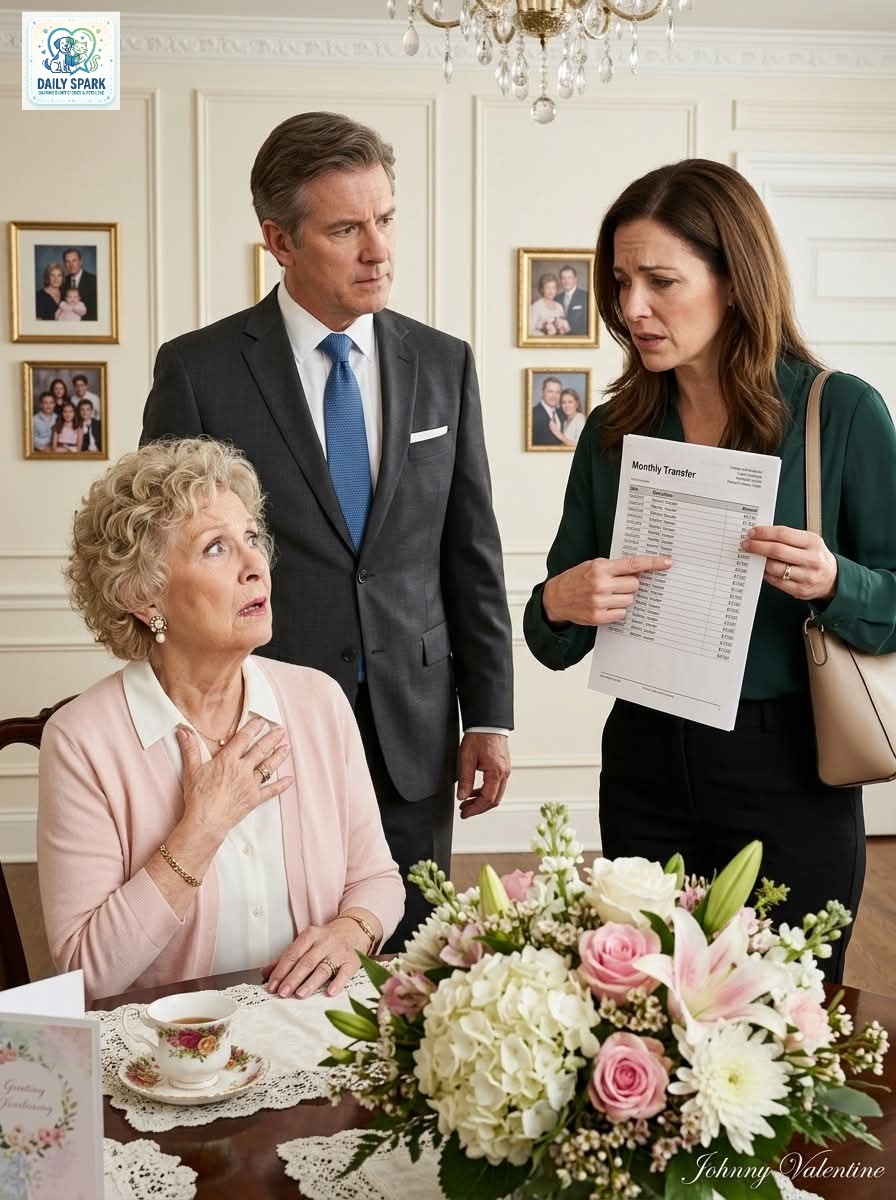
And on the coffee table between us sat a sealed folder from Harold Whitfield, signed by Diane three days before she died.
That was the moment I finally understood why my wife had been speaking to the attorney.
PART 2
Victoria stood in the center of the living room, her eyes scanning the quiet, dust-moted space with the casual appraisal of a guest who felt entirely too important for the company.
She didn’t ask how I was holding up. She didn’t mention Diane’s name.
Instead, she shifted the heavy leather designer handbag on her forearm, smiled that bright, artificial smile she always wore at family gatherings, and tapped a manicured finger against the side of her purse.
“Well, Raymond,” Victoria said, her voice lilting with a breezy self-importance. “Darnell and I just got back from the airport, but honestly, the trip was a complete disaster. First, our connection in London was delayed, and then Darnell had the audacity to lose his luggage tags! Honestly, I told him we shouldn’t have bothered coming back early, but he insisted we stop by to pick up our share of the estate papers before we fly out to our resort next week.”
I didn’t move from my armchair. My hands rested quietly on the wooden armrests.
“You came back early from Europe?” I asked.
“Of course!” Victoria scoffed, waving a hand as if I were being dense. “Darnell’s card kept declining at the boutique hotel in Paris. Apparently, your bank accounts or whatever were locked up because of the probate process—which is ridiculous, by the way. You should have had everything cleared before Diane passed. Anyway, Darnell is out in the driveway paying the rideshare driver. I told him I’d come in and grab the keys and the inheritance release forms so we can settle this quickly. Where is the paperwork?”
She spoke with the breathless entitlement of someone who believed the world existed entirely to fund her seasonal wardrobe.
She looked around the room again, her nose twitching slightly at the familiar scent of lavender and old paper that still clung to the cushions.
“Honestly, Raymond, this house is practically a museum,” she added, shaking her head. “Darnell and I were saying in the car that we can probably list it by winter. With the market in Detroit right now, we should clear a decent amount. We can use the cash to put down payments on that townhouse in Chicago Darnell’s been eyeing.”
A heavy, suffocating weight that had rested on my chest for ten days suddenly dissolved, replaced by a cold, crystal-clear calm.
I looked at the coffee table, right between us.
Resting squarely in the center of the worn oak surface was the thick, cream-colored manila folder Harold Whitfield had delivered the afternoon after the funeral.
Victoria’s eyes followed my gaze. Her face lit up.
“Oh! Are those the deeds?” She stepped forward, reaching out a hand with long, polished nails. “Let me see. Darnell said there were investment portfolios, too.”
“Stop,” I said.
My voice wasn’t loud. It wasn’t angry. But it had the hard, unyielding edge of a man who had spent forty-two years working on assembly lines and had finally seen enough broken machinery.
Victoria froze, her hand hovering an inch away from the folder. She blinked, annoyed. “Raymond, don’t be dramatic. You know Darnell is the only son. It’s all going to him anyway.”
The front door swung open behind her.
Darnell strode into the living room, still wearing his expensive travel jacket, looking flushed and irritable.
“Dad, for God’s sake, why didn’t you answer my texts?” Darnell demanded, running a hand through his gelled hair. “Victoria’s right, we’ve wasted half the morning dealing with your banking errors. The cards are frozen, the lawyer’s office wouldn’t speak to me without your written consent, and we have reservations to catch. Just sign the transfer papers so we can get this over with. Mom’s gone, the house is yours—just hand over our inheritance so we can move on with our lives.”
There it was again. Move on.
Just like that. No tears. No memory. No grief for the woman who had spent thirty years hiding money in an old biscuit tin just to pay for his college books when my paycheck fell short.
I slowly stood up from my chair. My joints ached, but my back was straight.
I reached down, picked up the heavy manila folder, and untied the red string.
“Your mother spent the last three weeks of her life talking to Harold Whitfield,” I said quietly, looking directly into my son’s eyes.
Darnell frowned, shifting his weight. “So what? She had a savings account. Everyone knows that. Dad, stop dragging this out.”
“She didn’t have a savings account, Darnell,” I replied. I pulled out a single sheet of stiff legal paper bearing the official gold seal of the Whitfield & Associates Law Firm. “Three weeks ago, when your mother went to the doctor for that persistent cough, she didn’t just get a prescription. She got a terminal diagnosis. She knew she had less than a month.”
Darnell’s smug expression faltered for a fraction of a second. “What… what are you talking about?”
“She called you,” I continued, my voice steady. “She wanted to tell you. But you were busy planning your trip to Europe. So she called Harold instead.”
I slid the legal document across the coffee table, stopping it right beneath Victoria’s staring eyes.
“On the back of that document,” I said, “is a complete audit of every single dollar Darnell has extracted from his mother over the last six years. The down payment for your suburban townhouse. The cost of Victoria’s wedding registry. The five thousand dollars you ‘borrowed’ last Christmas for your business venture that went nowhere.”
Victoria snatched the paper up. Her eyes scanned the first paragraph, and the color drained completely from her face.
“No,” she whispered, her voice pitching upward in panic. “This… this is an accounting error. This is a family loan!”
“It was a loan,” I agreed softly. “A loan your mother recorded legally, with interest, signed by Darnell himself during one of his weekend visits when he needed bailout money. And according to the final will and testament executed by Harold Whitfield three days before your mother died…”
I paused, letting the silence wrap around them like a shroud.
“…every single cent of that debt, totaling $142,800, was legally assigned as a lien against any future inheritance or estate distribution.”
Darnell lunged forward, grabbing the paper out of his wife’s trembling hands. His eyes darted across the numbers, his face turning a sickly, mottled grey.
“You can’t do this!” Darnell shouted, his voice cracking into panic. “She’s my mother! This house—everything you two own—it’s supposed to come to me! You can’t leave me nothing!”
“We didn’t leave you nothing, Darnell,” I said, walking slowly toward the front door and pulling it wide open.
The bright, indifferent Detroit sunlight spilled across the hardwood floor.
“Your mother left you exactly what you earned. A zero balance, a legally binding debt statement, and a reminder of what it costs when you decide a nonrefundable ticket to Europe is more important than the woman who gave you life.”
I pointed out toward the front porch.
“The Uber is waiting at the curb, Darnell. And unlike your mother’s love, that ride isn’t free. You’d better go pay your driver—because you won’t find a single dime coming from this house.”
Victoria stood frozen, her designer handbag slipping from her limp fingers and hitting the floor with a dull thud. Darnell looked at me, his mouth opening and closing, finally realizing that the world where he could treat his parents like an ATM had just come to a permanent end.
Without a word, he turned, grabbed his wife’s arm, and practically dragged her out the door.
The heavy oak door clicked shut behind them.
The house was quiet again.
I walked back into the kitchen, stood beside the sink, and looked at Diane’s faded blue coffee mug sitting by the window.
For the first time in ten days, I reached out, picked it up, and held it close.
And for the first time since she left, I didn’t feel entirely alone.



Leave a Reply