The Grocery Clerk Secretly Used Coupons So an Old Man Wouldn’t Have to Put Food Back—Months Later, He Asked to See Her Manager
“Leave the coffee,” Vernon said softly. “I don’t need it this week.”
Marsha Dean looked at the five things on the conveyor belt.
A loaf of wheat bread.
A carton of eggs.
Two cans of soup.
A small bag of coffee.
And a package of sliced turkey.
Vernon had already counted the bills in his wallet twice.
Marsha knew what was coming.
Every Thursday afternoon, the 82-year-old walked into the small grocery store in western Ohio wearing the same brown jacket and faded ball cap.
He bought almost exactly the same things.
And whenever the total went a few dollars higher than he expected, he quietly put one item back.
Never with a complaint.
Never with an embarrassed joke.
He would simply study the receipt, nod once, and say, “I can do without that.”
That Thursday, it was the coffee.
The week before, it had been the turkey.
Before that, the eggs.
Marsha picked up the coffee and scanned it again.
“Looks like this one has a coupon today.”
Vernon frowned.
“I didn’t bring a coupon.”
“You don’t have to. Somebody left one behind.”
That wasn’t exactly true.
There was a small stack of store coupons beneath Marsha’s register.
Customers forgot them all the time.
Some were left inside shopping carts.
Some were abandoned near the weekly advertisements.
Sometimes another customer would say, “Give that coupon to the next person who needs it.”
Marsha had started keeping a few.
She knew the rules.
Coupons had expiration dates. Some only worked on certain sizes. She never changed prices or took money from the register.
She simply paid attention.
If Vernon’s bread had a coupon, she found it.
If the soup was part of a weekly deal, she made sure he received it.
If there was a discount he had missed, Marsha quietly pointed it out before he could remove something from his cart.
She never said, “You look like you need help.”
She knew what that could do to a person.
Marsha understood pride.
At 58, she had learned more about surviving quietly than she ever wanted to know.
Three years earlier, her son Daniel had died unexpectedly, leaving behind two children, Lucy and Caleb.
Their mother had been struggling to keep her life together, so the children came to live with Marsha “for a little while.”
A little while became three years.
Marsha never complained.
She turned her sewing room into Lucy’s bedroom.
She put a secondhand desk in the corner of Caleb’s room.
She learned school pickup schedules, permission slips, lunch accounts, soccer practices, and how expensive children became when you hadn’t expected to raise them twice.
She worked extra hours whenever the store offered them.
Some nights, she sat at the kitchen table after the children went to bed with a calculator, three envelopes, and a cup of tea gone cold.
Mortgage.
Utilities.
Groceries.
School.
There was rarely much left after that.
But every morning, Lucy still had her hair brushed.
Caleb still had lunch packed.
And Marsha still arrived at work ten minutes early.
She believed there were some hardships children should not have to carry simply because the adults around them were tired.
Maybe that was why she noticed Vernon.
Most people saw an old man buying groceries.
Marsha saw the pause before he chose what to put back.
She saw the way he stood a little straighter whenever someone was waiting behind him.
She saw how quickly he folded his receipt so nobody else could study it.
So she helped him without making the help feel like help.
For nearly seven months, Thursday became their quiet routine.
“How are those grandkids?” Vernon would ask.
“Growing too fast.”
“That’s their job.”
“And yours?”
Vernon would smile faintly.
“Mostly gone their own directions.”
He never said much more.
Then one Thursday in September, Vernon didn’t come.
Marsha noticed at 3:15.
Then 3:30.
By four o’clock, she caught herself staring toward the automatic doors every time they opened.
The following Thursday, he was missing again.
Marsha wondered whether he had gotten sick.
She wondered whether he had moved.
She wondered whether she should have asked for his phone number months ago.
The third Thursday, her manager approached the register.
“Marsha, can you step into my office?”
Her stomach dropped.
“Did I do something?”
“Just come with me.”
Marsha’s mind immediately went to the coupons.
She had never stolen anything.
Never falsified a transaction.
But maybe someone thought she had been giving Vernon discounts she shouldn’t have.
She imagined losing the job.
Then she imagined Lucy’s upcoming school activity fee.
Caleb needed new shoes before winter.
The electric bill had gone up again.
By the time she reached the office, her palms were damp.
Her manager opened the door.
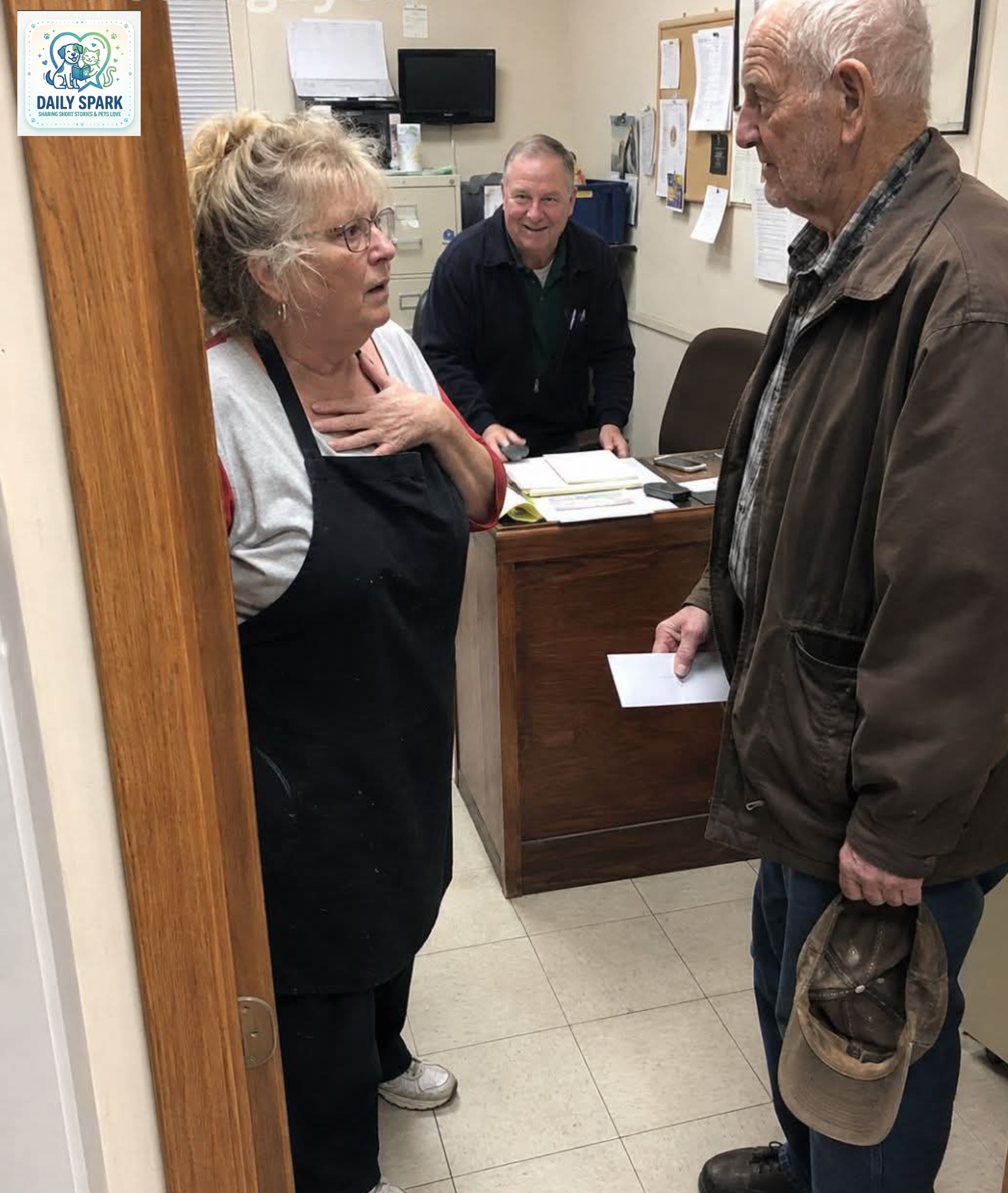
Vernon was sitting inside.
He wore his brown jacket.
His faded ball cap rested in his hands.
Marsha stopped.
“Vernon?”
He stood slowly.
“You look worried.”
“I thought I was in trouble.”
He glanced at the manager and smiled.
“She’s not in trouble, is she?”
Her manager shook his head.
“I’ll let you two talk.”
Then he closed the door.
Marsha stared at Vernon.
“What is going on?”
Vernon looked toward the wall for a moment.
“When I was thirty-four years old, this store was mine.”
Marsha laughed because she thought he was teasing her.
He wasn’t.
Vernon explained that decades earlier, the little grocery had belonged to his family.
His father had started with a neighborhood market.
Vernon expanded it.
For years, he knew nearly every family who walked through the doors.
He extended credit to farmers between harvests.
He let parents pay on Friday when they were short on Tuesday.
At Christmas, he sometimes told people a ham had been “marked wrong” so they could afford it without feeling like charity cases.
Then the town changed.
A business expansion failed.
Debt piled up.
Vernon borrowed more trying to save what his family had built.
Eventually, he lost the store.
Then his house.
Years later, his wife died.
He moved into a small apartment and lived mostly on Social Security and what little savings remained.
“I used to stand behind those registers,” he said. “Then one day I found myself standing in front of one, deciding whether I could afford eggs.”
Marsha didn’t know what to say.
Vernon looked down at his hands.
“Being broke is hard.”
He paused.
“But having people watch you be broke is harder.”
That sentence stayed in the room.
Then Vernon reached into his jacket and pulled out an envelope.
He held it toward her.
Marsha didn’t take it.
“What’s that?”
“I sold a small piece of land last month. One of the last things I had left from my parents.”
“Vernon, you shouldn’t—”
“Open it.”
Inside was a check.
Marsha stared at the amount.
It was enough to cover Lucy and Caleb’s school fees, activity costs, new winter shoes, and more.
Her eyes immediately filled.
“No.”
Vernon nodded.
“No, Vernon. Absolutely not.”
“Marsha.”
“You need this money.”
“So do you.”
“I cannot take this.”
He leaned forward.
“You spent months making sure I never had to stand in that checkout line and announce to strangers what I couldn’t afford.”
Marsha wiped her cheek.
“I only found coupons.”
“No.”
His voice cracked.
“You protected my dignity when you thought I had nothing left to give.”
Marsha looked down at the envelope.
Vernon continued.
“You never treated me like a poor old man. You treated me like a customer who happened to miss a sale.”
That finally broke her.
Marsha covered her mouth and cried.
Vernon’s eyes filled too.
“I know what you’re doing for those children,” he said. “I asked around.”
“They’re my grandchildren.”
“I know.”
“They’re my responsibility.”
Vernon smiled.
“That doesn’t mean you have to carry every bag by yourself.”
Marsha eventually accepted the envelope.
But there was one condition.
Vernon had to come back Thursday.
He did.
At 3:20 that afternoon, he walked through the automatic doors with his brown jacket zipped to his neck.
He bought bread.
Eggs.
Soup.
Coffee.
Turkey.
When Marsha handed him the receipt, he studied the total.
Then he looked at her suspiciously.
“You didn’t use one of your magic coupons again, did you?”
Marsha smiled.
“Coffee’s on sale.”
Vernon shook his head.
“Of course it is.”
The customer behind him laughed.
And for the first time in months, Vernon carried all five items home.
Marsha later used part of his gift for the children’s school expenses.
She saved the rest.
But she kept the envelope.
Not because of the money.
Because Vernon had written something on the back.
Just one sentence.
She taped it inside the kitchen cabinet above the mugs, where she sees it every morning before work.
It reads:
“Never confuse someone having little with someone having nothing to give.”
Marsha still works the grocery register.
She still notices forgotten coupons.
She still notices people quietly counting bills.
And sometimes, when a customer starts removing something from the belt with that familiar embarrassed look, she finds herself remembering an elderly man in a brown jacket.
Because kindness is not always paying someone’s bill.
Sometimes it is letting them keep their pride.
Sometimes it is noticing without staring.
Helping without announcing.
Giving without making someone feel small.
And sometimes, the person you think you are lifting is simply waiting for the day they can lift someone else.
The best kindness doesn’t remind people of what they lack. It reminds them that they still matter.




Leave a Reply