Three days after we buried my father-in-law, I learned he had left me the one thing his entire family had spent years assuming belonged to my husband.
The lake house.
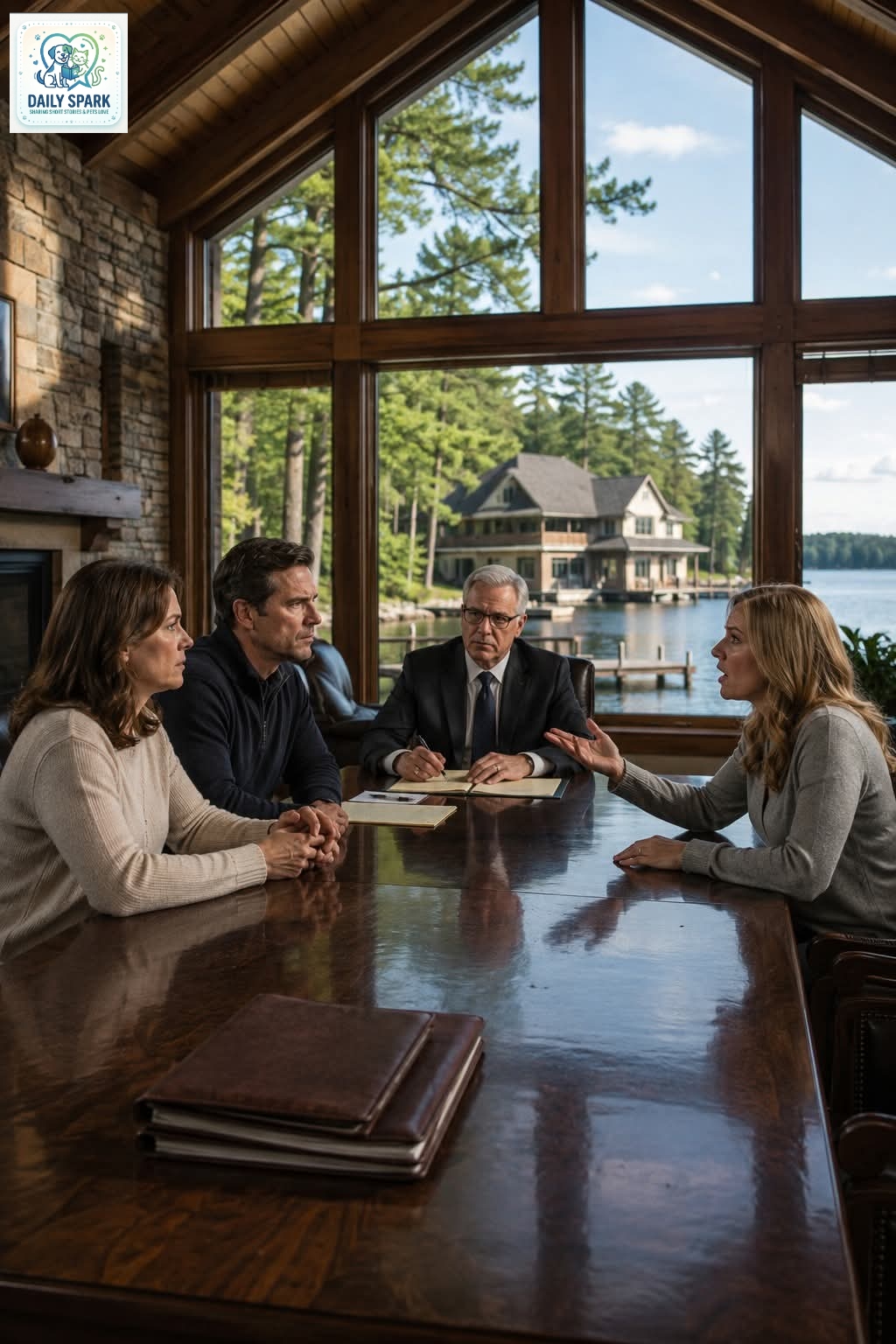
The moment the attorney said my name, my husband squeezed my hand beneath the conference table and leaned close.
“Don’t get confused,” Daniel whispered. “Dad’s house is still family property.”
At first, I thought grief had made him say something strange.
Minutes later, the attorney opened another folder and asked a question that made my sister-in-law go completely still.
But I’m getting ahead of myself.
“The Gull Lake property passes to Claire individually.”
For several seconds, nobody moved.
I heard attorney Charles Holloway clearly.
I understood every word.
My mind simply refused to connect them.
Claire.
That was me.
Gull Lake.
That was Frank’s house.
Daniel’s hand tightened around mine.
Across the table, his younger sister Meredith stared at the attorney before giving a small, disbelieving laugh.
“I’m sorry. What?”
Mr. Holloway glanced down at the trust documents.
“The lake property is distributed to Claire Bennett.
Meredith leaned forward.
“No. Daniel gets the lake house.”
“That is not what the current trust says.”
“But he’s the oldest son.”
Silence.
Meredith turned to my husband.
“Daniel.”
He was still holding my hand, but suddenly the grip didn’t feel comforting.
It felt like a reminder.
Frank had been dead for six days. He was seventy-nine. The funeral had been three days earlier, and I hadn’t slept properly in weeks.
For the final six weeks of his life, most of our world had existed inside his bedroom—hospice nurses coming and going, medication schedules taped inside a kitchen cabinet, oxygen tubing constantly getting twisted around furniture.
I was forty-six and had been married to Daniel for fourteen years.
For the last three, I had also become the person Frank called before almost anyone else.
It hadn’t always been that way.
When I married Daniel, Frank was polite but reserved. He was a classic Midwestern father who expressed affection through useful information—snow tires, interest rates, sump pumps.
His wife, Margaret, had died eight years earlier. Afterward, Frank clung even harder to routine.
Tuesday breakfast at the same diner.
Thursday card night.
Sunday football.
And every summer weekend possible at Gull Lake.
The cedar-sided lake house sat about two hours north of Minneapolis, near Brainerd. It wasn’t a twenty-million-dollar mansion. It was simply beautiful.
Four bedrooms. A screened porch. An aging dock. A detached garage packed with fishing gear nobody had organized since the Clinton administration.
Daniel and Meredith had spent their childhood summers there.
So had their cousins.
Our two children had learned to swim from that dock.
Nobody called it “Frank’s lake house.”
They called it “the lake house.”
I didn’t understand then how much that distinction mattered.
My role in Frank’s life began after he slipped on ice outside his townhouse and injured his hip.
Daniel traveled constantly for his job as a regional vice president for an industrial building-supply company.
Meredith lived nearly ninety minutes away in Rochester and worked as a nurse administrator.
I worked hybrid as a contracts manager for an engineering firm.
So when Frank needed someone to take him to an orthopedic appointment, I volunteered.
Then physical therapy.
Then the pharmacy.
Then another appointment.
Eventually, Frank recovered enough to drive, but the arrangement remained.
“Claire knows my medications.”
“Claire has the insurance login.”
“Claire knows which clinic I use.”
Then his health worsened.
Heart problems. Balance issues. Pneumonia. Hospitalization.
Eventually, he stopped driving completely.
I even applied for intermittent family leave.
Daniel would tell me, “You don’t have to do all this.”
Then another appointment would appear.
“I’m in Denver Tuesday.”
Or, “I have the quarterly review.”
Or his favorite:
“Dad’s calmer with you.”
Meredith had her own phrase.
Text me if you need anything.
I saw those words dozens of times.
Sometimes I actually asked.
Can you take him Thursday?
Usually the response was some version of:
I wish I could. Crazy week.
So I went.
Again.
And again.
I wasn’t a martyr. There were parts of caring for Frank that I treasured.
We had conversations in medical waiting rooms that would never have happened around Thanksgiving dinner.
He told me about Margaret. About how terrified he’d been when Daniel first drove a car. About spending nearly every dollar they had buying Gull Lake.
“Margaret bought that place,” he once told me.
“I thought you bought it together.”
“She found it. Saw the dock and decided our children were going to grow up there.”
“Did you agree?”
“No.”
He paused.
“Then I paid for it for thirty years.”
That was Frank.
As he grew weaker, I drove him to the lake for weekends. I opened windows, changed sheets, bought groceries, arranged the dock company, and called someone when the old water heater failed.
Once, as he sat on the screened porch staring across the water, he said, “You’re doing too much.”
“Your children inherited delegation skills.”
He laughed so hard he started coughing.
Our relationship wasn’t exactly father and daughter.
But it was real.
And Frank noticed things I didn’t.
Two years before his death, during Thanksgiving dinner, Meredith casually said, “Eventually we should redo that kitchen.”
Frank looked up.
“What kitchen?”
“The lake house.”
“Why?”
“The cabinets are ancient.”
“They work.”
Daniel joined in.
“The dock will need replacing before the kitchen.”
Frank’s expression changed.
“I like my dock.”
Later, while I loaded the dishwasher, he came into the kitchen.
“They talk about that house like I’m already dead.”
“They don’t mean it like that.”
“Maybe.”
Then he looked at me.
“You don’t.”
The following summer, Meredith brought a contractor friend to inspect a loose deck railing.
By dinner, they were discussing knocking down a wall between the kitchen and dining room.
After they left, Frank said quietly, “I asked about the railing. Nobody wants to fix what I have. They want to plan what comes after.”
When I told Daniel, he rolled his eyes.
“Dad gets territorial.”
“It’s his house.”
“Eventually somebody has to deal with it.”
Everybody knew who “somebody” meant.
Daniel.
The eldest son.
The person everyone assumed would “keep the lake house in the family.”
Meredith expected access. Her children expected access. Cousins casually discussed future Fourth of July weekends.
No one had ever seen paperwork.
They didn’t need to.
The family story had been repeated so often that it carried the authority of a legal document.
Even I believed Daniel would inherit it.
Frank never discussed his estate with me.
Not once.
When hospice began, he insisted on staying at Gull Lake despite the distance from Minneapolis and his doctors.
“I’m going home,” he said.
He meant the lake.
So I reorganized my life.
For six weeks, I spent three or four nights there every week.
Daniel came when he could. He loved his father. He sat beside him for hours, handled difficult hospice conversations, and once cried alone in the garage because he didn’t want Frank to see.
This would be easier if Daniel had been a selfish son.
He wasn’t.
But his job was always the thing that couldn’t move.
Mine moved.
So I became the person there at two in the morning.
The person who what Frank could eat.
The person who met the nurse.
Washed the bedding.
Found the paperwork.
Heard Frank call Margaret’s name one confused night.
Meredith came most weekends, but even then everyone asked me:
Did Dad take this?
When did he eat?
When is the nurse coming?
Where’s the paperwork?
Frank died Tuesday morning.
Daniel and I were there.
Meredith arrived forty minutes later.
Three hours after her father died, she stood on the screened porch and said, “We’ll need to figure out what furniture stays.”
I said nothing.
Then came the funeral.
Flowers. Photographs. Church. Obituary calls. Food nobody ate.
Afterward, Mr. Holloway scheduled the trust meeting.
Frank left financial assets to Daniel and Meredith, several charitable gifts, and personal belongings.
Nothing unusual.
Until the lake house.
“The Gull Lake property passes to Claire individually.”
Meredith objected immediately.
Daniel didn’t.
Instead, he squeezed my hand and whispered:
“Don’t get confused by the wording. Dad’s house is still family property.”
“The attorney just said—”
“I heard him. Dad probably did this because you handled his care. He wanted to protect you.”
“Protect me from what?”
“We’ll sort it out.”
Something cold settled in my chest.
Sort it out.
As though Frank had accidentally given me his house.
Meredith turned toward me.
“Did Dad ever talk to you about this?”
“No.”
“Never?”
“No.”
She studied my face.
Daniel jumped in.
“She didn’t know. We’ll figure it out.”
We.
Again.
Then Mr. Holloway slowly removed his glasses.
“Before anyone figures anything out,” he said, “there is another issue concerning the property.”
Something in Meredith’s posture changed.
Barely.
But I saw it.
The attorney opened a second folder.
Then he looked directly at her.
“Can someone explain why a real estate agent requested access to the lake house before Frank’s funeral?”
As the silence in the room stretched to a breaking point, Meredith’s face turned completely pale, her fingers digging desperately into the leather upholstery of her chair. Mr. Holloway laid out the printed emails and a signed brokerage agreement dated just two days after Frank’s passing—proof that Meredith had already listed the property for a quick cash sale behind our backs, expecting to pocket the inheritance before probate ever began. Daniel stared at the papers in absolute horror, the illusion of his family’s moral high ground shattering instantly. I didn’t raise my voice or argue; I simply stood up, detached my car keys from Daniel’s ring, and looked right at my stunned husband. “You can figure it out with your sister,” I said quietly, walking out of the office and straight toward the north highway, leaving behind a legacy built on entitlement and stepping foot into a sanctuary that finally belonged to me alone.



Leave a Reply