When I asked why I had not been invited to my own daughter’s wedding, she replied, “Greg doesn’t want you there.” Just one week earlier, I had given them an eight-million-dollar vineyard estate. I calmly said, “I understand.” Two hours later, my phone displayed fifty-nine missed calls.
The ringing eventually stopped, not because anyone had settled down, but because my battery died after call number fifty-nine.
I sat alone at the kitchen table, staring at the dark screen while the morning sun stretched across the hardwood floor. Outside the windows, orderly rows of grapevines continued toward the county road in the distance.
For the first time in years, the silence did not feel lonely.
It felt revealing.
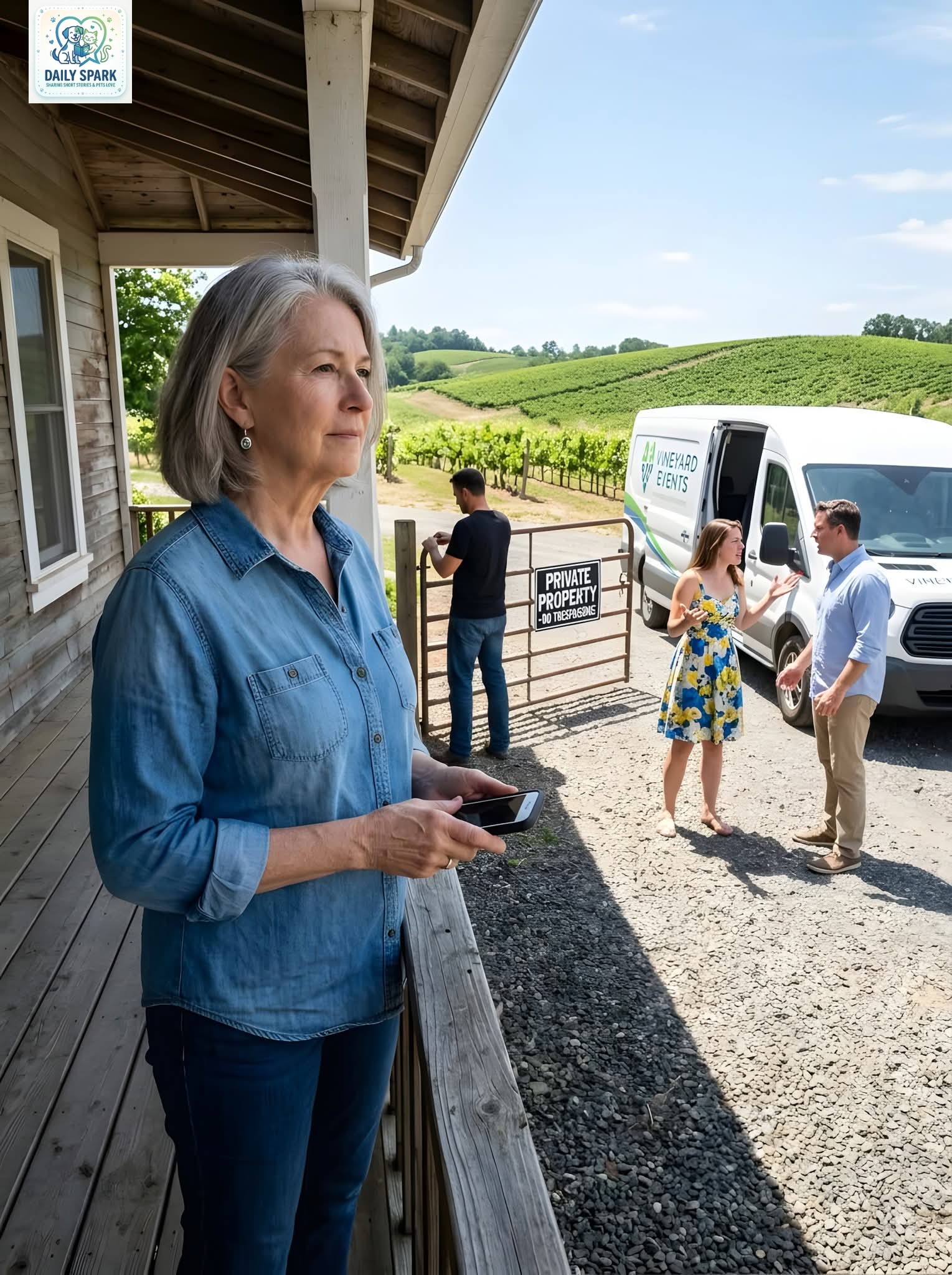
My name is Andrea. I am sixty-five, widowed, and the sole owner of the farmhouse, the surrounding land, and the eighty-acre vineyard my husband and I spent decades creating.
My daughter Samantha’s wedding was supposed to take place there that Saturday.
The ceremony would be held beside the rose garden. Dinner would be served beneath a huge white tent overlooking the vines. Almost two hundred guests would toast the newlyweds with wine made from grapes grown on my property.
I had also agreed to pay for nearly everything.
That morning, I called Samantha to ask when the florist would arrive.
She answered after four rings.
“Hello, Mom.”
There was an uncomfortable edge in her voice.
“What time is the florist coming?” I asked. “Ben needs to know which gate to open.”
She paused.
“Mom, there’s something we need to discuss.”
I slowly lowered my coffee cup onto the table.
“What is it?”
“I don’t think you should come to the wedding.”
For several seconds, I was certain I had misunderstood her.
The wedding was taking place on my land and being funded largely from my bank account.
“What are you talking about?”
“Greg thinks your being there could make his family uncomfortable.”
“How would my presence make anyone uncomfortable?”
“You’re different from them. You don’t really fit into their kind of social environment.”
Then she finally said what she had been trying to avoid.
“My husband doesn’t want you there.”
Greg was still technically her fiancé, yet Samantha had already started calling him her husband.
Only seven days earlier, they had sat with me on the patio while I placed a small velvet-covered box in front of them.
Inside was the key to the restored stone house beside the creek.
The home had solid oak floors.
A newly renovated kitchen.
Tall windows facing the vineyard.
And a spacious deck overlooking the water.
The residence and surrounding land were valued at no less than eight million dollars.
I had wanted my daughter to begin married life without a mortgage hanging over her head.
Samantha cried when she discovered the key.
Greg merely rolled it between his fingers and smiled with satisfaction.
“We’ll need to bring in a professional landscaping company,” he said, glancing at the dirt beneath my fingernails. “We can’t have the place looking like a real farm when our friends visit.”
Samantha laughed as though he had made a brilliant joke.
After that, Greg made remarks about my scuffed work boots, the older cabinets inside my farmhouse, the denim shirts I wore, and the pickup truck I drove around the property.
Samantha never defended me.
I kept inventing excuses for both of them.
That stopped during the phone call.
Sitting in my kitchen, I could no longer deny what was happening.
They wanted my vineyard.
They wanted the stone house.
They wanted the lavish wedding and the appearance of wealth created by a lifetime of my work.
They simply did not want me visible in the wedding photographs.
I did not shout.
I did not ask her to reconsider.
I took another slow sip of coffee and said,
“I understand.”
Then I ended the call.
A few minutes later, I entered my study and opened my laptop.
The final payments for the caterer, florist, band, tent company, furniture supplier, and decorators were scheduled to leave my account at noon.
I studied every pending payment.
Then I called Ben, the property manager.
“Good morning, Andrea.”
“Ben, I need you to change the code for the private entrance.”
He was silent briefly.
“All right.”
“And replace the locks at the stone house.”
His next pause lasted longer.
“Would you like to tell me what happened?”
“No.”
“Then I won’t press you.”
I looked at the wedding contracts spread across my desk.
“There’s something else. Do not allow any vendors onto the property.”
His voice immediately became firm.
“Understood.”
Two hours later, I returned to the farmhouse after trimming the roses beside the porch.
My phone was lighting up on the kitchen counter.
The screen was filled with text messages, voicemail notifications, and repeated call alerts.
At the top, four words appeared beside a large number:
59 missed calls.
My phone kept vibrating against the wooden counter, the missed call counter ticking past sixty as I calmly poured myself a fresh cup of coffee.
I unlocked my phone and tapped the most recent text. It was from Greg, his usual polished arrogance entirely replaced by panic. “Andrea, what the hell are you doing? The security gates are locked, the caterers are turning around on Route 9, and Samantha is crying her eyes out because the decorator can’t get in. Call me back right now!”
Behind him, Samantha had sent a frantic voice message. Her voice was shaking, entirely devoid of the cold dismissal she had used just two hours earlier. “Mom, please pick up. Greg called the county police because the main gate is chained, but the sheriff told him it’s private property and won’t intervene. The guests are going to start arriving in three hours. Please, Mom. You can’t do this to us.”
They assumed the eight-million-dollar estate and the wedding planner’s schedule were ironclad. They forgot a very crucial detail: nothing had actually been signed over yet.
While I had handed them the physical key to the stone house on the patio a week ago, the formal title transfer and deed paperwork were scheduled to be finalized by my attorney on Monday—two days after the wedding. They had jumped the gun, treating my life’s work as their inheritance before the ink was even dry.
I didn’t call them back. Instead, I called my lawyer, instructing him to halt all deed transfers permanently, put the stone house on the market, and begin the legal process of evicting Greg from the property by sundown.
By noon, the long, winding gravel driveway of the vineyard was entirely empty. The massive white tent stood half-raised near the vines like a forgotten ghost, fluttering silently in the breeze without tables, chairs, or food.
Two hours later, a sleek black SUV came tearing down the county road, sliding to a harsh stop right in front of my porch. Greg burst out of the driver’s side, his expensive suit rumpled, his face bright red with fury. Samantha scrambled out of the passenger seat, looking pathetic in her silk traveling dress, tears carving tracks through her makeup.
Greg marched up the steps, his hand raised to hammer on my screen door, but I stepped out onto the porch before he could touch the wood.
I was still wearing my denim shirt, my scuffed work boots, and my gardening gloves.
“Are you insane?” Greg roared, pointing a shaking finger toward the empty reception area. “Do you have any idea how much money is sitting out there? Our friends are already driving down from the city!”
“Then I suggest you tell them to turn around,” I said, my voice completely steady.
Samantha choked back a sob, climbing the steps and reaching for my arm. “Mom, please. Greg was just stressed out, he didn’t mean it like that—we want you at the wedding, we swear. Please open the gates.”
I gently pulled my arm away from her grip and looked at my daughter, seeing clearly for the first time how easily she had traded my dignity for a wealthy last name.
“You told me your husband didn’t want me in your photos because I don’t fit into his social environment,” I replied quietly, looking past her to where Greg stood scowling. “You were right about one thing, Samantha. I don’t fit into your world. And as of right now, neither do you.”
I turned my back on them, walking back into the cool, quiet safety of my farmhouse and letting the heavy oak door click shut behind me.
Outside, the silence of the eighty-acre vineyard returned—not lonely, not broken, but completely mine.



Leave a Reply