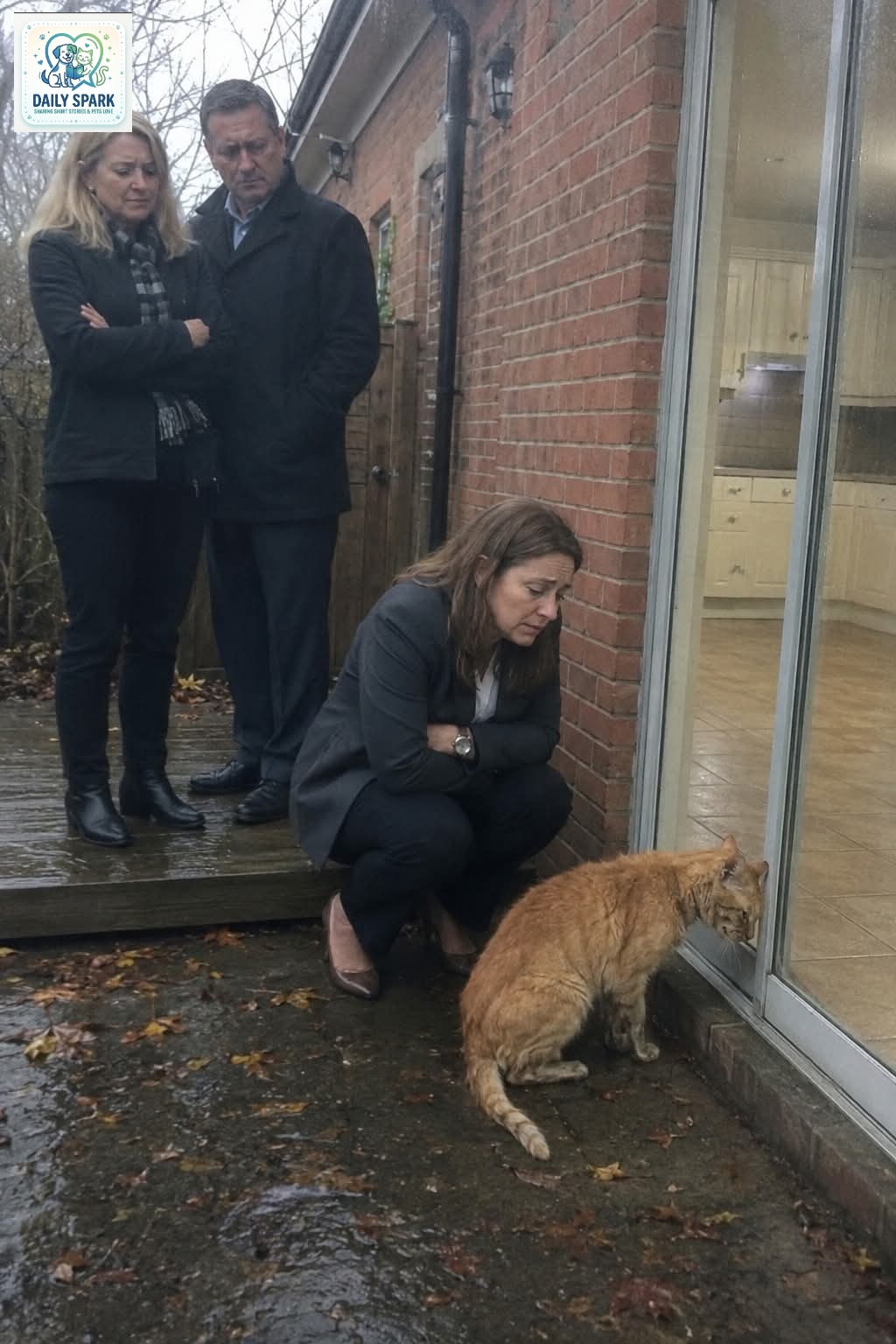
I lost the biggest commission of my year because an old orange cat refused to die quietly.
That is the truth.
I had three unpaid bills on my kitchen counter, a car that made a grinding sound every time I turned left, and a listing that could have saved my month.
The house was a beautiful brick townhome near the old park. Two stories, white trim, small backyard, the kind of place people call “charming” before they start tearing out the things that made it charming.
The owner, Mrs. Hanley, had passed away three weeks earlier.
Her son, Grant, wanted the house sold fast.
By the time I arrived, most of her life had already been removed. No family photos. No curtains. No coffee mug by the sink. Just pale rectangles on the walls where pictures used to hang.
Grant met me in the kitchen, scrolling through his phone.
“Let’s get this done,” he said. “I don’t want this place sitting.”
The buyers arrived ten minutes later.
Mrs. Whitaker and her husband had money. You could tell by the quiet way they wore it. She did most of the talking. He mostly nodded.
She loved the crown molding. Hated the wallpaper. Loved the backyard. Hated the old shed.
“Nothing a good renovation can’t fix,” she said.
I smiled the way agents smile when a deal is walking toward them.
Then we stepped onto the back porch.
That was when I heard it.
A tiny sound. Not a full meow. More like a cracked door hinge.
I looked down.
Under the porch, pressed against a pile of wet leaves, was an old orange cat.
He was thin, filthy, and shaking so hard I could see it from where I stood. One ear was torn. His fur was matted along his back. His eyes were cloudy with age, but he looked right at the kitchen door like he was waiting for someone.
Grant sighed.
“Oh. That thing.”
I crouched down. “Is he yours?”
“My mother’s,” he said. “Name’s Biscuit, I think.”
The cat lifted his head when he heard the name.
That small movement did something to me.
Mrs. Whitaker leaned closer, then stepped back quickly.
“He looks sick,” she said. “You’ll have him removed before closing, right?”
Grant gave a short laugh. “I’ll call animal control this afternoon. I’m not keeping a cat. I don’t even like cats.”
Biscuit tried to stand. His back legs trembled, but he managed two steps toward the door. Then he sat down again, as if his body had remembered something his heart had not forgotten.
Grant looked embarrassed, like the cat was a stain on the carpet.
“My mother fed him at that door every morning,” he said. “She treated him like a person. Talked to him constantly. Honestly, it was weird.”
I looked through the glass into the empty kitchen.
For a second, I could almost see her there. An old woman in slippers, bending down with a bowl, saying, “Morning, Biscuit,” like he was the only soul in the world who still needed her.
Mrs. Whitaker folded her arms.
“If we buy the house, I want the yard cleaned up. I’m putting in flower beds, and I don’t want some stray digging around.”
Stray.
That word landed hard.
Biscuit was not a stray. He was an old pet sitting outside the only home he understood, waiting for a woman who would never open the door again.
I thought about my bills.
I thought about the commission.
I thought about how tired I was of being one bad month away from panic.
Then Biscuit took one more shaky step and pressed his head against the back door.
Not hard.
Just enough to ask.
I closed my folder.
Grant looked at me. “What are you doing?”
“I’m ending the showing.”
Mrs. Whitaker blinked. “Excuse me?”
I turned to Grant first.
“I can’t make you love what your mother loved,” I said. “But I’m not going to stand here and pretend this cat is trash that got left behind.”
His face went red. “You’re serious?”
“Yes.”
Then I looked at Mrs. Whitaker.
“And ma’am, this house belonged to someone who loved a small, old creature until the day she died. If that bothers you more than the wallpaper, I don’t think this is your house.”
The silence that followed felt expensive.
Mrs. Whitaker walked out first.
Grant said a few things I won’t repeat. Then he left too.
I stood in that empty kitchen, staring at the half-frozen cat outside, knowing I had probably just destroyed the deal that could have saved me.
Then Biscuit made one tiny sound—and what happened next changed far more than that sale.
Biscuit let out one last, ragged rasp, his tired body finally yielding to the cold, and I dropped to my knees in the dust, lifting him gently into my coat before his breathing stopped.
I took him straight to the emergency vet down the road, charging the steep medical fees to a credit card I swore I would never use again. For three days, I sat in an uncomfortable plastic chair, feeding him warm broth with a syringe and listening to the steady beep of a monitor, convinced I had completely ruined my life over a stubborn, dying animal.
On the fourth day, the vet looked up from his chart with genuine surprise. “He’s a fighter,” she said. “He just needed someone to wait with him.”
When I brought Biscuit home to my tiny apartment, my car still made that grinding sound, and my bills were still unpaid. But as he curled up on the spare cushion by my radiator, purring with a heavy, steady rhythm, something in the air shifted.
A week later, my phone rang. It wasn’t Grant, and it wasn’t Mrs. Whitaker.
It was an elderly man named Arthur, who lived down the street from the old brick townhome. He told me he had been visiting his sister at the hospital when he overheard Mrs. Whitaker loudly complaining to a nurse about the “rude real estate agent who valued a mangy stray over a six-figure sale.”
Arthur had chuckled so hard he choked on his lozenge. Then, he asked for my number.
“My wife passed away six months ago,” Arthur told me when we met for coffee at a diner. “I’m looking to downsize. And any agent who has the guts to stand up for a faithful old cat is someone I want handling my life savings.”
Arthur didn’t just want a small townhome; he wanted a quiet, respectable neighborhood, and he wanted it immediately. The commission from selling Arthur’s estate—and helping him find a cozy, sunlit cottage—was triple what I would have made on Mrs. Whitaker’s sale. It paid off every single debt, fixed my transmission, and left enough in the bank for me to breathe easy for a year.
As for Biscuit, he didn’t have to worry about cold porches anymore. He spent his retirement sleeping across my feet while I worked at the kitchen table, reminding me every single day that the most expensive things we can lose are the things we shouldn’t have cared about in the first place.




Leave a Reply