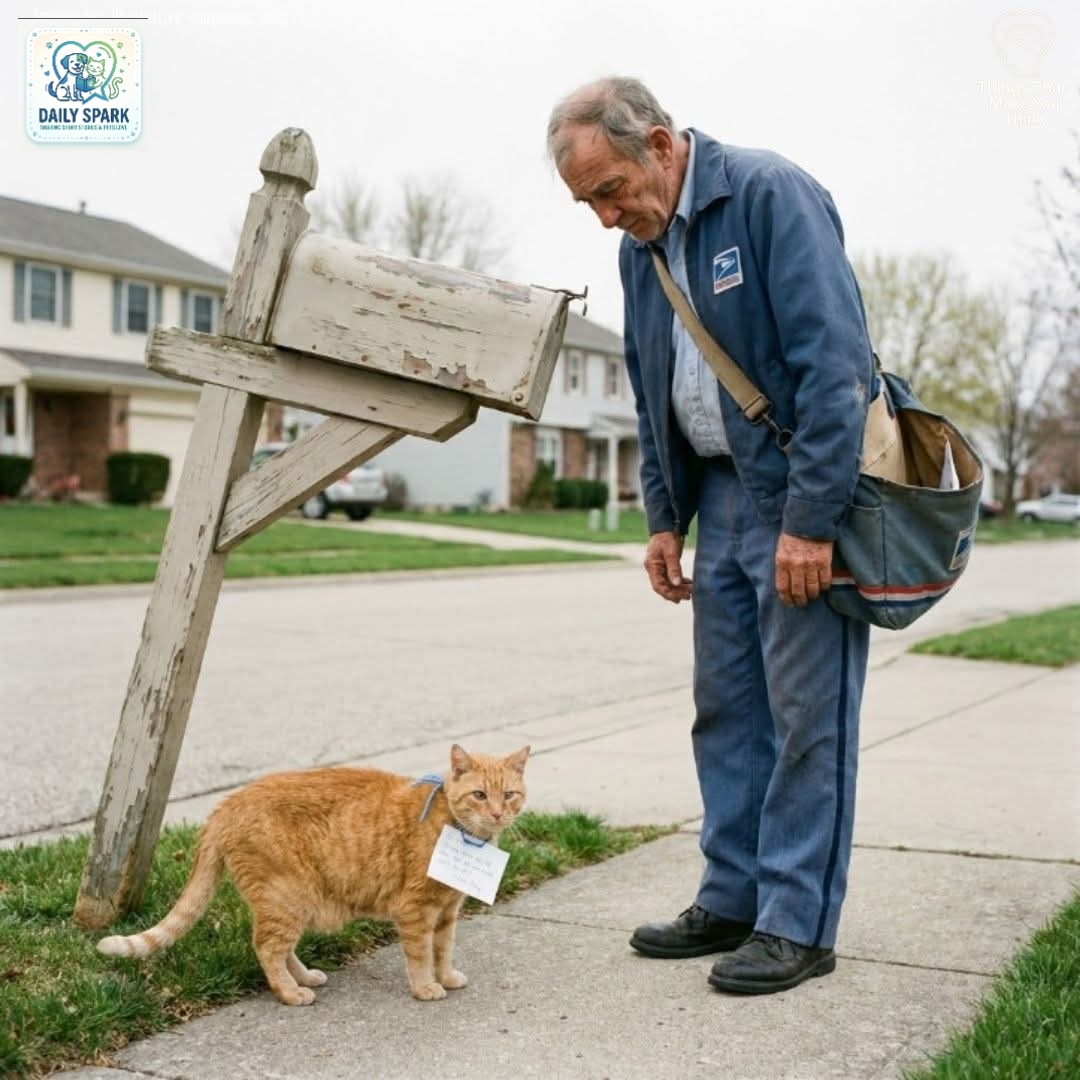
My last day carrying mail, the only goodbye I got was tied around the neck of an orange cat named Tammy.
I had walked Cedar Loop for eleven years. Same cracked sidewalks. Same leaning mailboxes. Same porch chairs nobody sat in anymore. Same little cameras blinking at me like they knew me better than the people inside did.
I wasn’t angry about it. People were busy. People worked from home. People ordered everything to their doors and spoke through tiny speakers instead of opening them. That was just how life had gotten. Still, after eleven years, I thought maybe one person would remember it was my last day.
Nobody did. Not until I reached the last mailbox on the loop.
Tammy was waiting there, like always. She was an old orange cat with a round belly, one cloudy eye, and a crooked little walk that made her look like she had places to be but no reason to hurry. She had been meeting me at that last mailbox since my first week on the route.
At first, I thought she wanted food. She didn’t. I thought she wanted attention. Not really. Tammy would just stand up when I arrived, stretch like she had been on break, then walk beside me for the last stretch of the street.
Twelve houses, one slow curve, and then the dead-end sign by the big maple tree. After that, she would turn around and go home.
I used to joke with her. “Well, Tammy,” I’d say, “another day nobody bit us.” She never answered, of course. But she stayed. Some days, that was enough.
That last morning, my knees hurt worse than usual. My bag felt heavier, though it was almost empty. Retirement was supposed to feel like a reward, but all I felt was a strange kind of grief. A man spends half his life being part of other people’s routines, then one Friday, he just disappears from them. No announcement. No cake. No folded card passed around the neighborhood. Just one more stack of bills, flyers, birthday envelopes, and grocery coupons.
When I got to the final mailbox, Tammy was sitting in the grass.
Something was tied to her collar. I bent down slowly. It was a small white tag, cut from an index card and tied with blue yarn.
The handwriting was shaky: Thank you for walking him home.
I read it twice. Then a third time.
“Walking who home?” I whispered.
Tammy looked up at me with that cloudy eye, then started down the sidewalk like she expected me to follow. So I did. She led me past the last mailbox, past the dead-end sign, and up to a small white house I had delivered to for years. The curtains were always closed. The porch light was always on, even in daylight.
Before I could knock, the door opened. Mrs. Evelyn Brooks stood there in a pale sweater, holding the screen door with both hands.
“You found the note,” she said.
I nodded, still holding it. “I don’t understand.”
She looked down at Tammy and smiled in a way that almost broke my heart. “My husband had this route before you.”
I knew that much. Not his name, really. Just that an older carrier had retired before I took over Cedar Loop. People used to say he was the kind of man who remembered birthdays, dog names, bad knees, and which doors stuck in winter.
Mrs. Brooks stepped aside. “You don’t have to come in,” she said. “I just wanted to tell you.”
Tammy walked between us and sat on the welcome mat.
“My husband picked her up as a kitten behind the last mailbox,” she said. “Tiny little thing. Orange as a pumpkin. He brought her home in his mailbag.”
I smiled at that.
“She started meeting him there every afternoon,” Mrs. Brooks continued. “At first, he thought it was cute. Then he started depending on it.” Her voice got soft. “Our son moved out west. My health got bad. Neighbors changed. Friends passed. And my husband would come home from the route and say, ‘That last walk is the hardest part of the day.’”
I looked at Tammy. “She walked him home?”
“Every day,” Mrs. Brooks said. “For years.”
I swallowed hard. “And after he died?”
Mrs. Brooks looked at Tammy, and her answer changed everything I thought I knew about those eleven years.
“After he died,” Mrs. Brooks said softly, her voice barely carrying over the quiet hum of the afternoon, “I couldn’t bear to watch her look for him at that mailbox anymore.”
She reached down, her fingers trembling slightly as she touched the cat’s orange fur. “So I shut the blinds. I tried to keep her inside. But cats have their own logic, don’t they? On your very first Monday, she slipped out the back screen door. I chased her all the way to the end of the loop,
panicked, thinking she’d get hit by a car or bother the new stranger in the blue shirt.”
Mrs. Brooks looked up at me, her eyes shining behind her glasses. “I watched from behind the bushes as you walked up to the last box. And instead of shooing her away, you bent down and talked to her. You said something about not getting bitten. And she just… stood up, stretched, and walked right beside you. Exactly the way she used to do with him.”
A heavy, quiet warmth settled into my chest, chasing away the chill that had followed me all morning.
“She chose you,” Mrs. Brooks whispered. “Or maybe she just knew a good mailman when she saw one. Either way, for eleven years, you didn’t just carry the letters, son. Every single day, you brought my husband’s best friend home safe.”
I looked down at Tammy. The old cat blinked her one cloudy eye at me, let out a tiny, raspy chirp, and gave her tail a single flick before trotting across the threshold into the dark, cool hallway of the house.
I stood on the porch for a long moment, the weight of the empty mailbag finally feeling like something else entirely—not an end, but a completion.
“Well, Tammy,” I whispered, touching the index-card tag one last time. “Looks like we’re both off the clock.”


Leave a Reply