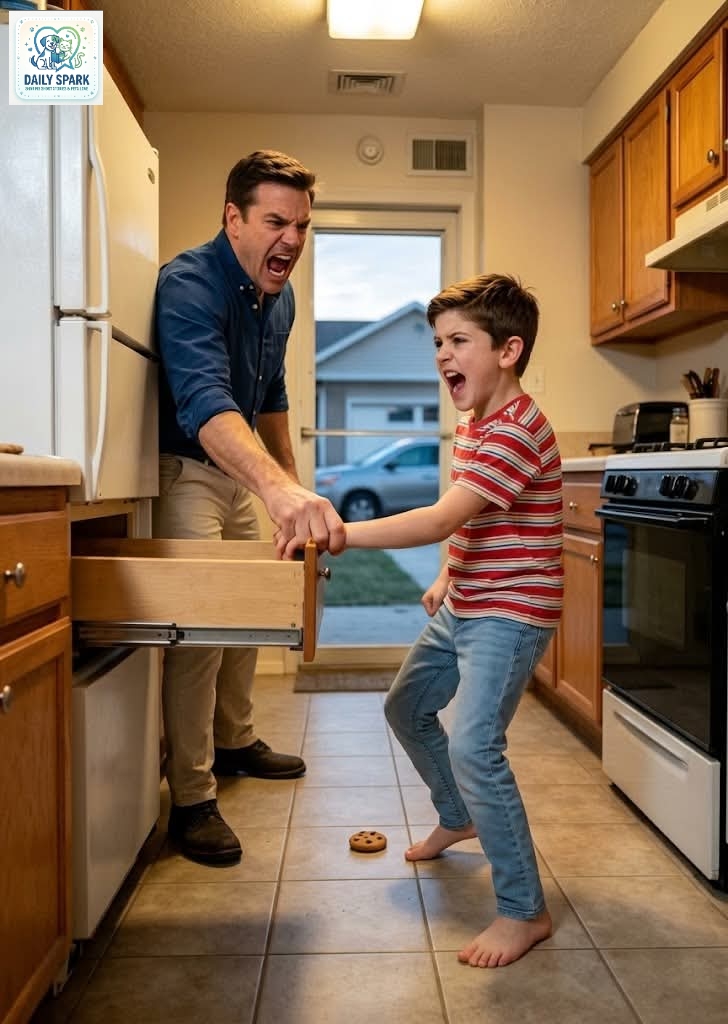
When I was nine, my stepfather slammed my hand in a drawer because I took a cookie before dinner.
Two of my fingers swelled purple while he stood there yelling about “discipline.”
The cookie was still on the floor beside my bare feet.
I waited until he turned away, then kicked it under the refrigerator where I knew my mother would find the blood beside it.
I spent the next twenty minutes at the kitchen table with my injured hand tucked between my knees.
The refrigerator hummed behind me.
Every time my stepfather crossed the room, the floorboards pressed cold against my bare feet and I kept my eyes on the table.
He told me twice to stop sulking.
I said nothing.
When Mom came in, he got to her first.
He told her I had been sneaking food again and had thrown a tantrum when he corrected me.
He sounded tired, almost amused, like I had created an exhausting little parenting problem for him.
Mom set her bag down and looked at me.
I kept my injured hand hidden.
She asked what happened.
He answered for me.
“He caught his hand in the drawer.”
I looked at him.
He looked at Mom.
He kept talking.
He kept explaining.
He kept making my silence sound like proof.
Then Mom bent to pick up something near the refrigerator.
It was the cookie.
There was a dark smear beside it.
She stayed crouched for a second, then looked underneath the table at my feet.
Her eyes moved from the cookie to me and finally to the hand I was trying to hide.
“Show me.”
My stepfather sighed.
“It looks worse than it is.”
Mom didn’t answer him.
I put my hand on the table.
Two fingers were swollen and deep purple.
I couldn’t straighten them without pain.
Mom’s mouth tightened, but she didn’t raise her voice.
“Which drawer?” she asked.
My stepfather pointed toward the counter.
“That one. He yanked it shut on himself.”
Mom looked at me.
“Did you?”
I shook my head.
He stepped closer.
“Don’t start encouraging him to lie.”
That scared me more than the yelling had.
I could already feel the story changing around me, becoming something adults might believe because he could say it louder.
Mom touched the edge of the cookie with one finger.
“Why was this under the refrigerator?”
My throat closed.
I hadn’t planned what I would say if she actually found it.
At nine, I only understood that the cookie was something he wouldn’t think to clean up because he believed I’d dropped it during the struggle.
So I told her the smallest truth I could manage.
“I kicked it there for you.”
Her eyes came back to mine.
“For me?”
I nodded.
“So you’d know where it happened.”
My stepfather gave a short laugh.
“Listen to this. Now he’s making up clues?”
Mom didn’t look at him.
She asked me one more question.
“Did he close the drawer on your hand by accident?”
“No.”
“Did he know your hand was there?”
“Yes.”
My stepfather started talking over me, but Mom raised one hand without turning around.
For the first time that night, he stopped.
She asked whether I could put on my sneakers by myself.
I said I could if I didn’t have to tie the right one.
She told me to get them and my jacket.
My stepfather moved between her and the hallway.
“Where exactly do you think you’re taking him?”
Mom finally faced him.
She didn’t make a speech.
She didn’t argue about discipline.
She didn’t tell him what kind of man he was.
She simply held out her hand.
“The keys.”
He stared at her.
She kept her palm open.
I stood there with one sneaker half on, watching the two of them while my fingers throbbed against my chest.
Then Mom reached past him, took the car keys from his hand, and closed them inside her fist.
He didn’t try to stop her again.
He didn’t yell, and he didn’t follow us out to the driveway.
For all his loud certainty and the way he liked to stand tall in the center of the kitchen, the sound of those car keys sliding out of his grip seemed to deflate him.
He just stood by the counter, watching through the screen door as Mom opened the passenger side of the sedan and helped me climb inside.
The drive to the county hospital was quiet, save for the hum of the heater and the muffled click of my left sneaker tapping against the floor mat.
I kept my right hand tucked safely inside my jacket pocket, pressing it against my ribs to keep it from bumping against anything.
Every few miles, Mom glanced over at me, her hands steady on the steering wheel, her jaw set tight in the amber glow of the dashboard lights.
By the time we got home three hours later—my fingers wrapped in a thick, stiff white cast and throbbing with a dull, medicated ache—the house was dark.
His coat was gone from the hook by the back door.
His boots were missing from the mat.
When we walked into the kitchen, the floor had been swept.
The cookie and the dark smear beside the refrigerator were gone.
But the heavy, suffocating weight that had lived in those rooms for as long as I could remember had lifted just enough to let the air back in.
Mom didn’t turn on the overhead light.
She walked over to the kitchen table, pulled out the chair where I had sat with my hands between my knees, and sat down.
“Your hand is going to hurt for a few days,” she said softly, looking at me across the wood.
I nodded, resting the heavy cast carefully on the tabletop.
“You did the right thing,” she added, her voice barely louder than the refrigerator’s hum.
“Leaving that there for me.”
I looked down at my shoes, feeling a strange, hollow sort of relief bloom behind my ribs.
I was only nine, and I didn’t know what tomorrow would look like, or where we would sleep next week, or how we were going to untangle our lives from the man who had left his boots in the hall.
But as Mom reached across the table and gently touched the edge of my cast with one finger, I knew one thing for certain.
The story had finally stopped changing.



Leave a Reply