For Two Years, Our Waitress Took Every Sunday Shift After Her Husband Died—Then a Customer Asked Her to Sit Down and Eat
“Did I get something wrong?”
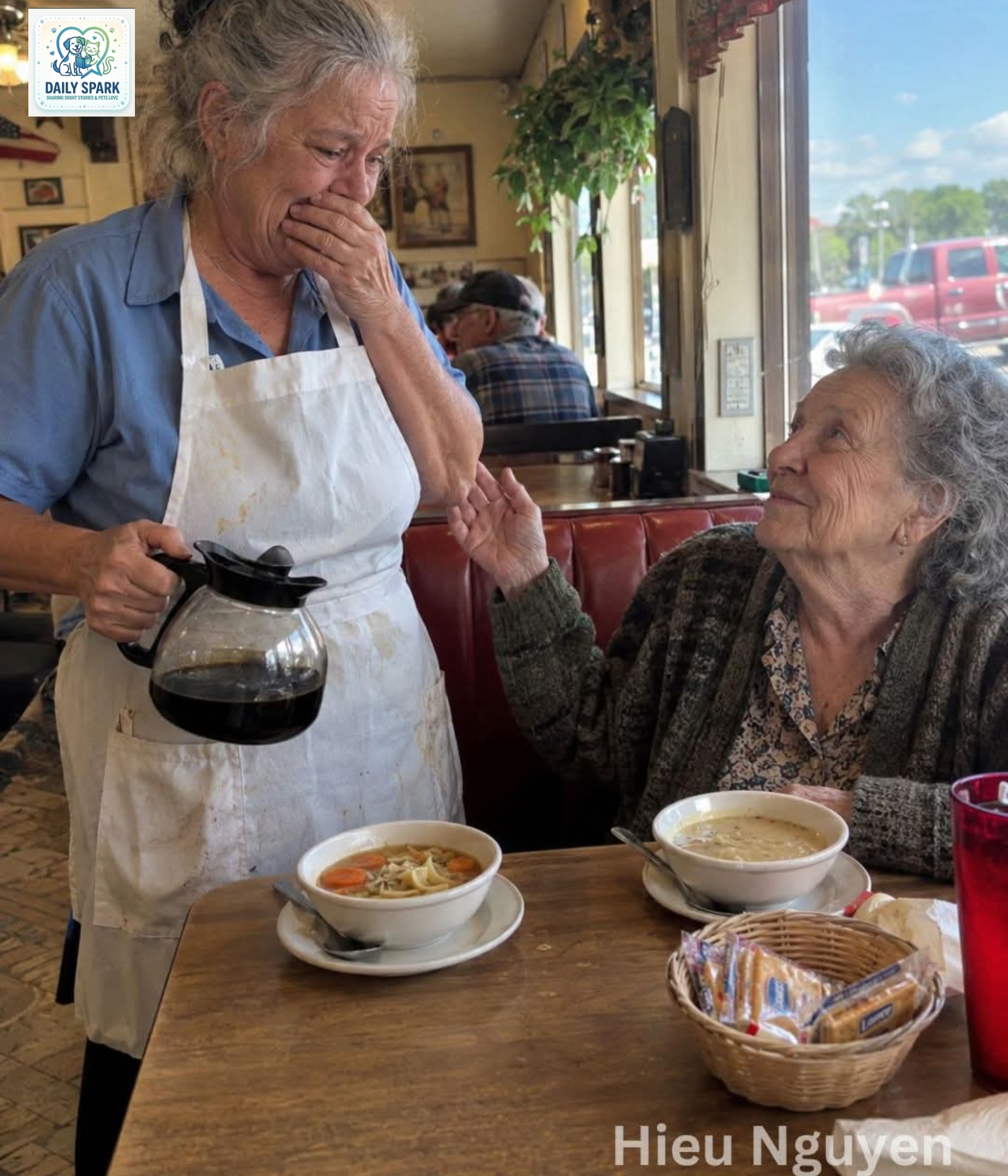
Nadine stood beside my booth with a coffeepot in her hand. Before I could answer, she glanced at my soup, then the spoon, then the little basket of crackers.
“No,” I said. “I was hoping you’d eat with me.”
She looked toward the counter, where her boss was putting clean glasses on a shelf.
“He said somebody wanted to see me.”
“I did.”
For a moment, she just stood there. Then she gave me the pleasant, practiced smile she used when someone asked whether the pie was homemade.
“That’s sweet of you, honey. But you don’t have to buy me lunch.”
“I know,” I said. “I’d just rather not eat mine alone.”
Her name was Nadine. That was all I knew then.
She knew I liked my toast light, my coffee with cream, and my vegetable soup without the shredded cheese they sometimes put on top. She knew I couldn’t open those little cracker packets easily, so she loosened the seams before bringing them over.
I’d been coming to that small Arkansas diner nearly every Sunday for eleven months.
I didn’t know her last name.
That embarrassed me later. A person can take such good care of you that you forget you haven’t asked a single thing about her life.
My husband, Curtis, had been gone a year that March.
I started eating out on Sundays because it was the day we used to cook together. He peeled potatoes over a sheet of newspaper while I worked at the stove, and somehow the radio was always too loud.
After he died, I could manage toast in that kitchen. I could heat something in a mug.
But I couldn’t make Sunday dinner.
So I drove to the diner, sat in the back booth, and ordered whatever required the fewest decisions.
Nadine was always there.
She was sixty-eight, though I didn’t learn that until later either. She wore white sneakers with a gray patch near one toe and kept a pencil tucked into hair that never stayed pinned up through the lunch rush.
She called the little boys “sir” when they ordered for themselves. She remembered which older man needed his sandwich cut in half. When somebody spilled something, she always said, “Well, that table needed wiping anyway.”
One Sunday, I heard her boss tell her she could go home early.
“We’ve got it covered, Nadine. Go put your feet up.”
Her hand stopped on the stack of menus.
“I can refill the sugar first.”
“It’s done.”
“Then I’ll get those back tables.”
He looked at her a moment before saying, “All right.”
I recognized that little search for one more thing to do.
I’d spent twenty minutes straightening cans in my pantry the night before because going to bed meant walking past Curtis’s empty recliner.
The next Sunday, I asked her whether she ever took a weekend off.
“Oh, I volunteer for Sundays,” she said. “The younger ones have families.”
“Do you have family nearby?”
“A daughter in Missouri. Three grandchildren.” She smiled, then smoothed a corner of my paper placemat. “My husband passed two years ago.”
“I’m sorry. Mine, too.”
Her eyes met mine.
For the first time since I’d started coming in, she forgot to check my coffee.
“How long?” she asked.
“Just over a year.”
She nodded slowly.
Then the bell rang at the kitchen window, and somebody called for ketchup, and she was needed again.
I thought about her all week.
On Saturday evening, I got out two soup bowls at home without thinking. I stood there holding the second one, feeling foolish and tired.
That was when I decided to ask.
The next morning, I arrived before the rush and spoke to the owner. I asked when Nadine took her break and whether I could order lunch for both of us.
“Does she know you’re doing this?” he asked.
“Not yet. She can say no.”
He glanced toward the kitchen.
“About one-thirty,” he said. “I’ll cover her tables.”
Now she stood beside my booth, still holding that coffeepot like it gave her a reason to leave.
“You should eat while it’s hot,” she told me.
“So should you.”
She looked at the second bowl.
“I’m not very good company lately.”
“Neither am I.”
That got a small laugh out of her. But she still didn’t sit.
So I told her the thing I hadn’t been able to say to my children, who called faithfully and worried enough already.
“I’m tired of pretending I like the quiet.”
Her smile disappeared.
Behind her, somebody dropped a fork. The kitchen fan rattled, and a little girl at the counter was explaining very loudly why she didn’t need a nap.
Nadine put the coffeepot on an empty table.
Then she sat down.
For the first minute, we ate.
She broke crackers into her soup. I pushed a piece of carrot around with my spoon. Neither of us seemed to know how to begin now that we had permission.
“My husband used to leave every cabinet door open,” she said finally.
“Curtis left his shoes in doorways.”
“Dwight did that, too.”
“I spent thirty-nine years telling him somebody was going to break a hip.”
She smiled into her bowl.
“I’d like something to fuss about again,” she said.
That was what undid me.
I pressed my napkin beneath my eyes, and Nadine reached across the table. She didn’t tell me to be strong. She didn’t tell me Curtis would want me happy.
She just left her hand over mine until I could pick up my spoon again.
Then she told me about Dwight.
He bought bruised peaches because he felt sorry for the farmer who might have to take them home. He couldn’t carry a tune but sang while washing dishes. Every Sunday, he waited at their kitchen table for her to finish work.
Even after forty-two years, he always stood up when she came through the door.
“I still have both chairs there,” she said. “Some nights I eat standing at the counter so I don’t have to look at his.”
I told her about the second soup bowl.
She nodded before I’d finished.
Her break lasted twenty minutes. We talked for eighteen of them.
When she got up, she gathered both bowls out of habit.
“Same time next week?” I asked.
She looked at me carefully.
“You don’t have to make this a regular thing.”
“I was hoping you would.”
The following Sunday, there was a small, worn photo envelope beside my place.
Nadine came over carrying two glasses of iced tea.
“I thought you might like to see him,” she said. “But if that’s too much—”
“Show me.”
She slid into the booth and opened the envelope.
There was Dwight beside a crooked tomato trellis. Dwight asleep with a baby on his chest. Dwight in a brown suit, looking impossibly young beside a bride with a crooked veil.
“You were beautiful,” I said.
“That veil caught on the car door. My sister fixed it with a bobby pin.”
She turned the picture over, though there was nothing written there.
Then she turned it back.
“He thought it was a lovely wedding.”
“It looks like it was.”
She sat a little closer so we could both see.
We’ve been having Sunday lunch together for seven months now.
Sometimes we talk about our husbands. Sometimes we talk about grocery prices or her granddaughter’s haircut. Once, we spent most of lunch laughing about a cake I’d made that had to be served with a spoon.
Last Sunday, Nadine took the afternoon off.
She came to my house carrying a peach pie, and I made a pot of coffee. We ate at the kitchen table, with the radio playing low.
Before she arrived, I got out two plates.
For the first time in a long time, the second one wasn’t a mistake.
Sometimes the kindest thing you can offer someone is a place at your table.




Leave a Reply