Everything started in English, with a single, battered notebook and a sixteen-year-old boy who finally learned how to read between the lines of grease and iron.
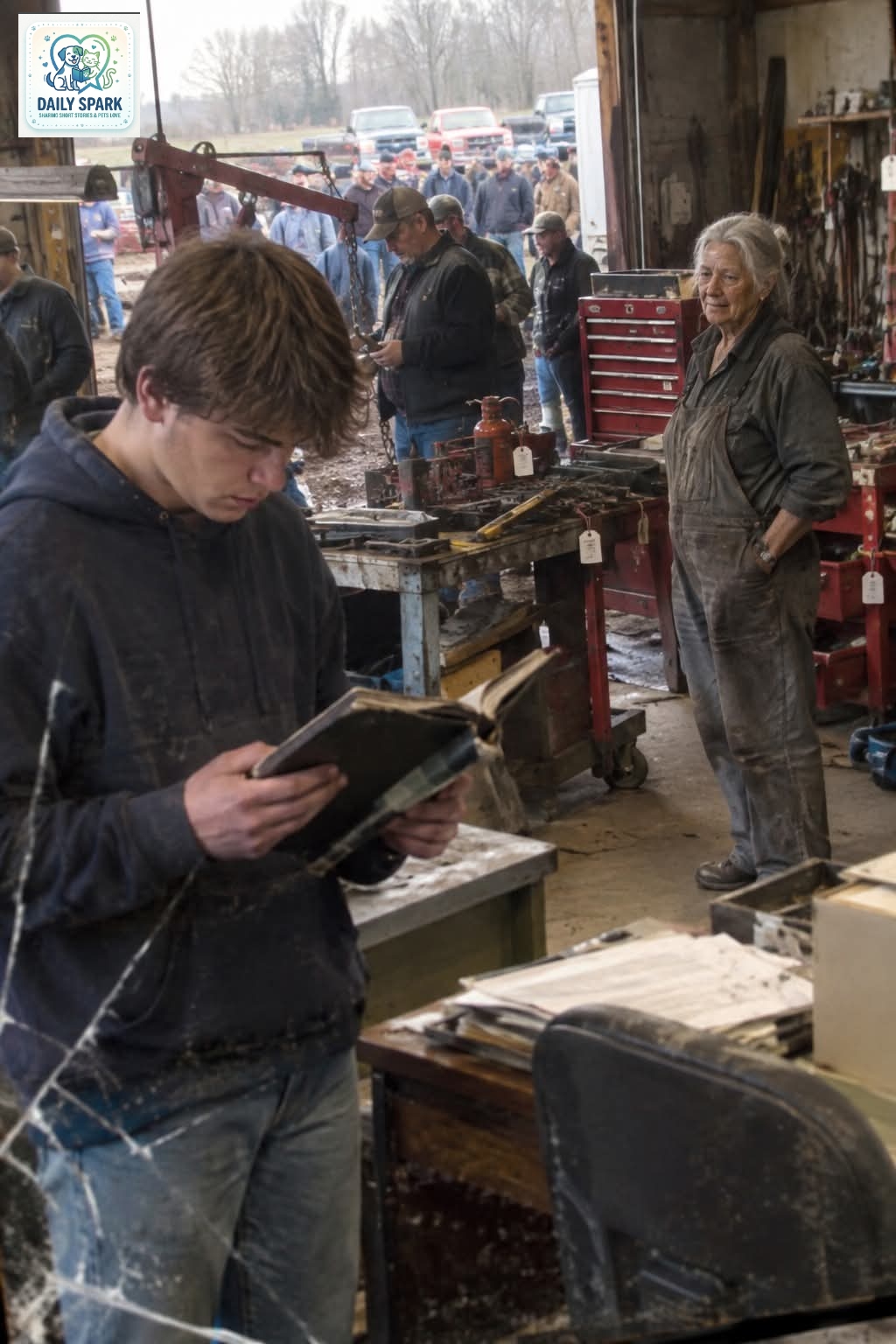
My grandmother stood beside her red toolbox while strangers placed price stickers on everything she had spent forty-six years earning. Five dollars for the dented oil can. Twenty dollars for the steel workbench. Two hundred for the engine hoist she had bought after repairing school buses all winter with a borrowed chain and a block of wood.
“Don’t look so miserable, Caleb,” she told me. “Tools are supposed to be used.”
I was sixteen, embarrassed by the rusted garage, the faded coveralls she refused to throw away, and the smell of diesel that followed her everywhere. I wanted her to retire like a normal grandmother. I wanted her to travel, buy clean clothes, and stop coming to my basketball games with grease beneath her fingernails. Instead, she was losing everything.
For nearly half a century, Evelyn Price had kept the school buses running in our small West Virginia town. She could identify an engine problem by listening through an open window. She knew which buses pulled to the left, which heaters needed coaxing on cold mornings, and which drivers kept peppermints in the glove box for nervous kindergarteners. People called her Miss Evelyn, even after her hair turned silver.
She had begun as a bus driver at twenty-four, when few women in town were trusted behind the wheel of anything larger than a station wagon. When the district mechanic quit one winter, she taught herself to replace belts, repair brakes, and rebuild engines because, as she put it, “Children cannot learn if they cannot get to school.”
Eventually, she opened her own garage beside the road leading out of town. The sign above the door read: PRICE BUS AND AUTO REPAIR — NO CHILD LEFT WAITING.
The trouble began when the county awarded its bus-maintenance contract to a large company three states away. The officials said the new arrangement would save money, using computers to track every repair. Grandma listened quietly at the meeting, then asked if the computer would know that Bus 18 needed warming before the first freeze, or that the driver of Bus 7 had a bad shoulder. When they brushed her off, she knew the garage was finished. Without the contract, there wasn’t enough work to cover the mortgage and debts. Six months later, the bank scheduled the auction.
On auction morning, pickup trucks lined both sides of the road. At noon, the auctioneer climbed onto a flatbed trailer. Grandma sat on an overturned bucket near the office, looking smaller than I had ever seen her. I had been livestreaming the auction on my phone, making a cynical joke into the camera about the garage she refused to modernize. She heard me, and only looked down at her hands.
That hurt worse than anything.
I walked into the empty office to escape. On the desk sat a black notebook held together with silver tape. I opened it—and the first page made me realize I had never understood what my grandmother had really been doing in that garage.
The page was not filled with tax records, invoices, or repair schedules. It was a ledger of IOUs, but not the kind that asked for money. In her steady, block-lettered handwriting, every page listed names of families, dates, and what she had truly charged them across forty-six years.
December 14, 1988 — Tom Miller (Brakes on Bus 4). Paid: One homemade apple pie delivered when the winter wheat came in.
March 3, 1994 — Sarah Jenkins (Transmission work). Paid: Promised to help her daughter pass eighth-grade algebra.
October 22, 2002 — David Vance (Alternator replacement). Paid: Nothing. Just needed the truck running so he could get to the hospital.
Below those entries, folded into the back cover, was a stack of cashier’s checks and personal letters, written by parents, town council members, and former apprentices who had tried to pay her back for groceries or medical bills she had secretly covered during hard winters, only for her to tuck the money away untouched because “friends don’t charge friends for keeping kids warm.”
I stared at the pages, the smell of diesel suddenly feeling less like poverty and more like a quiet kind of legacy.
When I stepped back outside into the sunlight, the auctioneer was calling for bids on the building itself. An out-of-town speculator threw out an opening price of twenty thousand dollars, and local mechanics raised their hands lazily.
I walked over to the flatbed trailer, held up the black notebook, and stepped in front of the microphone.
“Before you place your bids,” I said, my voice cracking before steadying out, “you need to know what’s inside this book.”
I began to read. I read about the winter she rebuilt the plow truck for the township for free so the side roads to the elementary school could be cleared. I read the names of the men standing in the crowd whose brakes she had fixed on credit when they had lost their farms. I read the total value of what she had quietly given away—not in dollars, but in decades of life.
The auctioneer lowered his microphone. The out-of-town speculator looked around, confused by the sudden stillness in the crowd. Around us, men who had raised their paddles high slowly lowered them to their sides, staring at their boots.
Nobody spoke for a long moment.
Then, old man Vance stepped forward, pulling a heavy canvas money bag from his belt loop and tossing it onto the flatbed.
“That’s twenty thousand for the deed,” Vance said, his voice gravelly. “And it stays in Miss Evelyn’s name. She’s just leasing it back to us for a dollar a year so she can keep the lights on.”
Another hand went up. Then another.
The auction was over before it could begin. That evening, the garage doors stayed wide open, filled not with the cold echo of an ending, but with the warm laughter of a town refusing to let go of the heart that kept it beating.

Leave a Reply