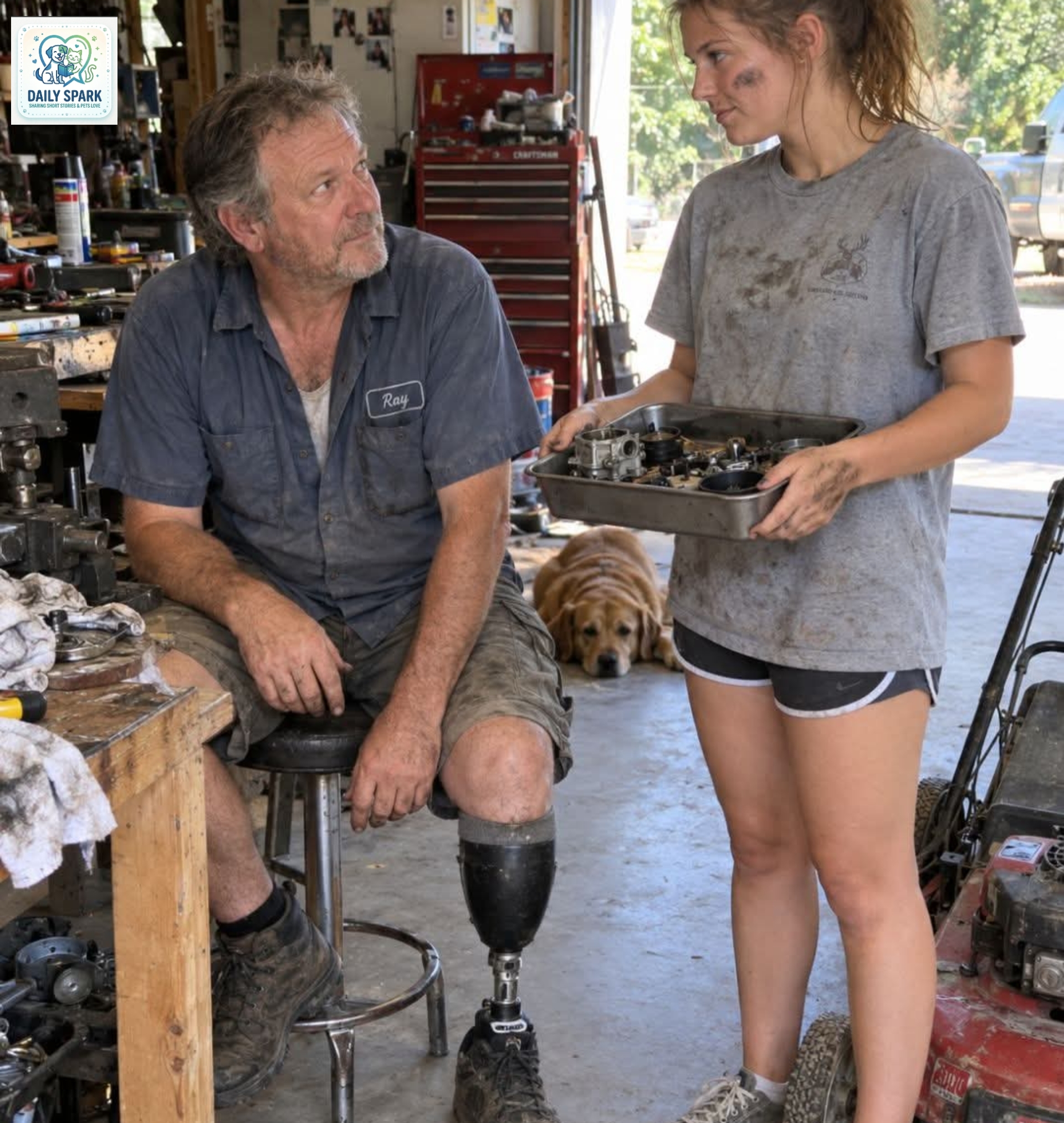
I told the neighbor girl I was finished fixing things. Then she brought me a broken lawn mower and refused to believe me.“You don’t have to stand up,” she said. “You can just tell me what I’m doing wrong.”Seventeen years old, standing in my garage doorway with a greasy carburetor in a baking pan. One shoelace untied. A streak of dirt across her cheek.I looked at the pieces, then at her.“From the looks of that pan, we could be here awhile.”“That’s okay,” she said. “I told my mom I’d be late.”My name is Deacon Webb. I’m fifty-eight, and for thirty-four years, people around our little Alabama town brought me things that wouldn’t run.Trucks that coughed. Tillers that quit halfway through a garden. Lawn mowers that had spent the winter outside because somebody kept meaning to put them away.Then an accident took part of my left leg, and I became the thing everybody kept meaning to check on.People were good to me. I need to say that.They built a handrail beside my steps.
Brought casseroles. Drove me to appointments. My brother cut my grass without asking, which was the only way I would’ve let him.But eventually, folks went back to their lives.I stayed home with mine.The garage sat thirty feet from my back door. I could get there fine once I learned my way around with the prosthetic leg, though some days were harder than others.Getting there wasn’t the trouble.Knowing what to do with myself once I arrived was.I covered my old engine bench with a faded canvas tarp. Underneath were the vise my father had given me, a little rebuilding stand, and sockets arranged in an order nobody understood but me.I told people I was taking a break.After eight months, they stopped asking when the break would end.Then Willa knocked.She lived two houses down with her mother and grandfather. I remembered her as a little kid riding a pink bicycle with one training wheel that never touched the ground.Now she was tall enough to look through the screen door without standing on her toes.“Granddad’s mower won’t start,” she said. “Mom says you used to fix those.”Used to
.Two harmless words. I found a way to resent them anyway.“Not anymore.”“Could you look at it?”“No, ma’am.”She glanced past me toward the garage.“You sell your tools?”“No.”“Then how come—”“Because I’m finished fixing things.”She stood there a second, chewing the inside of her cheek.Then she said, “Okay,” and left.I figured that was the end of it.Three days later, she came back with the baking pan.“I watched some videos,” she told me.“That explains the loose parts.”“They didn’t show what to do when this spring fell off.”“Did you take a picture before you pulled it apart?”She looked down into the pan.I sighed.She waited.Finally, I dragged a chair over beside the small folding table where I’d been stacking unopened mail.“Set it there.”Her face brightened so fast I had to look away.“I’m telling you what to do,” I said. “You’re doing it.”“That’s what I asked.”That first evening, she dropped the same screw three times.She called the carburetor “the little metal lung,” argued that a part shouldn’t have two names, and asked why I kept telling her to slow down when I’d also complained about how long she was taking.“You always this contrary?” I asked.“Mom says it’s why she has gray hair.”For the first time in a long while, I laughed without somebody trying to make me.She came back Thursday with the mower in a borrowed garden cart.It was an old red push mower, faded almost pink along the top.
A strip of electrical tape held the foam grip together.“That thing belongs in a museum,” I said.“Granddad says that about your truck.”“Your granddad owes me forty dollars from 2009.”“He said you might mention that.”We worked with the garage door open. A box fan rattled in the corner, and the evening smelled like warm pavement and somebody’s supper cooking.Willa turned the wrenches. I talked.
When my leg bothered me, I shifted in the chair. She noticed but didn’t announce it, didn’t ask whether we should quit, didn’t give me that worried look I’d come to dread.She just moved the parts tray closer.On the fourth evening, I asked why she was going to all this trouble.“Your mother could get somebody to cut the yard.”“She does.”“Then what do you need the mower for?”Willa wiped her hands on a rag before answering.“Granddad used to do everybody’s yard. Ours, the lady next door, that empty house when it was for sale.”I nodded.
I remembered.“His hands hurt now. He can still do some things, but every time he starts something, Mom says, ‘Let me get that.’ I say it, too.”She picked at a loose thread on the rag.“Last week, he told somebody on the phone he was just taking up room.”I looked toward my covered bench.“He doesn’t have to mow the whole yard,” she said. “I thought maybe he could do a strip. Or show me how he gets those straight lines.”“Has he asked you to fix it?”“No. He told me not to bother.”She smiled a little.“
I figured you two might get along.”That night, after she went home, I stayed in the garage.There was a small trail of dirt where she’d rolled the mower in. A socket sat on the floor beneath the table. She had written “TAKE PICTURE FIRST” on a piece of cardboard and propped it against the wall.For months, that garage had looked exactly the way I’d left it.Now there was evidence somebody expected to come back.The next afternoon, I went out before she arrived.I sorted the parts we still needed. Found a better light. Cleared a drawer for the tools she kept reaching for.When Willa walked in, she noticed all of it.
She had the good sense not to say much.“Am I late?”“Clock’s right there.”“You could’ve just said you missed me.”“Get your safety glasses.”It took us two more evenings.When that mower finally started, it sputtered, shook, and settled into a steady rumble.Willa threw both hands in the air.I hollered, “Well, look at that!”She was grinning at me, and I realized I was standing beside my chair. I’d gotten up without planning it, too interested in the engine to think about anything else.We shut it down, and she wheeled it home.About twenty minutes later, she returned with her grandfather.He ran one hand over the taped handle, then looked at me.
“Appreciate what you did, Deacon.”“She did the work.”Willa started to object.I shook my head.“She did,” I told him. “Every bit of it.”The old man looked at his granddaughter differently then. Like he’d been watching her grow taller and somehow missed the rest.“Guess you’ll have to help me keep it going,” he said.“I guess you’ll have to teach me those straight lines.”They took it home together, walking slowly enough for each other.Willa came back the next evening empty-handed.“What broke now?” I asked.
“Nothing.”“Then what are you doing here?”She leaned against the doorframe.“What should we tackle next?”I almost told her there wasn’t anything.The words were right there, worn smooth from use.Instead, I looked around the garage. There was an old tiller in the corner. My brother’s generator. Plenty of things I’d decided were somebody else’s problem.I took hold of the canvas tarp and pulled.Dust rose in the evening light. My father’s vise was right where I’d left it.“Bring a notebook tomorrow,” I said.Willa smiled.I still have difficult days. Some mornings, getting out to the garage takes longer than I’d like.But there are two chairs beside the bench now, and I’ve learned to leave the second one clear.Sometimes the kindest thing you can say to someone is, “I still need you.”And as the autumn air began to crisp the edges of the Alabama evenings, Willa and her
grandfather started dropping by on alternate Tuesdays, bringing not just broken carburetors or rusted blades, but old transistor radios, tangled fishing reels, and quiet company. We didn’t always talk about the old days or what had broken us; mostly, we just listened to the rhythmic scrape of sandpaper against metal, the sharp click of a wrench tightening a bolt, and the steady, comforting proof that things—and people—could always be put back together.

Leave a Reply