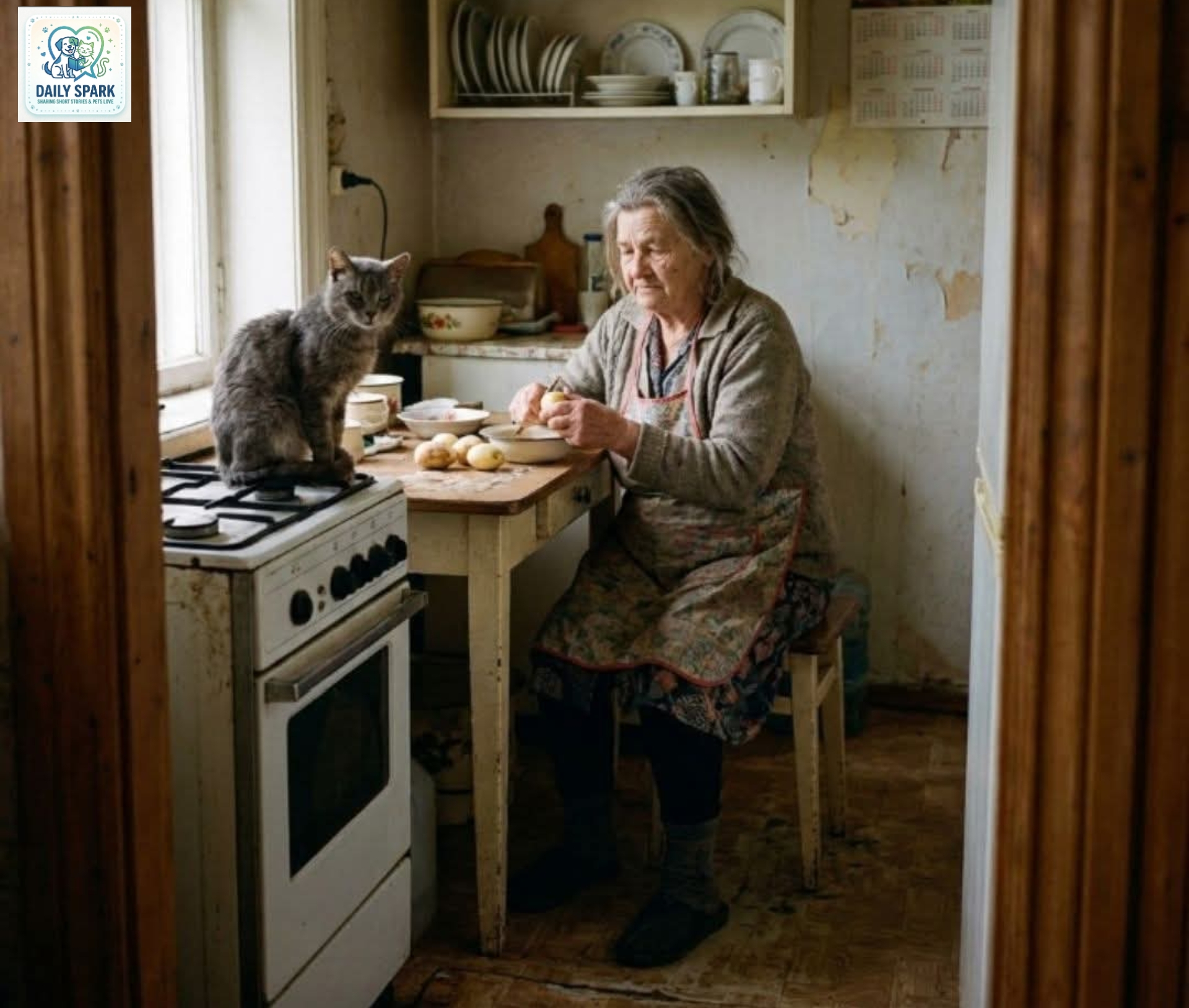
The first time I saw that stray cat sitting on my grandmother’s stove, I thought grief had finally broken something in our house.
My grandfather had been gone for four months.
In that time, my grandmother’s little kitchen had turned into the quietest place I knew. No radio. No humming. No small talk to fill the space. Just the sound of a spoon against a bowl, a cabinet closing, water running in the sink.
I started stopping by after work as often as I could, mostly because I was worried about her.
She always told me she was fine.
Older people say that a lot when they are absolutely not fine.
One Wednesday evening, I let myself in through the back door like I always did, and there he was.
A skinny gray cat with a torn ear sat right on top of the stove like he paid taxes there.
My grandmother was standing at the counter peeling potatoes, and that cat was watching her so closely you would’ve thought he was supervising the whole meal.
“What is that?” I asked.
She didn’t even turn around.
“That,” she said, “is the reason I don’t eat dinner alone anymore.”
The cat looked at me once, slow and unimpressed, then turned right back to her.
I laughed, but something about it unsettled me.
My grandmother had never been a cat person. Not once in my whole life had she shown the slightest interest in having one. She liked clean counters, closed doors, and routines. This cat was dirty, bold, and already acting like he owned the place.
But over the next two weeks, I saw the same thing every time I came by.
If she was in the kitchen, he was in the kitchen.
If she walked to the sink to rinse a plate, he jumped up onto the counter near the dish rack and watched her.
If she stirred soup, he sat by the stove.
If she made toast in the morning, he appeared out of nowhere and waited beside the butter dish.
He followed her from room to room, but the kitchen was his favorite.
That was the part that got to me.
My grandfather had loved that kitchen too.
Not because he cooked. He didn’t. But every night, without fail, he would sit at the table or lean against the counter and talk to her while she made dinner. He’d tell dumb jokes. Sneak bites. Dry dishes she didn’t need dried.
He was always there.
And now this cat was always there.
One night I came over later than usual, and the house smelled like beef stew.
I stopped in the doorway before she saw me.
My grandmother was at the stove, stirring slowly, and the cat was sitting beside her on the counter, his tail wrapped neatly around his paws. She looked tired, but softer somehow. Less frozen.
Then she said, very quietly, “You always did show up when supper was on.”
I felt my stomach drop. She wasn’t talking to me—and what happened next made me question everything I thought I understood about that cat.
The gray cat raised his head, let out a single, low trill, and bumped his forehead gently against her wrinkled hand. My grandfather had always done that—a quiet, habitual gesture whenever he walked up behind her at the stove.
I stepped into the light, my heart hammering against my ribs. “Grandma?”
She blinked, startled out of a trance, and quickly pulled her hand back, though the cat didn’t budge. She offered a faint, tired smile, trying to mask the vulnerability in her eyes. “Oh, you’re here. Good. There’s plenty of stew.”
”Who were you talking to?” I asked softly, pulling out a chair at the small wooden table.
She didn’t answer right away. She scooped a ladle of hot broth into a bowl, set it down, and then, to my utter shock, poured a tiny splash of milk into a chipped saucer on the floor. The cat hopped down from the counter with silent precision and began to drink.
”People talk to themselves when they get old, honey,” she said, but her voice lacked conviction.
”That cat isn’t just a stray, is he?”
My grandmother paused, her hands resting flat on the counter. She looked toward the small window above the sink, where the evening shadows were stretching across the backyard. For a long time, the kitchen was entirely silent except for the steady, rhythmic sound of the cat lapping up the milk.
”Your grandfather used to say he’d come back as something stubborn enough to keep me company,” she murmured, a bittersweet smile finally touching the corners of her mouth. “I told him he was a fool then. I suppose he still is.”
I looked from my grandmother’s softened face down to the gray cat, who had finished his milk and was now sitting upright, staring directly at me with sharp, knowing green eyes—the exact same color as my grandfather’s old hunting jacket.
I didn’t try to argue or rationalize it. As I sat down across from her and pulled my chair close, the heavy shadow that had haunted that kitchen for four long months finally began to lift. The house wasn’t empty anymore, and the ghost of a love like theirs wasn’t something to fear—it was just waiting for supper time.



Leave a Reply