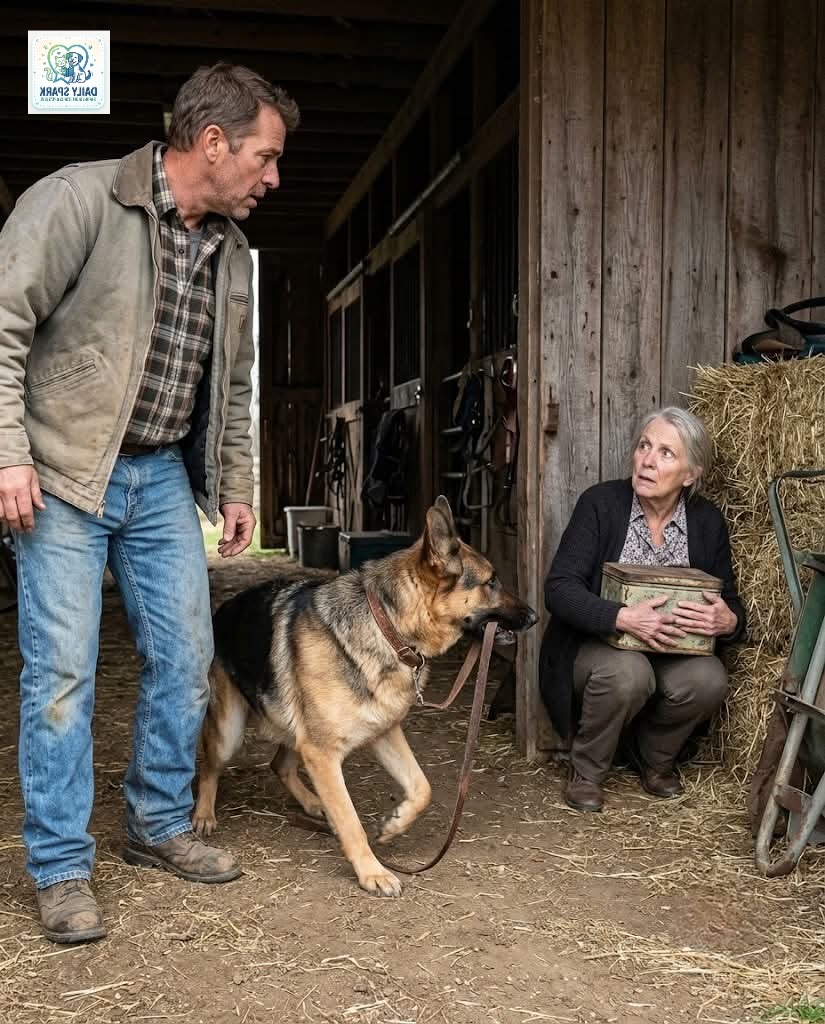
My German Shepherd Refused to Leave the Barn Until I Followed Him Inside—There I Found a 71-Year-Old Woman Hiding Bruises Beneath Her Sleeves and Clutching a Battered Tin Box. Three Weeks Later, a Gray Pickup Stopped at My Ranch Gate… and the Man Who Stepped Out Called Her “Mom.”
My dog found her before I understood she needs finding.
His name was Ranger, a seven-year-old German Shepherd who had spent enough years beside me to know when something wasn’t right. That November evening, he stopped outside the old barn on my ranch and refused to take another step.
Ranger didn’t freeze for rabbits. He didn’t hesitate around horses. And he never stared at an empty building without a reason.
So I followed him.
My name is Luke Bennett. I was forty-two then, a recently retired Marine gunnery sergeant trying to figure out what came after twenty-two years of following orders. I came home expecting fences, cattle, and silence.
Instead, I found Margaret Ellis.
She was standing beside the last stall, carrying a bucket nearly half her weight. Thin. Silver-haired. Wearing an oversized green cardigan and worn work boots. She had one suitcase. No car. No place to go. The ranch manager had found her at a bus station two weeks earlier. When he offered her money, she refused. She asked for work.
But Margaret acted like someone who believed she had to earn every meal. She cleaned things that were already clean. Carried feed nobody asked her to carry. Apologized when someone simply opened a door for her.
That night, I reached for the bucket.
“I can take that.”
She smiled politely. “I’ve got it.”
Her hands were shaking. When she lowered her arm, her sleeve slipped. I saw the bruises. Finger-shaped. Some newer. Some older. I had seen enough injuries to know the difference between falling and being held too hard.
Margaret noticed where I was looking and pulled her sleeve down. “My skin bruises easily.”
I didn’t argue. People tell the truth when they feel safe enough to survive telling it.
Ranger walked over and sat beside her boots. Margaret slowly placed one hand against his neck. Ranger closed his eyes. That mattered. He was polite with strangers. He wasn’t affectionate with them.
The next morning, she joined us for breakfast only after Walt practically insisted. She sat on the edge of the chair like she was ready to leave at any moment. Halfway through breakfast, I watched her slip part of a biscuit into her cardigan pocket. She caught me looking.
“I’m sorry.”
“For what?” I asked.
“I wasn’t thinking.”
That bothered me more than the biscuit. She thought saving food required an apology. Then the battered tin box she carried everywhere fell from her lap. The lid popped open. Photographs scattered across the kitchen floor. Letters. Newspaper clippings. Old handwritten recipe cards.
Margaret panicked. Before I could move, Ranger gently picked up an envelope and carried it back to her. Then another. Then a photograph. He returned every piece without tearing a single thing.
Margaret pressed an old recipe card against her chest. “My husband wrote this fifty-one years ago.”
I asked what it was. “Cinnamon apple bread.”
That was when I learned Margaret had once owned a bakery with her husband, Arthur. They woke before dawn, baked bread, and gave people a reason to smile before work. But there was a part of her story she still couldn’t say out loud.
Two days later, she nearly collapsed in the garden. The doctor found injuries that explained what Margaret couldn’t: old rib fractures, a badly healed wrist, and years of repeated trauma. That night, I called my friend Dana, who quietly looked into Margaret’s past.
The next week, Margaret slowly changed. She ate breakfast with us. Restored my mother’s neglected flower garden. Baked an apple pie from Arthur’s recipe. For a few days, the ranch finally felt peaceful.
Then Ranger heard the engine.
During dinner, his head lifted. He walked to the porch. A gray pickup sat beyond the gate with its lights off. Someone was watching us. After three minutes, the truck disappeared.
An hour later, Dana called. “That truck belongs to a man named Ethan Ellis.”
I looked through the kitchen window at Margaret laughing for the first time in years.
Dana lowered her voice. “Luke… he’s her son.”
Then she told me the rest. The house Margaret lost control of had been transferred into Ethan’s name. The signatures looked forced. Loans had been taken against the property. And now he knew exactly where Margaret was.
I looked outside again. Ranger was lying beneath Margaret’s chair. Then the sound of tires rolled back up the ranch road, and the gray pickup door began to open.
The heavy gravel crunched beneath the tires of the gray pickup as it rolled to a stop just outside the ranch fence, its high beams cutting a harsh line across the front yard. The engine died, but the headlights stayed on, blindingly bright, framing the silhouette of the man stepping out onto the dirt.
He was tall, broad-shouldered, and moved with a heavy, restless energy. Ethan.
Margaret stopped mid-sentence, the fork frozen halfway to her plate. The laughter that had filled our kitchen just moments before vanished, replaced by the unmistakable, hollow look of absolute terror. Her breath hitched, and she instinctively pulled her cardigan tighter around her wrists, as if the fabric could shield her from what was coming.
Ranger didn’t growl. He didn’t bare his teeth. He simply stood up, shook his thick coat, and walked with slow, deliberate purpose toward the front screen door.
I set my napkin down on the table, met Walt’s steady gaze, and stood up. Twenty-two years in the Marines had taught me one fundamental truth: when someone brings a fight to your doorstep, you don’t wait for them to kick the door in. You meet them on your terms.
”Stay inside, Margaret,” I said, keeping my voice level and calm.
“Luke, please,” she whispered, her voice trembling. “He… he just wants to talk. Don’t let him—”
“He’s not talking to you tonight,” I replied.
I pushed the screen door open and stepped out onto the porch. Ranger flanked me immediately, matching my pace, his shoulder brushing against my leg as we descended the wooden steps. Ethan slammed the truck door shut and marched up the driveway, stopping a few feet short of the cattle guard.
”I’m looking for my mother,” Ethan barked, his voice sharp and aggressive, masking an underlying panic. “An old woman wandered off from her family. I’m taking her home.”
“She isn’t wandering,” I said, stopping at the edge of the porch light. “And she’s not going anywhere with you.”
Ethan took another step forward, his jaw clenching. “Who the hell do you think you are? You’re harboring someone who belongs with her family. I have legal rights—”
“You have forged signatures and a trail of bruises,” I cut him off, my voice dropping into the quiet, flat tone I used when I was completely done negotiating. “Dana checked the records. The bank checks out. The county records check out. And the local sheriff has already been briefed on what happens if you take one more step onto this property.”
Ethan stopped dead. The arrogance drained from his face for a split second, replaced by sudden, ugly realization.
“She’s my mother,” he snarled, pointing a finger toward the house. “You don’t know anything about our family!”
Before Ethan could lunge forward, Ranger let out a low, chest-deep rumble—a sound that carried the weight of seventy pounds of muscle and absolute protection. He didn’t break stride, stopping right at the edge of the property line, locking eyes with Ethan. Ethan instinctively took a step back, his hand dropping toward his side.
“Try it,” I whispered, stepping down into the gravel. “Just try it.”
For a long, agonizing moment, the only sound was the wind rustling through the dry autumn grass. Ethan glared at me, his chest heaving with suppressed rage and cowardice. He knew the math. A retired Marine, a trained German Shepherd, and a sheriff who already knew his name meant he had lost.
”This isn’t over,” Ethan spat, turning sharply on his heel. He climbed back into the gray pickup, threw it into reverse with a violent grind of gears, and spun the tires in the gravel before speeding back down the dark ranch road.
I stood there until the tail-lights vanished into the night. Then, I turned and walked back up the porch steps. When I opened the door, Margaret was standing by the kitchen table, tears streaming silently down her weathered cheeks, clutching her battered tin box to her chest like a shield.
”He’s gone,” I told her softly.
Margaret let out a long, shuddering breath—the first real, unfiltered breath she had taken in years. Ranger walked over, sat quietly at her feet, and rested his head against her worn work boots. Margaret looked down at him, then up at me, a tiny, fragile smile breaking through the sorrow. For the first time since she arrived at the ranch, she didn’t look like she was ready to run.
She looked like she was finally home.




Leave a Reply