The Sanitation Worker Everyone Overlooked Opened One Trash Bag—And Changed How an Entire Town Took Care of Its Elderly
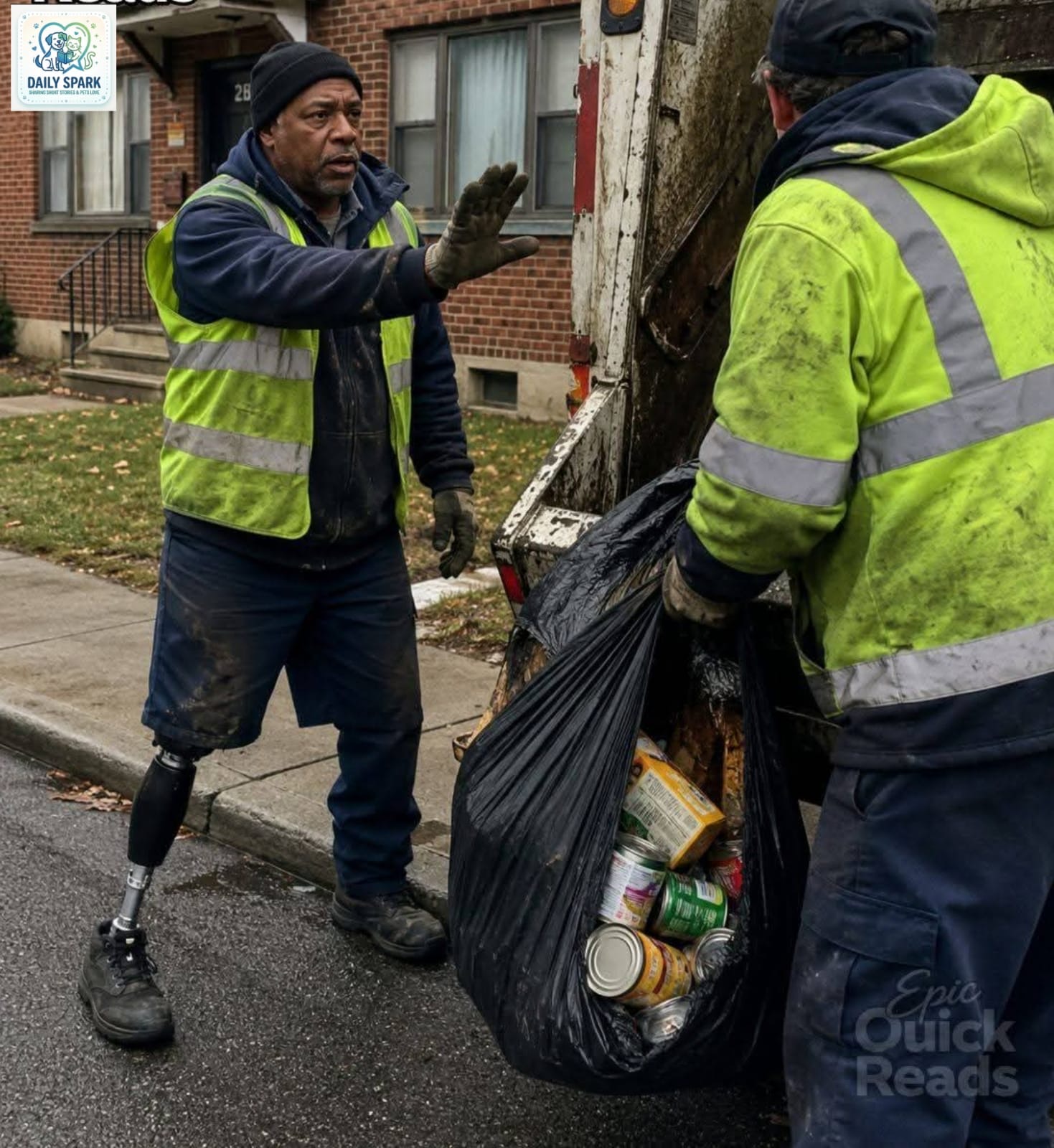
“Hold up,” Ramon said, raising one gloved hand. “Don’t toss that one yet.”
His coworker had already lifted the black trash bag toward the back of the sanitation truck.
It was Thursday morning in a small Michigan town, cold enough that Ramon could see his breath, and his prosthetic leg was already aching beneath his work pants.
“Why?” his coworker asked. “Same guy throws out food every week.”
That was exactly why Ramon had stopped him.
For nearly two months, Ramon Beck had noticed the same thing outside a faded brick apartment building on Maple Street.
Every Thursday, beside the regular household trash, sat one carefully tied bag that felt strangely heavy.
The first time it split open, Ramon saw canned soup, vegetables, beans, boxed pasta, and crackers inside.
None of it had been opened.
“Some people have too much,” one coworker joked.
“Must be nice to throw groceries away,” another said.
Ramon had laughed weakly the first time.
But the comment bothered him.
Maybe because Ramon knew what it felt like to have strangers look at one piece of your life and decide they understood the whole story.
Three years earlier, Ramon had gone into work at a manufacturing plant with two healthy legs.
He came home months later learning how to walk with one.
An industrial accident had taken part of his left leg below the knee.
For a while, people looked at him differently.
Some stared.
Some spoke too loudly, as if losing a leg had damaged his hearing.
Others told him how “brave” he was while quietly assuming he could no longer do much of anything.
The hardest part wasn’t the pain.
It was being reduced to what people could see.
Ramon eventually took a job with the town sanitation department.
The work was physical, dirty, and honest.
He liked that.
He learned how to climb in and out of the truck without thinking about it.
He learned which houses had dogs that barked behind fences, which porches smelled like Sunday bacon, and which elderly residents needed an extra second before bringing their cans back from the curb.
And he learned that trash told stories people rarely meant to tell.
Baby formula.
Moving boxes.
Empty medicine bottles.
Birthday decorations.
Sometimes a whole household changed in one week.
So when Ramon kept seeing unopened food in that same trash bag every Thursday, something didn’t feel right.
That morning, instead of making another joke, he walked toward the apartment building.
His coworker called after him.
“You gonna ask the guy why he wastes free food?”
Ramon stopped.
“No,” he said. “I’m gonna ask if he’s okay.”
He knocked on apartment 2B.
After a minute, an elderly man opened the door.
He was thin, maybe in his late seventies, wearing a button-up shirt tucked neatly into old gray slacks.
“Morning,” Ramon said. “Sir, I’m Ramon. I work the route out front.”
The man looked worried.
“Did I do something wrong?”
“No, sir.”
Ramon hesitated.
“This might be none of my business, but I’ve noticed unopened food in your trash. I just wanted to make sure everything was all right.”
The old man’s face changed immediately.
Not anger.
Embarrassment.
He looked down at the floor.
“I suppose you think I’m wasteful.”
Ramon shook his head.
“I don’t know what to think. That’s why I asked.”
The man introduced himself as Walter.
Then he stepped aside and invited Ramon into a tiny kitchen.
On the counter sat a cardboard box filled with canned soup, canned meat, instant noodles, crackers, and vegetables.
Walter rested one hand on the box.
“A community pantry sends this every Thursday,” he explained. “Good people. Very good people.”
He swallowed.
“My kidneys aren’t doing well. My doctor told me I have to be careful with sodium. Most of this…” He tapped one of the cans. “I’m not supposed to eat.”
Ramon looked at him.
“Then why don’t you tell them?”
Walter gave a sad little smile.
“Because somebody is trying to help me.”
He looked toward the window.
“I grew up believing when somebody gives you something, you say thank you. You don’t complain.”
“So you throw it away?”
Walter nodded.
“I tried giving it to neighbors. Most don’t need it. I don’t drive anymore. And I was ashamed to call the pantry and say their food wasn’t good enough for me.”
His voice became quieter.
“I know that sounds foolish.”
Ramon thought about all the people who had assumed things about him after his accident.
He thought about how easy it had been for his own crew to call Walter wasteful.
Then he said, “Doesn’t sound foolish. Sounds like you didn’t want to hurt anybody’s feelings.”
Walter’s eyes watered.
“That’s about the size of it.”
Ramon went back outside and opened the black bag.
Every can was still sealed.
That afternoon, instead of letting the food go to the landfill, Ramon asked his supervisor whether unopened items could be redirected.
With permission, he brought them to another small pantry across town.
The following Thursday, he did it again.
And again.
Walter stopped hiding the bags inside black plastic.
He simply set a box beside his trash can labeled:
UNOPENED — PLEASE GIVE TO SOMEONE WHO CAN USE IT. THANK YOU.
Ramon thought that might be the end of the story.
It wasn’t.
About a month later, a volunteer from the original pantry happened to see Ramon unloading one of Walter’s boxes at the second pantry.
She recognized the labels.
“Where did those come from?” she asked.
Ramon told her.
Not angrily.
Not accusing anyone.
He simply explained that Walter was grateful for the food but couldn’t safely eat much of it.
The volunteer stood there silently.
Then she said something Ramon never forgot.
“How many other people are doing the same thing?”
That question traveled back to the pantry.
Within weeks, volunteers began calling elderly recipients instead of assuming one food box worked for everyone.
They asked about dietary restrictions.
Could they chew harder foods?
Did they have a stove?
Did they have diabetes?
Were they limiting sodium?
Did they have trouble opening cans?
Some people cried on the phone because nobody had ever asked.
The pantry started placing small colored cards on boxes so volunteers could prepare different versions.
Low-sodium.
Soft foods.
No-sugar-added.
Easy-open containers.
No one called it revolutionary.
It was just common sense mixed with compassion.
Then one Thursday, Ramon knocked on Walter’s door again.
Walter was standing in the kitchen beside a new cardboard box.
Inside were low-sodium vegetables, rice, oatmeal, fruit packed in juice, unsalted crackers, and other foods he could actually use.
Walter picked up a handwritten note from the top.
It said:
Mr. Walter, thank you for helping us learn how to serve people better.
He read it twice.
Then he sat down at the kitchen table.
Ramon thought something was wrong.
Instead, Walter covered his face with both hands.
“I spent all this time trying not to be ungrateful,” he whispered.
Ramon sat across from him.
Walter looked up with tears in his eyes.
“And all I had to do was tell somebody the truth.”
Ramon smiled.
“Sometimes people have to ask first.”
Months passed.
The new food-box system stayed.
Other pantries nearby heard about it and began asking better questions too.
Ramon never received an award.
His picture never appeared in the newspaper.
Most people in town never knew his name.
He simply kept climbing off the sanitation truck every Thursday, his prosthetic foot hitting the pavement with the same steady sound.
But the jokes about Walter stopped.
So did the unopened cans in his garbage.
And something changed in Ramon’s crew.
Whenever something looked strange on their route, somebody would eventually say:
“Maybe there’s a reason.”
That was Ramon’s favorite part.
Because he had learned years earlier that a person’s visible struggle was rarely the whole story.
The man throwing away food wasn’t ungrateful.
The sanitation worker with the prosthetic wasn’t helpless.
And the simplest act of kindness wasn’t hauling a box across town.
It was refusing to judge a person before understanding why they were carrying it.
Sometimes changing someone’s life begins with four words: “Can I ask why?”
A Beautiful Ending
Years rolled by, turning the maples on Maple Street from gold to green and back again, but the change that single Thursday morning brought to the town never faded.
Neighbor started looking out for neighbor with a gentler eye. The local outreach programs expanded their care, ensuring no senior citizen ever felt invisible behind closed doors.
Walter lived to see his eightieth birthday, surrounded by friends who finally understood his heart. Every week, the box waiting at his door was tailored precisely to his needs, carrying notes of genuine gratitude from the people he had accidentally helped teach.
And every Thursday morning, as the heavy rumble of the sanitation truck echoed down the street, Walter would stand quietly by his window. Ramon would step down from the cab, his prosthetic foot making its familiar, steady rhythm against the pavement, and look up. Walter would lift a hand in a gentle wave, and Ramon would wave back—a silent, powerful reminder between two souls that true human connection doesn’t come from what we see on the surface, but from the willingness to listen, to care, and to ask before we judge.




Leave a Reply