“I never agreed to give her my baby”—then the lawyer discovered page two was missing.
Three weeks after giving birth, Erin walked into a family lawyer’s office carrying an empty infant car seat.
Her newborn son was living with her younger sister.
Her mother had provided the hospital with a signed guardianship document. A nurse had approved the baby’s discharge, and a judge had issued a temporary order after being told Erin was not ready to care for him safely.
Every official record appeared to support the family’s version of events.
Even Erin’s signature was real.
But Erin insisted she had agreed only to emergency help if she became seriously incapacitated—not to surrender custody of her child.
Her lawyer initially believed the case would depend on proving that someone had forged the document.
Then she counted the pages.
Page one.
Page three.
Page four.
The missing page contained the condition that could change the entire case—and raised a painful question:
Had Erin’s mother misunderstood an emergency plan, or had she deliberately rewritten one daughter’s future to protect the other?
A fictional legal drama about family loyalty, hidden evidence, and the difference between helping someone and taking away their right to choose.
The fluorescent lights of Katherine Vance’s office hummed softly as the attorney slid the incomplete court file back across the mahogany desk. The absence of that single sheet of paper wasn’t just a clerical error; it was a carefully constructed trap. With the missing terms removed, a temporary medical proxy had magically transformed into a permanent surrender of rights.
”We need that second page, Erin,” Katherine said firmly, her professional instincts kicking into overdrive. “If your mother or anyone in her household destroyed or hid it, they’ve crossed the line from family dispute into criminal fraud.”
Erin clutched the handle of her empty car seat tighter, her knuckles whitening. “She kept saying she was just trying to protect my future, that I couldn’t handle the pressure of being a single mother after everything. But she didn’t protect me. She stole my child.”
Without wasting another second, Katherine drafted an emergency motion for production of documents and a subpoena for the original hospital intake logs. By sunrise the next morning, they weren’t just fighting an uphill legal battle; they were armed with a court order that gave Helen nowhere to hide.
When Katherine, Erin, and two local sheriff’s deputies arrived at Helen’s suburban home later that afternoon, the confrontation was swift. Helen tried to block the doorway, her voice trembling with righteous indignation as she claimed they were only doing what was best for the baby. But when the lead deputy stepped past her and served the subpoena—noting that withholding court-mandated disclosures carried immediate arrest warrants—the formidable matriarch finally crumbled.
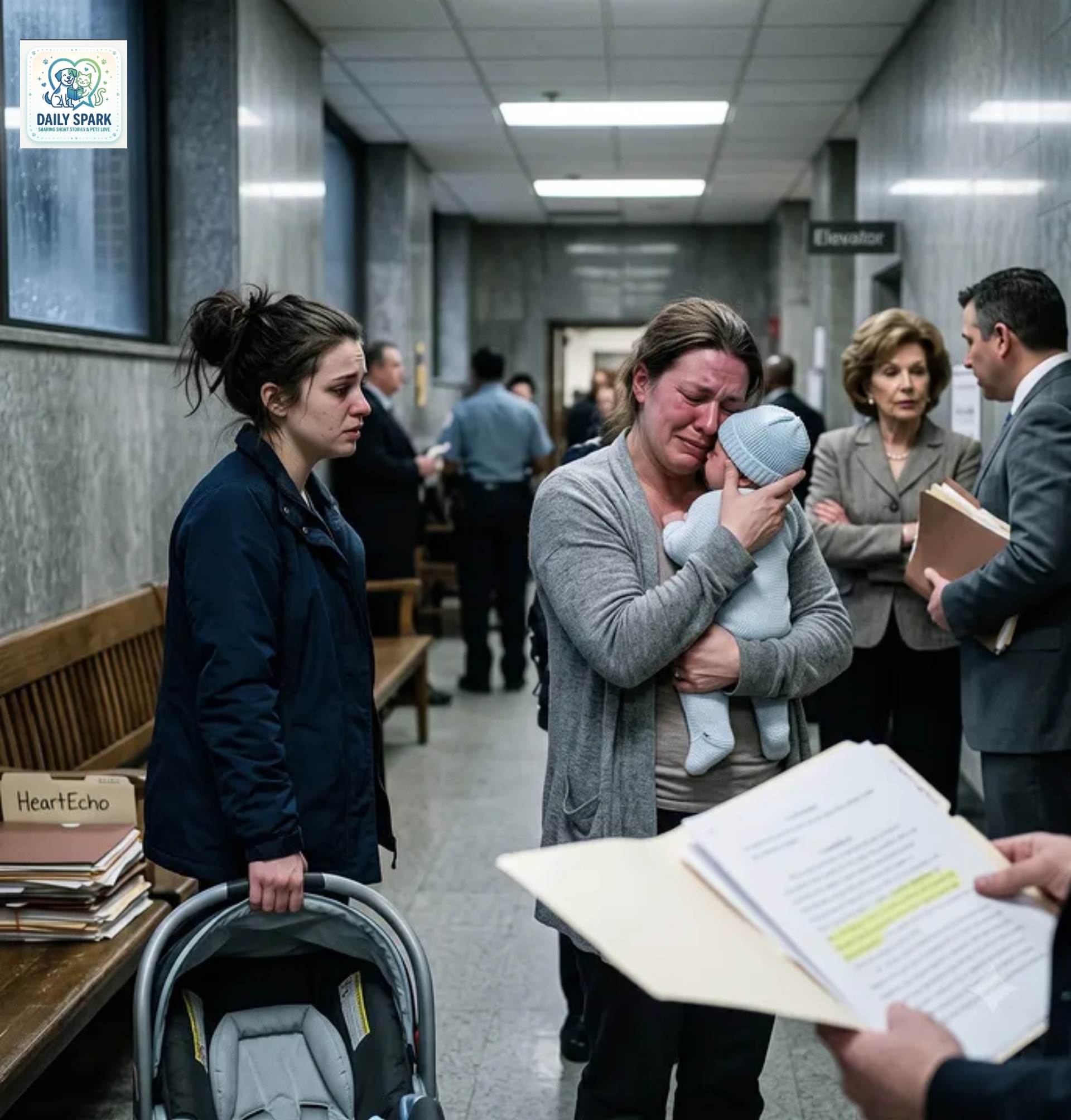
From the hallway, Chloe emerged, her eyes red and swollen. In her arms was the quiet bundle wrapped in blue cotton. She didn’t look at her mother. Instead, she walked straight to Erin, tears streaming down her face as she extended the baby.
”I’m sorry, Erin,” Chloe choked out, her voice breaking. “Mom told me you signed away your rights permanently. She said you wanted me to have him. But… I couldn’t keep living a lie. The original paper is in the study desk drawer. I kept it safe because I knew it wasn’t right.”
Two days later, the emergency injunction hearing took place in Judge Alvarez’s private chambers. The crumpled, original page two—recovered from the desk drawer just as Chloe had promised—sat on the judge’s desk alongside the falsified court packet. The page clearly outlined that the agreement was strictly a seventy-two-hour medical monitoring proxy, entirely voidable upon demand.
Judge Alvarez read through the documents, his face darkening with each passing second. When he looked up at Helen and her panic-stricken defense attorney, his gaze was colder than winter ice.
”Mrs. Harris,” Judge Alvarez said, his voice ringing with quiet authority, “using family vulnerability to manipulate court records is a profound abuse of the justice system. Falsifying legal instruments to bypass a mother’s consent is not protection; it is kidnapping under the color of law.”
With a swift, decisive motion, the judge signed the dismissal of the fraudulent guardianship petition, restoring full physical and legal custody of the newborn to Erin with immediate effect.
Furthermore, he ordered all court costs to be covered by Helen and referred the document tampering case to the district attorney’s office for formal investigation.
As Erin walked out of the courthouse into the warm afternoon sunlight, the empty car seat was finally gone, replaced by the warm, breathing weight of her son resting safely against her chest. The law had nearly failed her, but truth, once uncovered, had proven sharper than any deception. The road ahead would require time to heal the deep fractures left by family betrayal, but as she kissed her baby’s forehead, Erin knew she was finally home.


Leave a Reply