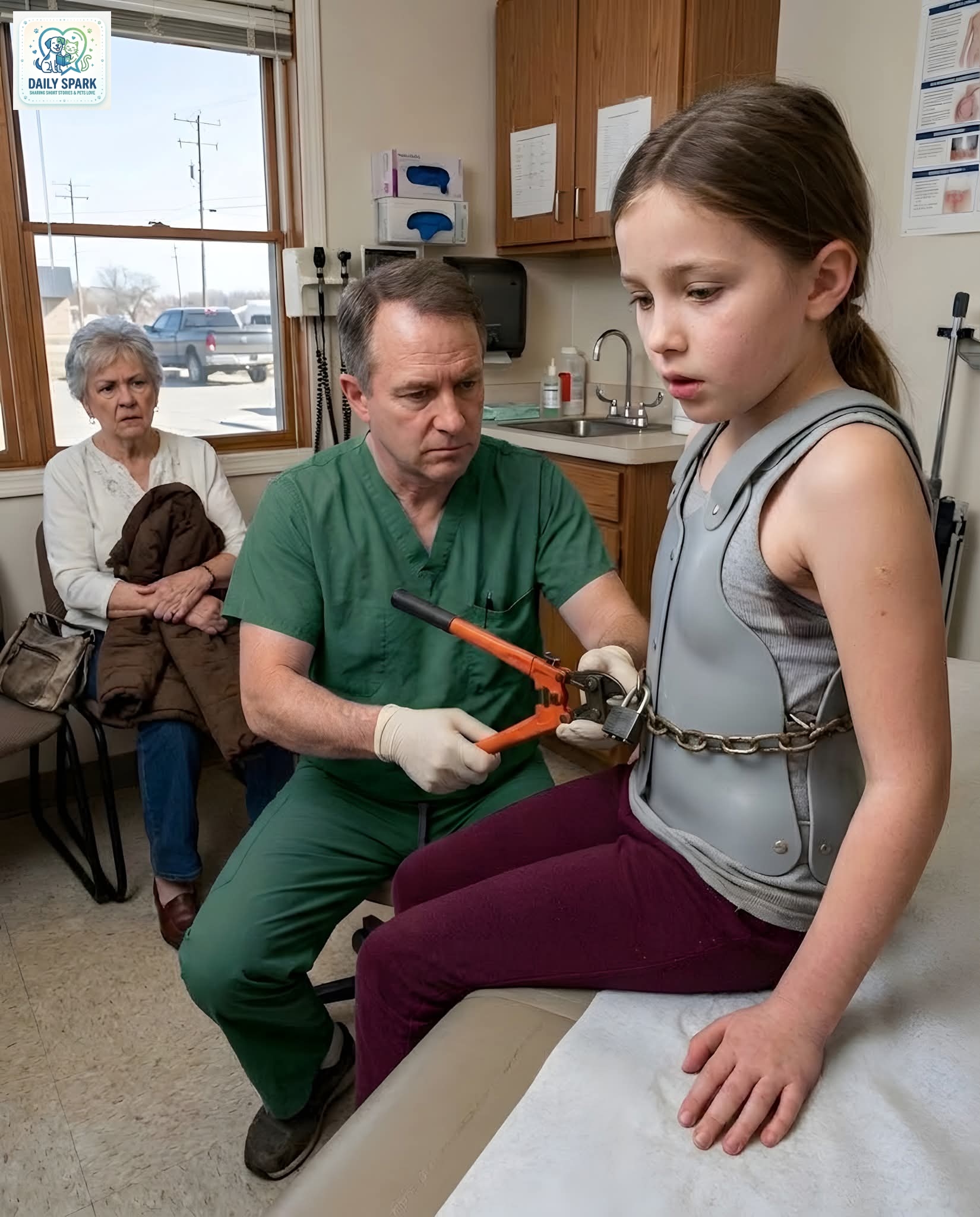
I was ten when Grandma carried me into a rural clinic with my brace secured by a tiny padlock.
“Disobedient children stay where they’re placed,” she said, refusing to provide the key.
When the surgeon cut it away and the hidden chain hit the floor, I asked whether I finally had permission to breathe.
The clinic smelled like bleach and burnt coffee, and I hadn’t eaten breakfast because Grandma said children who complained before appointments didn’t need food making them sick.
My ribs hurt where the brace had rubbed them.
I stayed still.
The surgeon, Dr. Mercer, crouched beside the cut plastic and lifted one end of the chain without touching my skin.
Behind him, a fly kept tapping against the screen in the open window.
Grandma folded my coat across her lap.
“She takes it off,” she said. “I hate having to be strict, but she doesn’t understand what’s good for her.”
Dr. Mercer looked at me.
“Do you take it off?”
I shook my head.
Grandma smoothed my hair behind my ear as if we were getting a school picture taken.
“She gets embarrassed,” she told him. “You know how girls are.”
Before he could ask another question, I pointed to the dark mark below my left arm where the chain had pressed through my undershirt.
His hand stopped.
For months, Grandma had called the brace my seat belt.
She said I wandered.
The wandering had happened once: sometime after supper, I had walked down our gravel driveway to the mailbox because I could see the red flag was still up.
Grandma found me before I reached it.
After that, she told Dad I couldn’t be trusted near the road, and I never corrected the story when he came home tired.
That part was mine.
Earlier that week, the school nurse had asked whether the brace hurt.
I told her no.
Grandma had been standing behind me with one hand on my shoulder, but I still said it.
The nurse wrote something down, and I went back to class.
Now Dr. Mercer asked Grandma how long she had been locking the brace.
“Locking is an ugly word,” she said. “I’m keeping her safe.”
He asked again.
Grandma reached into her purse, took out a tissue, folded it twice, and placed it back without using it.
“A little while.”
Dr. Mercer told the receptionist to call my father.
Grandma’s fingers tightened around my coat.
“That isn’t necessary.”
“It is now.”
She gave me half a package of crackers from her purse while we waited.
I ate all four even though my mouth was dry.
For the next however-many minutes, Grandma talked about ordinary things—the laundry, Dad’s work schedule, whether rain would ruin the tomatoes—as if the chain were not lying in two pieces on the examination table.
Then she leaned toward me.
“You’re making your father leave work for this.”
I looked at the floor.
One of my socks had twisted under my heel, and I tried to fix it without bending enough to hurt.
When Dad finally came through the clinic door, there was pale sawdust caught in the cuff of his work shirt and one bootlace was longer than the other.
Grandma stood first.
“She worked herself up again.”
Dad looked at me, then at the brace.
“Did she run?”
I knew that question.
Grandma answered for me.
“She’s been difficult all morning.”
Dr. Mercer picked up the cut chain.
Dad blinked.
“What is that?”
Grandma’s voice softened.
“The only thing that keeps her from hurting herself.”
Dad rubbed both hands over his face.
I expected him to apologize to her.
Instead, he asked me where the key was.
“Grandma has it.”
Grandma gave a small laugh.
“She loses things.”
“I’ve never had it,” I said.
Dad looked at her.
For the first time that morning, Grandma did not touch me.
Dr. Mercer asked Dad whether he had known the brace was being secured with a padlock.
Dad said he knew it was supposed to stay on.
Then Dr. Mercer asked who had told him the lock itself was medical.
Dad turned to Grandma.
“Mom, you told me this lock came from the clinic.”
Grandma didn’t blink. She stood a little taller, smoothing the front of her cardigan with hands that didn’t tremble.
“And I told the truth,” she said, her voice hard and flat against the antiseptic smell of the room. “The brace is medical equipment, Arthur. You wanted her safe while you were out providing for this family. If I hadn’t secured it, she would have wandered into traffic by now. You know how her head works.”
Dad didn’t answer. He looked at the heavy plastic brace, then at the bright steel padlock sitting on the metal tray beside Dr. Mercer’s scissors. The silence in the examination room stretched so tight I could hear the rhythmic buzzing of that single fly against the window screen.
Dr. Mercer set the pieces of the chain down with a soft metallic click.
“Mr. Miller,” Dr. Mercer said quietly, “this isn’t a medical device modification. This is a logging chain and a standard utility lock. It was restricting her circulation, and the bruising on her ribs is deep enough to indicate long-term compression.”
Dad turned his gaze back to me. His eyes looked tired, carrying the weight of early shifts, unpaid bills, and a grief for my mother that he never quite knew how to name. He looked at the dark mark beneath my left arm—the jagged indigo shape where the chain had dug through my shirt every single night for months.
“Did it hurt?” Dad asked. His voice was barely a whisper.
I nodded once.
Grandma stepped forward, her face tightening with anger. “Don’t you dare look at her like that, Arthur. She’s ungrateful. She’s just like her mother—always running off, always looking for a way out.”
“Stop it, Mom,” Dad said.
It wasn’t loud. It wasn’t the roar I had imagined when I lay awake in the dark listening to them talk in the kitchen. But the absolute finality in his tone made Grandma step back, her mouth parting in shock.
“You’re taking her side over your own mother?” she hissed.
“I’m taking my daughter home,” Dad replied. He walked over to the exam table, knelt down beside me, and gently pulled the twisted sock straight under my heel. His rough, sawdust-dusted thumb brushed against my ankle. “Are you ready to go?”
I looked past him at Grandma. She was standing by the door now, clutching her purse so tightly her knuckles looked white, her face twisted in a look of bitter betrayal that she would carry back to the empty house on the gravel road.
“Can we stop for a milkshake?” I asked softly.
Dad gave a slow, shaky nod, a faint ghost of a smile touching the corners of his mouth. “Yeah, kiddo. We can stop for a milkshake.”
As Dad helped me slide off the high examination table, for the first time in ten years, I stood completely upright without metal cutting into my ribs or a chain holding me in place. The air filled my lungs easily, and as we walked out past Dr. Mercer and out the clinic doors into the warm Kansas sun, I finally understood what it meant to breathe.
That afternoon marked the beginning of a quiet revolution inside our house. Grandma packed her bags by nightfall and left for her sister’s place, refusing to speak to either of us. Dad and I spent the weekend clearing out the dark, locked routines of the past, replacing the heavy rules with quiet conversations across the kitchen table.
It took months for the physical bruises to fade from my ribs, and even longer for the phantom weight of the chain to leave my shoulders. But as the seasons shifted and the gravel road outside our window filled with the bright green of spring, Dad and I learned how to heal together. He started taking Sundays off, and we would sit on the porch drinking sweet tea, watching the red flag on the mailbox rise and fall in the breeze without fear.

Leave a Reply