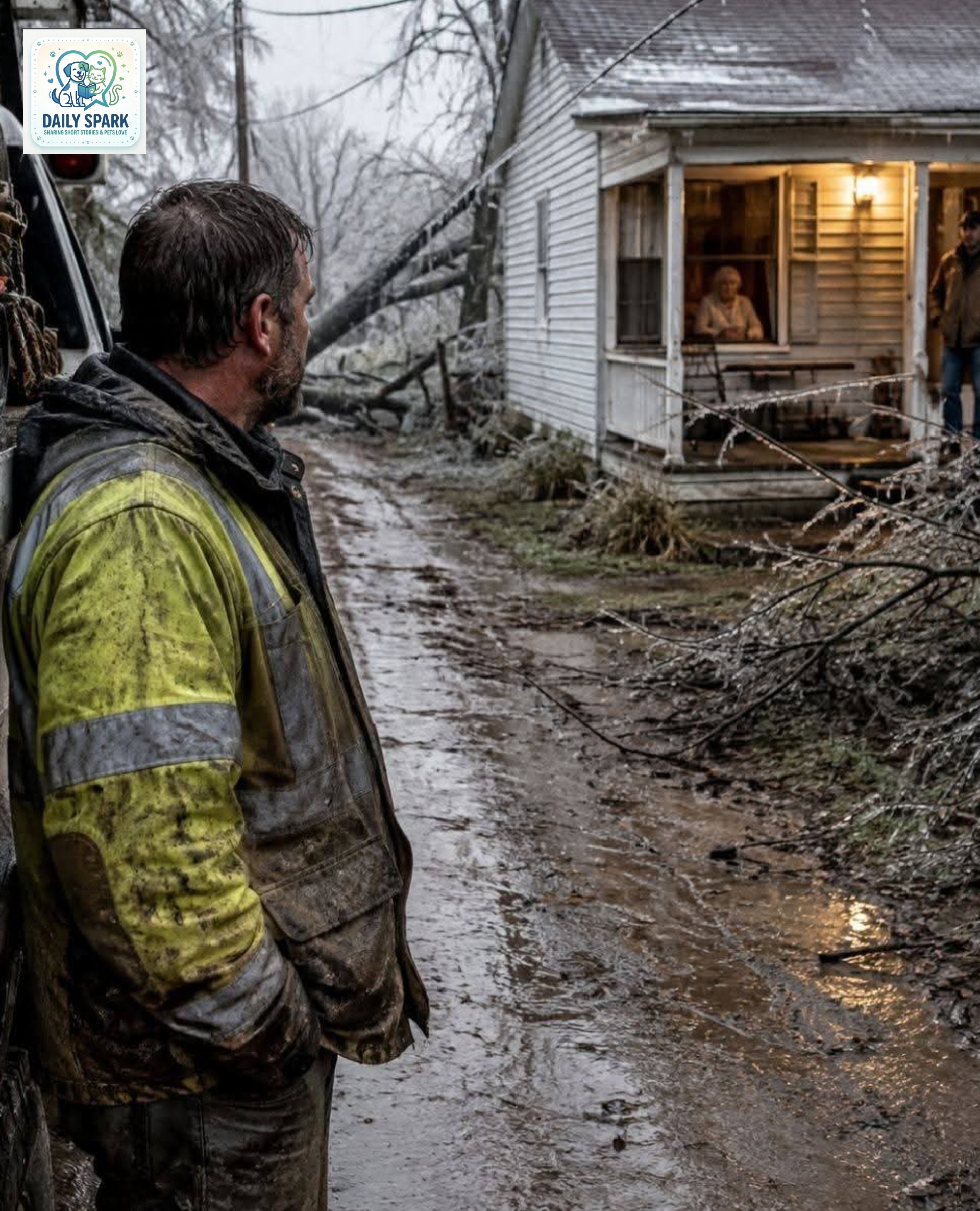
For years, that porch light was the final landmark on Derek Hanley’s mental map before he could finally call it a night.
“Derek, that porch light is still out,” the dispatcher’s voice would crackle through the radio while freezing rain hammered the thick glass of his utility truck windshield.
Derek always knew which house she meant without looking at a map or checking a ticket. A small white farmhouse sitting back from a narrow county road, framed by a rusted mailbox and two weathered rocking chairs resting peacefully under a sagging wooden awning. Inside that house lived an eighty-four-year-old woman named Mabel Carter, and she was almost certainly sitting beside her living room wall, waiting patiently for the electricity to return so the medical machine humming beside her favorite armchair could keep doing its vital job.
“I’m headed there,” Derek would reply into the mic, shifting the heavy truck into gear.
His supervisor’s voice would immediately cut back through the static, tight with exhaustion and safety protocol. “Hanley, you’ve been working fourteen straight hours in this freezing muck.”
“I know.”
“You need to come back to the yard. That’s an order.”
“I’ll come in after I check one house. Just one.”
There would be a long, heavy silence over the radio waves, punctuated only by the rhythmic slap of the windshield wipers fighting the sleet. Then the supervisor would sigh, defeated by a stubbornness he had learned long ago he couldn’t break. “Ten minutes, Derek. Not a minute more.”
Derek had been making and keeping that exact promise for nearly four years. Ten minutes. One house. One porch light. Then, and only then, would he drive back to the depot, park his truck, and head home to a warm bed.
Derek Hanley was forty-five years old back then, and he had spent the better part of his adult life stringing cables, replacing blown transformers, and wrestling with stubborn utility poles across the sprawling, unpredictable hills of rural Arkansas. Most people who sat safely inside their homes during a major winter storm only thought about electricity in terms of basic convenience. They thought about keeping their food from spoiling in the refrigerator, keeping their living rooms warm through the night, or keeping the television tuned to the local weather channel to track the storm’s path.
But when you spend enough decades working the lines, you realize electricity means something entirely different behind every single front door. In one house, it means comfort and a hot cup of coffee. In another, it means light for children doing homework. And in Mabel Carter’s house, it literally meant breathing.
Derek first met Mabel years earlier during a violent summer thunderstorm that had torn through the county like a freight train. A massive oak branch had snapped under the weight of wet foliage, crashing straight across the high-voltage lines serving six isolated homes along the ridge. When Derek and his bucket truck finally hacked their way down the overgrown road, Mabel’s grandson, Caleb—then a lanky teenager with mud splattered up to his knees—was standing right beside the mailbox, waving both arms frantically in the pouring rain.
“My grandma has a breathing machine inside!” Caleb had shouted over the roar of thunder, his face pale with panic. “She has a backup battery unit, but nobody knows how long this outage is going to last, and the charge is dropping fast!”
Derek and his crew didn’t waste a single second. Working with practiced, high-tension precision in the driving downpour, they cleared the splintered limbs, spliced the severed lines, and re-energized that specific section of the grid in record time.
When the transformer finally hummed back to life and the overhead wires stopped vibrating, Caleb shook Derek’s hand with a grip so fierce it made his knuckles ache. An hour later, as the crew packed up their gear, Mabel herself walked slowly out onto the front porch, wrapped neatly in a faded blue flannel robe despite the humid summer air.
“You boys just saved me from a truly miserable night,” she said, her voice steady and warm.
Derek had smiled, kicking a piece of fallen bark away from his boot, and told her they were simply doing their everyday job.
Mabel had paused, stepping closer to the edge of the porch, and looked him straight in the eye with a gaze that felt entirely too piercing for a casual roadside chat. “Young man, sometimes doing your job is a much bigger thing than you ever realize.”
Derek carried those words with him for years, turning them over in his mind like a smooth river stone. Maybe because, deep down inside, he desperately needed to hear them.
Only two years prior to meeting Mabel, Derek had lived through the darkest chapter of his working life. He had been out on a brutal midnight ice call alongside his closest friend and partner of eleven years, a man named Travis. Travis was the kind of steady, salt-of-the-earth guy who always kept peppermint candies tucked away in his front shirt pocket for local kids and never missed calling his wife right at 4:30 in the afternoon, no matter how chaotic a job site got.
During one chaotic midnight repair in blinding sleet, a sudden equipment failure and a snapping guy-wire turned the pole into a trap. Travis never came home to those phone calls. Derek did.
The physical scars faded over the months, but the internal storm never truly let up. After Travis died, bad weather completely changed its shape and meaning for Derek. A sudden crack of thunder could jerk him awake from a dead sleep with his heart pounding against his ribs. The sound of high wind battering the bedroom windowpane would cause a tight, suffocating band of pressure to clamp across his chest before he even opened his eyes in the dark. On particularly bad nights, when the rain lashed hard against the glass at 2 a.m., Derek would quietly slip out of bed, get fully dressed in his heavy work jeans and boots, and sit alone at the kitchen table in the dark, listening to the tempest and agonizing over memories he had no idea how to outrun.
His wife, Amy, knew what was happening without needing explanations. His kids sensed it too, though they rarely spoke about it out loud, tiptoeing around his sudden silences like ghosts in their own home. Derek kept showing up for work day after day, year after year, not because he was fearless, but because fixing lines was the only language he truly understood. Yet, every single gale-force wind and freezing drizzle felt entirely different after losing Travis.
That was until Mabel’s farmhouse entered his life.
Whenever a harsh front or winter system rolled across that particular rural route, Derek found himself instinctively checking the grid status for Mabel’s neighborhood. It wasn’t because a dispatcher ordered him to do it, and it certainly wasn’t because she was on some VIP list. It was simply because the thought of that old woman sitting in the dark with her oxygen machine failing gnawed at his conscience. If the system monitors showed a flicker of trouble near her circuit, Derek paid absolute attention.
Sometimes Caleb would happen to be visiting, spot Derek’s utility bucket truck rolling down the gravel lane, and wave a friendly greeting. Other times, Mabel would leave a small brown paper bag resting quietly on the porch railing containing warm, homemade buttermilk biscuits wrapped in foil.
On one especially cold November morning, Derek found a handwritten note taped directly to the bag:
FOR DEREK AND THE CREW. THANK YOU FOR WORKING WHILE THE REST OF US ARE HIDING FROM THE WEATHER.
Derek tucked that simple piece of lined notebook paper safely inside the sun visor of his truck cab, where it stayed for three solid years, collecting dust and fading around the edges. Amy found it one afternoon while borrowing his truck to haul groceries.
She held the note up, turned toward the driver’s seat with a knowing, gentle smile, and asked, “You really care a lot about that old lady, don’t you?”
Derek just shrugged, looking out the windshield at the rainy highway. “She reminds me why I still bother putting on these heavy boots every morning.”
The underlying truth, however, was far more complicated than a simple roadside friendship. Following Travis’s death, Derek had spent countless lonely hours wondering if climbing another swaying wooden pole in the dead of winter was worth the risk. Mabel gave that abstract labor a human face and a real purpose. Whenever he hauled heavy copper wire up a pole or secured a blown fuse in the howling wind, he stopped picturing abstract electrical grids and instead visualized that small porch light flickering back to life above those two weathered rocking chairs.
Seasons shifted and years marched steadily onward. Mabel grew slower and more fragile with each passing winter. Derek’s dark beard began to fill in with heavy streaks of silver. Caleb got married, bought a modest brick home fifteen minutes down the state highway, yet still made it a point to drive out and check on his grandmother every single morning before heading to work at the local sawmill.
Then came January, and with it, the worst ice storm central Arkansas had seen in a generation.
Anyone who has ever lived through an authentic Arkansas ice storm knows the exact, haunting soundtrack that accompanies it. It starts with a subtle, chilling ping against the windowpanes, followed by the terrifying, echoing sound of heavy tree branches snapping like dry twigs deep within the frozen woods. Transformers explode in flashes of eerie blue-green light far off in the darkness, turning the night sky into a surreal theater. The entire world becomes coated in a blinding, crystalline layer of beauty while quietly, dangerously falling apart at the seams.
Derek and his restoration crews had been working on roughly four hours of broken sleep across two grueling days when the accident finally happened.
It occurred with terrifying speed. One second, Derek was braced against a frozen pole high above the icy ground, performing a routine disconnect he had executed thousands of times without incident. The next second, a hidden patch of black ice on the crossarm gave way under his cleat, and gravity took over.
When he woke up, he was lying flat on his back in the freezing mud, staring up at a featureless gray sky while frantic voices shouted his name through the howling wind.
By all medical accounts, Derek was remarkably lucky. That was the phrase everyone kept repeating like a comforting mantra during his weeks in the hospital and his subsequent months confined indoors: You’re lucky, Derek. It could have been so much worse.
And they were entirely right. He hadn’t broken his neck; he hadn’t left behind a grieving family the way Travis had. But being “lucky” still translated to months away from the bucket trucks. It meant moving with agonizing slowness through the hallways of his own house, leaning heavily on a wooden cane. It meant sitting helplessly in the living room while watching his wife, Amy, haul heavy armloads of firewood through the snow because his torn shoulder and ribs simply wouldn’t allow him to lift a single split log.
Compounding the misery, a massive limb from an ancient pine tree in their backyard finally succumbed to the freezing weight of the ice storm, ripping a jagged hole straight through the back bedroom roof.
Water began dripping in a steady, maddening rhythm into a plastic bucket placed squarely on the carpet. Derek stood alone in the dark hallway one afternoon, staring down at the dripping water with a surge of hot, bitter anger that felt entirely disproportionate to the leak. He wasn’t mad at the storm, or the tree, or the rotten shingles. He was furious at himself.
For his entire adult life, Derek Hanley had been the man who fixed things. He was the pillar, the dependable hand, the one who climbed into the freezing dark so everyone else could stay safe and warm. Now, watching Amy struggle to handle repairs, home maintenance, and physical chores while carrying the emotional weight of his recovery, he felt utterly hollowed out.
Well-meaning coworkers dropped by with casseroles and offers to help patch the roof on the weekends. Local neighbors called to ask if he needed his driveway plowed. To every single offer, Derek gave the exact same stubborn, defensive answer: “No thanks, we’re fine. I’ll get it sorted out myself as soon as I’m back on my feet.”
He wasn’t fine, and everyone in the county knew it.
Then, on a crisp Saturday morning just as the sun was beginning to break through the lingering winter fog, Derek heard the unmistakable rumble of heavy diesel engines idling out on the gravel drive.
Not one engine. Six distinct vehicle engines rumbling in unison.
Frowning deeply, Derek pushed himself up from the armchair, grabbed his cane, and limped toward the front window to peer through the frosty glass.
Out in his front yard sat a convoy of pickup trucks. Caleb was already out of his cab, unloading aluminum extension ladders from a trailer. Stepping out behind him were men and women from farms up and down the county road—people Derek had helped restore power to over the years, alongside folks he barely knew by name. One neighbor was unloading bundles of fresh asphalt shingles from the back of a flatbed. Another had hitched a heavy utility trailer loaded to the brim with perfectly split, seasoned oak logs. Two local women were already walking briskly up the front path carrying large, foil-covered baking dishes straight toward the kitchen door, while a neighborhood teenager eagerly grabbed an armload of firewood and began stacking it neatly beside the woodshed.
Derek’s chest tightened with a sudden, overwhelming wave of pride and stubborn resistance. He pulled the front door open, stepped out onto the porch into the biting morning air, and called out, “Hold on just a minute! What in the world do you all think you’re doing here?”
Caleb paused, slinging a tool belt over his shoulder with a wide, easy grin. “Fixing your roof, Derek. Looks like it needs some attention.”
“No, you’re definitely not,” Derek protested, planting his cane firmly on the wooden planks.
“Yes, we most certainly are,” Caleb replied cheerfully, walking right past him toward the ladder.
“I can hire a professional contractor when I’m back on my feet!” Derek argued, his voice rising in frustration.
A quiet, familiar voice cut sharply through the conversation from behind Caleb’s truck.
“Derek Hanley, stop your stubborn arguing this instant and use some common sense.”
Stepping out from the passenger seat with Caleb’s careful assistance was Mabel.
Eighty-four years old by then, walking with a steady wooden cane and wrapped tightly in a thick, old-fashioned brown winter coat, she looked impossibly frail against the vast landscape of frozen Arkansas hills. Yet her eyes held that exact same fierce, unyielding spark from the day they first met.
Derek froze, his jaw going slack as he stared down from the porch steps. “Mabel… what are you doing out here in this freezing weather? You shouldn’t be traveling.”
“And you shouldn’t be standing out here in the cold pretending you don’t need a hand when your house is falling apart,” she retorted smoothly, taking measured steps up the wooden stairs.
A ripple of warm laughter broke out among the neighbors gathered in the yard, but Derek couldn’t laugh. He felt a hot, unfamiliar prickling sensation behind his eyelids, and his throat clamped shut so tightly he couldn’t form a single word.
Mabel walked right up to him, reached out with thin, cold fingers, and took his rough, calloused hand firmly in her own.
“Every single storm that ever rolled through these hills for years,” Mabel said softly, her voice carrying clearly in the crisp morning air, “you made damn sure I was safe. You made sure I could breathe.”
Derek looked away, staring down at the frozen ground, unable to meet her gaze.
She gave his hand a gentle, grounding squeeze. “This storm right here belongs to you, Derek. And we aren’t going to let you face it alone in the dark.”
That final sentence completely broke whatever emotional armor Derek had left. His legs suddenly felt hollow beneath him, and he sank down onto the front porch step, burying his face in his free hand as the tears finally spilled over.
For his entire life, Derek had firmly believed that helping people meant being the strong one. It meant being the individual who climbed the shaking wooden pole, carried the heavy aluminum ladder, and showed up at midnight when everyone else was locked safely inside their homes. It had never once occurred to him that there might be an entirely different kind of courage—the quiet, humbling courage required to sit still and let somebody else show up for you when you are the one who has fallen.
By the time the winter sun dipped below the tree line that evening, the transformation was complete. The roof leak was permanently patched with brand-new shingles. The woodshed out back was stacked ceiling-high with dry oak. The kitchen refrigerator was packed tight with enough homemade casseroles and pies to feed an entire utility crew for a month.
Before Caleb loaded Mabel back into the truck to take her home, the elderly woman reached into her coat pocket and handed Derek a small, familiar brown paper bag.
Inside were warm, freshly baked buttermilk biscuits. Just like the old days.
Taped neatly to the top of the bag was a fresh piece of lined notebook paper with a new message written in her shaky, handwriting:
THIS TIME, THEY’RE FOR YOU.
Derek still keeps both notes pinned side-by-side above his workbench in the garage. The first note reminds him why the grueling, dangerous work of a lineworker matters so deeply to ordinary people. The second note reminds him of a much harder, more essential truth: no matter how strong, independent, or resilient you believe yourself to be, there will eventually come a storm in life when your own house is the one with the porch light out.
Mabel passed away peacefully in her sleep a few years later, surrounded by her family. Caleb mentioned to Derek at the funeral that his grandmother kept talking about “her lineworker” right up until her final days.
Derek often wonders if he truly deserved a title that loyal. He only knows that whenever dark, heavy storm clouds begin to roll across those winding Arkansas hills, he still catches himself looking out toward that little white farmhouse, remembering two rocking chairs, and thinking about a remarkable woman who taught him a profound lesson he should have understood long before he ever climbed his very first utility pole.
We spend so much of our fleeting lives trying to appear useful, trying to project unbreakable strength, and trying desperately to be the one absolute person everyone else can lean on when the world breaks down. But life has a quiet, humbling way of switching places on us when we least expect it. The hand that reaches out to offer help today may well be the hand that desperately needs to grab hold of someone else’s tomorrow.
And perhaps that is the true secret to how a community is supposed to function. It isn’t about keeping score, keeping ledgers, or calculating who owes a favor to whom. It is simply about remembering who stood beside you when the weather turned foul and the night went pitch black. Because sooner or later, the person who kept your light burning through the worst of the gale will need you to carry a lantern right to their door.


Leave a Reply