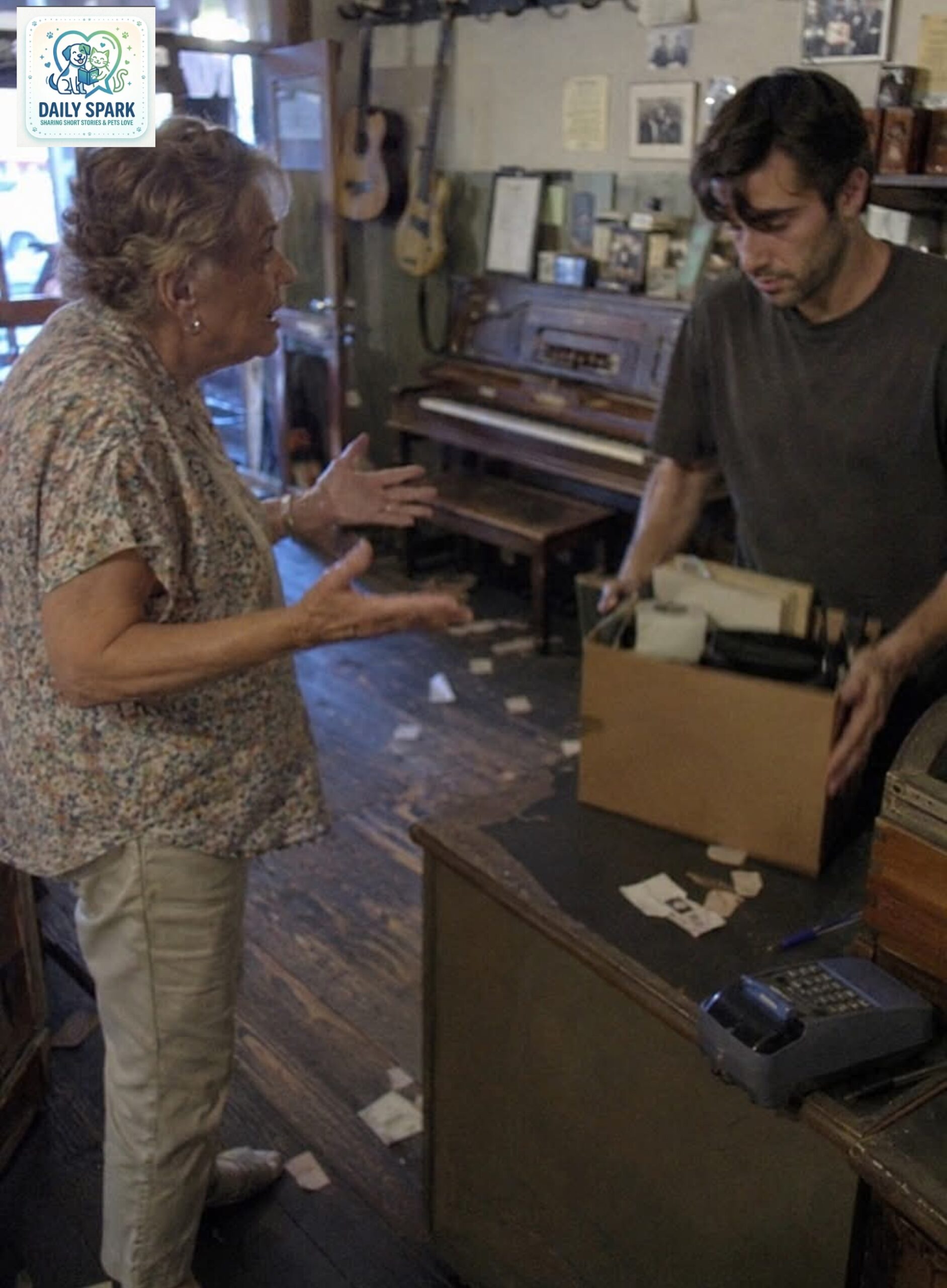
A 69-year-old accountant saved a young man’s failing music shop—then he helped her play the song she had avoided for years.
“You can’t close this place.”
The words came out sharper than I intended.
Malik stood behind the counter with a cardboard box in his arms, surrounded by empty guitar hooks and handwritten clearance signs. At twenty-six, he was young enough to be my grandson, but the exhaustion in his eyes belonged to someone much older.
“Mrs. Mercer,” he said quietly, “I can’t keep losing money.”
I looked around the little music shop on Main Street—the dusty piano by the window, the scuffed wooden floor, the wall of faded photographs showing children holding their first instruments.
Then I looked at the envelope on the counter marked FINAL NOTICE.
I had spent forty-three years as an accountant.
Numbers had always made sense to me.
Grief did not.
My husband, Walter, had been gone for two years. Since then, I had lived alone in a quiet condominium outside Dayton, Ohio, where every morning looked exactly like the one before it.
Coffee for one.
Toast for one.
The local news playing to a room that no longer needed the sound.
My daughter kept telling me I should travel, join a club, or move closer to her family.
But I didn’t want another hobby.
I wanted a reason to get dressed before noon.
I found the music shop by accident on a rainy Thursday.
A handwritten sign in the window said:
HELP NEEDED. HOURS FLEXIBLE. PATIENCE REQUIRED.
Inside, Malik was balancing a stack of receipts on one knee while trying to restring a guitar for a nervous teenage boy.
“Do you know anything about bookkeeping?” he asked when I mentioned my accounting background.
“I know enough to see that your receipts are being stored in a cookie tin,” I replied.
He smiled.
That was how it began.
I started working three mornings a week.
Malik paid me very little, which was fine because I was not there for the money. I was there because the bell above the door rang, people said my name, and somebody noticed when I didn’t come in.
At first, Malik and I irritated each other.
I believed invoices should be filed alphabetically.
He believed piles had personalities.
I wore sensible shoes and arrived fifteen minutes early.
He wore mismatched socks and considered “around ten” an acceptable opening time.
He listened to music so loud that the calculator vibrated across my desk.
I listened to an old radio station that made him ask, “Were songs always this sad?”
“No,” I told him. “People were just better at admitting it.”
Despite our differences, I began to understand why the shop mattered to him.
His father had opened it nearly thirty years earlier.
When Malik was a child, he had done homework beneath the counter while his father repaired trumpets, tuned pianos, and gave free guitar picks to children who could not afford them.
After his father died, Malik inherited the shop and all its problems.
He knew music.
He did not know payroll taxes, inventory reports, or why buying expensive instruments “because they looked lonely” was not a business strategy.
I spent weeks going through the books.
What I found made one thing terrifyingly clear: Malik wasn’t just struggling—the shop was running out of time.
That evening, after turning off the fluorescent lights and locking the glass front door, I sat down beside him at the battered oak counter. I didn’t hand him a spreadsheet full of red ink; instead, I slid over a revised budget alongside a cup of hot chamomile tea.
“We restructure the debt, negotiate with the equipment suppliers, and phase out the vintage saxophone consignment that’s been bleeding cash,” I told him gently. “And you stop buying lonely flutes. Agreed?”
Malik stared at the paperwork, then looked up at me with tears pooling in his eyes. “You’re really going to help me save this place?”
“I’m an accountant, Malik,” I said with a faint smile. “I hate seeing good ledgers go to waste.”
Over the next six months, the shop transformed. We organized community open-mic nights, guitar lessons for neighborhood kids, and weekend jam sessions that brought life back into the old building. Malik became like a grandson to me, bringing me a fresh pastry every morning and listening patiently whenever I talked about Walter.
Yet, as the shop flourished, Malik noticed something else. Every afternoon, when the piano tuner left or the store grew quiet, I would walk past the upright piano by the front window, touch the wooden keys, and immediately pull my hand back, walking away.
One stormy Tuesday, when no customers came in, Malik closed the front blinds, walked over to the piano, and opened the lid.
“You’ve been staring at this instrument for half a year, Clara,” he said, looking at me with absolute sincerity. “It’s time you played.”
My chest tightened, a heavy wave of grief crashing over me. “I can’t, Malik. Walter and I used to play duets every Sunday afternoon. The house is too quiet, and the keys only remind me of the silence he left behind.”
Malik didn’t argue. He simply sat on the bench, placed his fingers on the keys, and began playing a gentle, halting melody—the exact jazz tune Walter had loved to hum while making Sunday coffee. He looked back at me, inviting me in.
Slowly, fighting the lump in my throat, I walked across the scuffed wooden floor, sat down on the bench beside him, and placed my trembling hands on the keys.
As we played together, the notes filling the small shop and spilling out onto Main Street, I felt the heavy armor of grief finally melt away. For the first time in two years, the music didn’t sound like an ending; it sounded like a homecoming, proving that even after the coldest winters, the heart always remembers how to sing again.



Leave a Reply