The General’s Retribution
I never told my sister-in-law that I was a Colonel in Army Intelligence. To her, I was just a “broke veteran” she could look down on. I came home early for my daughter’s fifth birthday and found her locked outside. Her tiny body was burning with fever as she whispered, “Aunt Sarah said I’m not allowed inside… I’ll make her child sick.” Before I could even react, a bucket of icy water was dumped over us. Sarah laughed from the doorway. “Fastest way to lower a fever. Now take your burden and leave.” I rushed my daughter to the hospital. Then I made one phone call. “Activate the team. Return to my house. Target confirmed.” She had no idea who she had just humiliated. And she was about to find out.
Autumn wind pushed dry leaves across the driveway while I worked under the hood of my old 2004 Ford F-150, grease ground into my hands and the elbows of my faded gray hoodie. To Sarah, that truck and those clothes proved everything she wanted to believe about me.
“Still pretending to be useful?”
She stood in the garage doorway holding a vanilla latte, looking at me like I had wandered onto somebody else’s property.
Sarah was Claire’s older sister. She had arrived three months earlier after a breakup and what she called a toxic work situation.
Claire had offered her our guest room for a few weeks. Sarah stayed for months—and somewhere along the way, she started acting like the house belonged to her.
“The truck needed a belt,” I said. “It runs fine now.”
“Maybe you can use it to drive to a job interview. Claire is working herself to death in Chicago while you play mechanic. If this were my house, you’d be living in a tent.”
I let her talk.
She didn’t know Claire’s trip to Chicago was a vacation I had paid for. She didn’t know there was no mortgage because I had bought the house outright. She definitely didn’t know the card she had been using for coffee was connected to my account.
Most important, she didn’t know what I actually did in the Army.
I had spent years learning when to respond and when not to. At home, with my daughter turning five, I wanted peace more than I wanted to prove anything.
So I wiped the grease from my hands and went to pick up Sophia’s birthday cake—a pink unicorn cake with sprinkles she had talked about for days.
When I returned, the temperature had dropped hard. The house was strangely quiet.
“Sophia? Honey, I got the cake!”
Nothing.
Sarah sat on the couch watching television with a glass of wine. Her ten-year-old son, Lucas, was on the floor playing video games.
“Where’s Sophia?”
“Outside.”
I stopped. “Outside where?”
“The patio. She was coughing. I’m not letting Lucas get sick before soccer tryouts.”
The cake box stayed on the counter.
I ran to the back of the house and pulled open the curtains.
Sophia was curled into a ball on the stone patio in thin cotton pajamas. Her cheeks were blotchy red. Her entire body shook hard enough that I could see it through the glass.
The sliding door was locked.
Worse, Sarah had dropped the security bar into place.
“Sophia!”
I fought the lock, then slammed my shoulder into the frame until the bar broke loose. Cold air rushed inside as I dropped beside my daughter.
“Daddy?” Her teeth chattered between the words. “Aunt Sarah said I have germs. She said I can’t come in.”
I pressed my palm to her forehead.
Burning.
The air outside was around forty degrees, but her skin felt like a furnace. I estimated her fever was at least 104.
“I’ve got you, baby.”
Then Sarah’s voice came from above us.
“Hey!”
I looked up.
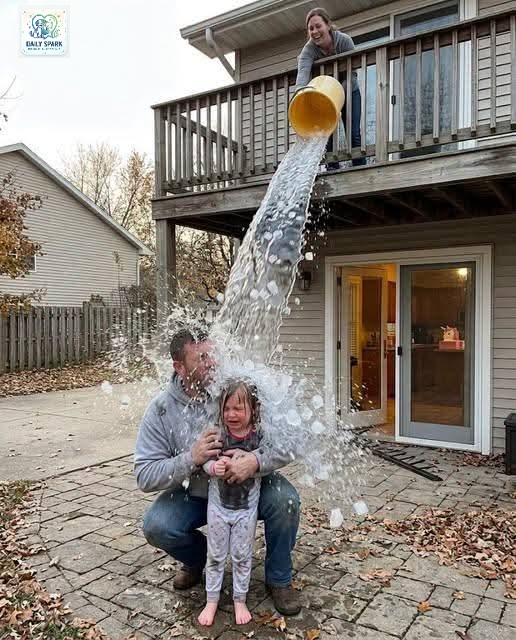
She was standing on the balcony with a large yellow cleaning bucket in both hands.
“What are you doing?” I shouted. “She’s sick!”
Sarah tipped the bucket.
Gallons of icy water crashed over us. Ice cubes struck the patio stones and bounced around my knees. Sophia’s pajamas went instantly dark and clung to her shaking body.
She made a weak, broken sound that scared me more than any scream could have.
Sarah laughed.
“Fastest way to break a fever. Now take that burden and get out. I’m not having my weekend ruined because she’s contagious.”
She turned toward the house.
I didn’t argue. I didn’t threaten her. I pulled Sophia against my chest, stood with water streaming from both of us, and ran for the truck.
The drive to the emergency room was a blur of flashing taillights and silent fury. By the time we rushed through the sliding doors, Sophia was semi-conscious, her breathing dangerously shallow. The medical staff immediately swarmed her, whisking her away to trauma bay three. Doctors worked urgently, stripping off her freezing, soaked pajamas, packing her small body in cooling ice blankets, and running intravenous fluids to combat the spiking 104.8-degree fever.
Standing in the sterile corridor, water still dripping from my faded hoodie, the quiet restraint I had maintained for years finally shattered. I pulled my secure satellite phone from my pocket and completed the call.
”Target confirmed. Execute protocol,” I told the voice on the other end.
Within thirty minutes of leaving Sophia resting comfortably under a nurse’s watchful eye, I pulled my Ford F-150 back into the driveway. Black tactical vehicles quietly blocked both ends of the street. Floodlights illuminated the front porch. As I walked up the steps, the heavy oak front door swung open automatically, held by two members of my former intelligence extraction unit.
Sarah was standing in the hallway clutching her wine glass, her face pale with sudden, blinding panic as she looked past me at the men securing the perimeter.
”What is this? Who are these people?” she stammered, her voice shaking. “Call the police! This man is a broke nobody—”
”The only nobody here is the guest who forgot her place,” I interrupted, my voice dropping into that cold, commanding tone that used to make enemy commanders tremble.
I gestured to the lead operative. “Pack her bags. Escort her and her belongings off the property immediately. Cancel all linked financial privileges, and ensure she never comes within fifty miles of this house again.”
Sarah tried to scream, to threaten, to call Claire, but the silence of the tactical team was absolute and terrifying. Within five minutes, she was out the door, her bags tossed onto the curb under the cold night sky.
When Claire returned from her trip a few days later, the house was warm, peaceful, and entirely safe. Sophia was back to her bright, laughing self, eating unicorn cake at the kitchen table. Claire never asked why her sister was gone for good, and I never had to explain. Some lessons don’t need words—they just need a father who remembers how to protect his own.

Leave a Reply