The rescuers thought the old Labrador was trapped after the tornado. Then they saw what he’d been doing for four hours.
About two hours in, one of the younger guys beside me said, “That dog’s got some sense. He’s saving his voice.”
I remember nodding.
But something about it bothered me.
Buddy didn’t sound scared.
He sounded tired.
There is a difference.
By the third hour, rain had started falling again.
Cold rain.
It ran through the broken house and disappeared into the cracks below us.
That made me nervous.
Old farm basements flood fast when drainage lines break, and we had no idea what condition it was in underneath.
So we kept digging.
My gloves tore.
Somebody handed me another pair.
We found the remains of the basement door, then part of the staircase, then a narrow opening barely wide enough for a flashlight.
I got down on my stomach and shined the beam through.
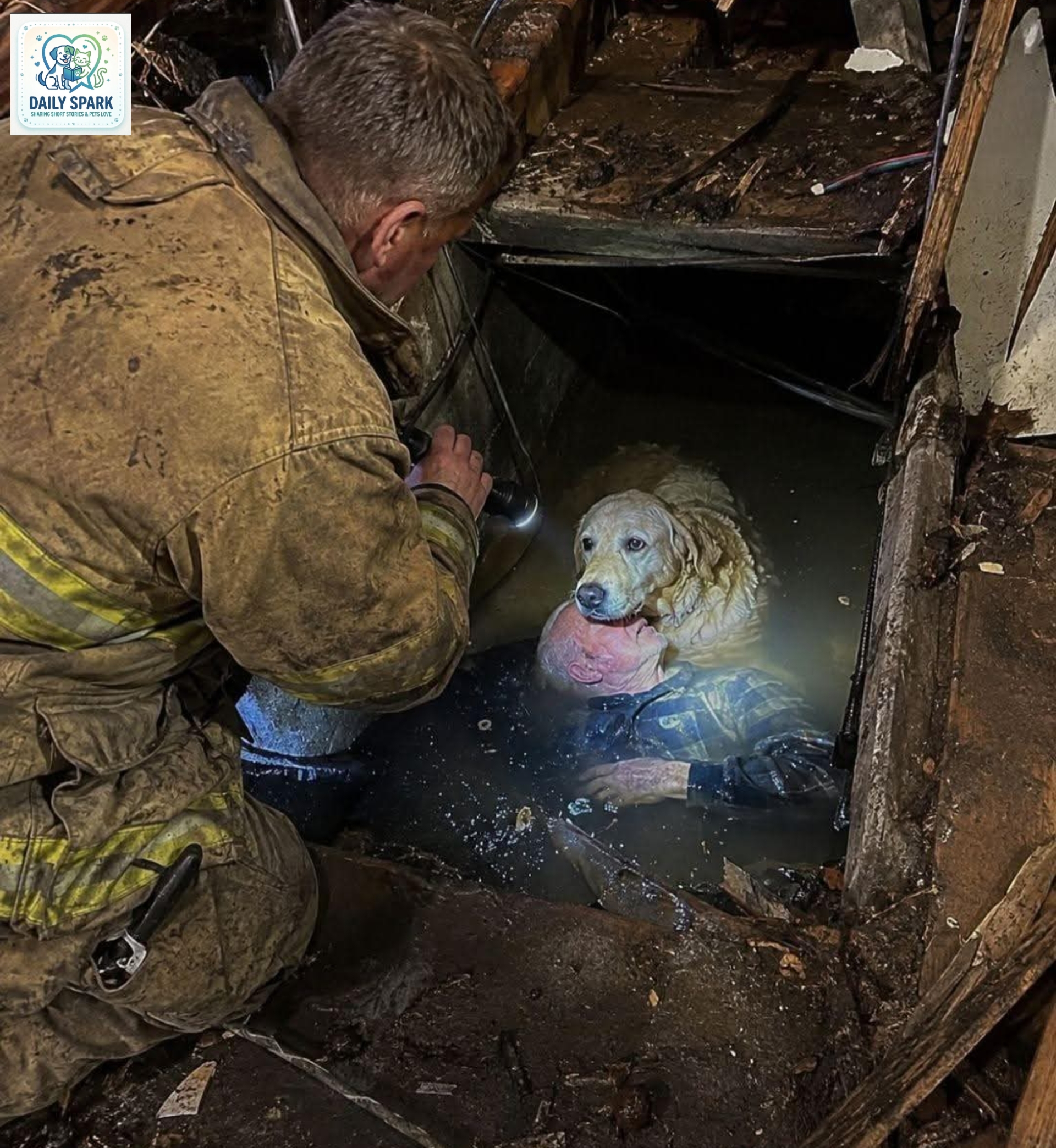
At first, all I saw was water.
Dark water.
Maybe a foot and a half deep.
Then I saw Buddy.
He was standing in it.
And that confused me immediately.
He wasn’t pinned.
He wasn’t trapped beneath anything.
There was open space behind him.
If he wanted to, that dog could have moved.
Then I moved the flashlight a few inches farther.
And I saw Earl.
He was lying partly on his side near the bottom of the stairs.
A section of broken railing and debris had fallen around his legs, and he wasn’t moving.
But his face was above the water.
Only barely.
Because Buddy was standing underneath him.
The old Labrador had wedged his body against Earl’s shoulder and neck, lifting him just high enough that his mouth and nose stayed clear.
For hours.
That dog had been standing in cold water, trembling, exhausted, holding his owner’s head above the surface with his own back.
I yelled for the others.
Everything moved quickly after that.
We widened the opening.
Two of us climbed down.
When I stepped into the basement, Buddy looked at me but did not move away from Earl.
“Easy, boy,” I said. “We’ve got him.”
Buddy stared at me.
I reached down and put my hand on Earl’s shoulder.
He was alive.
Weak, cold, barely responsive.
But alive.
We cleared the debris around his legs and brought a stretcher down.
Only when we started lifting Earl did Buddy finally step away.
His legs almost gave out.
I caught him around the chest before he hit the water.
For the first time that afternoon, he stopped trying to be strong.
He just leaned into me.
I remember feeling how badly he was shaking.
Not fear.
Cold.
Exhaustion.
Maybe relief.
I carried him up behind the stretcher.
Outside, the rain had stopped.
Neighbors were gathered beyond the emergency vehicles, standing in muddy yards and along the road.
Most of them had lost something that day.
Roofs.
Cars.
Barns.
Trees planted by grandparents.
But when they saw Earl coming out alive, people started crying.
And when they saw Buddy behind him, somebody shouted, “That’s his dog!”
I don’t know why that sentence got to me.
Maybe because it sounded so ordinary.
That’s his dog.
As if that explained everything.
And maybe it did.
Earl was taken to the hospital.
Buddy went with one of Earl’s neighbors until we knew what would happen.
The next afternoon, I stopped by the hospital.
Earl looked about twenty years older than he had the week before.
He had bruises on his face, blankets piled over him and one hand wrapped around a paper cup of coffee he hadn’t touched.
He looked at me for a second.
Then his first question was:
“Did you get Buddy out?”
Not, “How bad is my house?”
Not, “Where’s my truck?”
Not even, “What happened?”
Just:
“Did you get Buddy out?”
I told him Buddy was safe.
Earl closed his eyes.
And that tough old man started crying.
Quietly.
He told me later that when the tornado warning came, he had tried to reach the basement.
Buddy followed him.
The house started coming apart before they made it all the way down.
Earl remembered falling.
Then nothing.
He had no idea how long he had been unconscious.
He didn’t know the basement was flooding.
He didn’t know Buddy had stayed.
“All these years,” Earl whispered, “I thought I was taking care of him.”
He looked toward the window.
“Turns out he was taking care of me.”
A few weeks later, Earl came home.
There wasn’t much of the farmhouse left to come home to, so neighbors helped him fix up a small place on his son’s property.
Someone built a ramp.
Someone donated furniture.
Someone else replaced the tools Earl had lost.
Small-town people have a way of appearing with pickup trucks when somebody’s life falls apart.
Buddy came home too.
The first evening, Earl sat on the porch with him.
I happened to be there dropping off a box of things we’d recovered from the rubble.
Buddy was stretched out beside Earl’s chair, gray around the muzzle, sleeping like nothing remarkable had ever happened.
Earl reached down and rested one hand on the old dog’s head.
“He could’ve left me,” he said.
I nodded.
There had been enough room.
We both knew it.
Buddy could have climbed onto higher debris.
He could have moved away from the cold water.
He could have barked for himself.
Instead, he stayed beside the man who had fed him, walked him, talked to him through lonely evenings after his wife died and scratched behind his ears every morning for eleven years.
And when Earl could no longer hold his own head above the water, Buddy became the thing that held it there.
I have thought about that dog many times since.
People talk about loyalty as if it is a feeling.
I don’t think it is.
Not really.
Loyalty is what you do when leaving would be easier.
It is the chair beside a hospital bed.
The adult child who keeps checking on an aging parent.
The spouse who stays awake through the hard nights.
The neighbor who shows up with a chainsaw after the storm.
The old dog standing in freezing water because the person he loves still needs him.
Buddy never knew anybody would hear about what he did.
He wasn’t waiting for praise.
He wasn’t trying to be brave.
He simply knew where he belonged.
Beside Earl.
And sometimes I think the world would be a better place if more of us understood loyalty the way an old Labrador did that afternoon.
Real loyalty is not staying when it is comfortable. It is refusing to leave when leaving would save yourself.
As the years rolled on, the memory of that terrible storm began to fade into local legend, but the bond between Earl and Buddy only grew deeper with every passing season. Earl lived to see his ninetieth birthday, surrounded by family, children, and the comforting quiet of the countryside. Through every ache of old age, Buddy remained his constant shadow, sleeping across his feet during winter nights and walking slowly beside him down the dirt paths in the summer warmth. When Earl finally passed away peacefully in his armchair on the front porch, Buddy refused to leave his side, resting his heavy chin on the old man’s motionless hand until help arrived. The townspeople built a small, beautiful memorial beneath the large oak tree on the property—a bronze statue of a loyal dog looking up faithfully, with an inscription that read: True love never leaves, even when the waters rise. Buddy lived out his remaining days cared for by Earl’s son, and when he finally closed his eyes for the last time, everyone knew he had gone to find his master, ready to walk beside him once more where storms could never reach them.

Leave a Reply