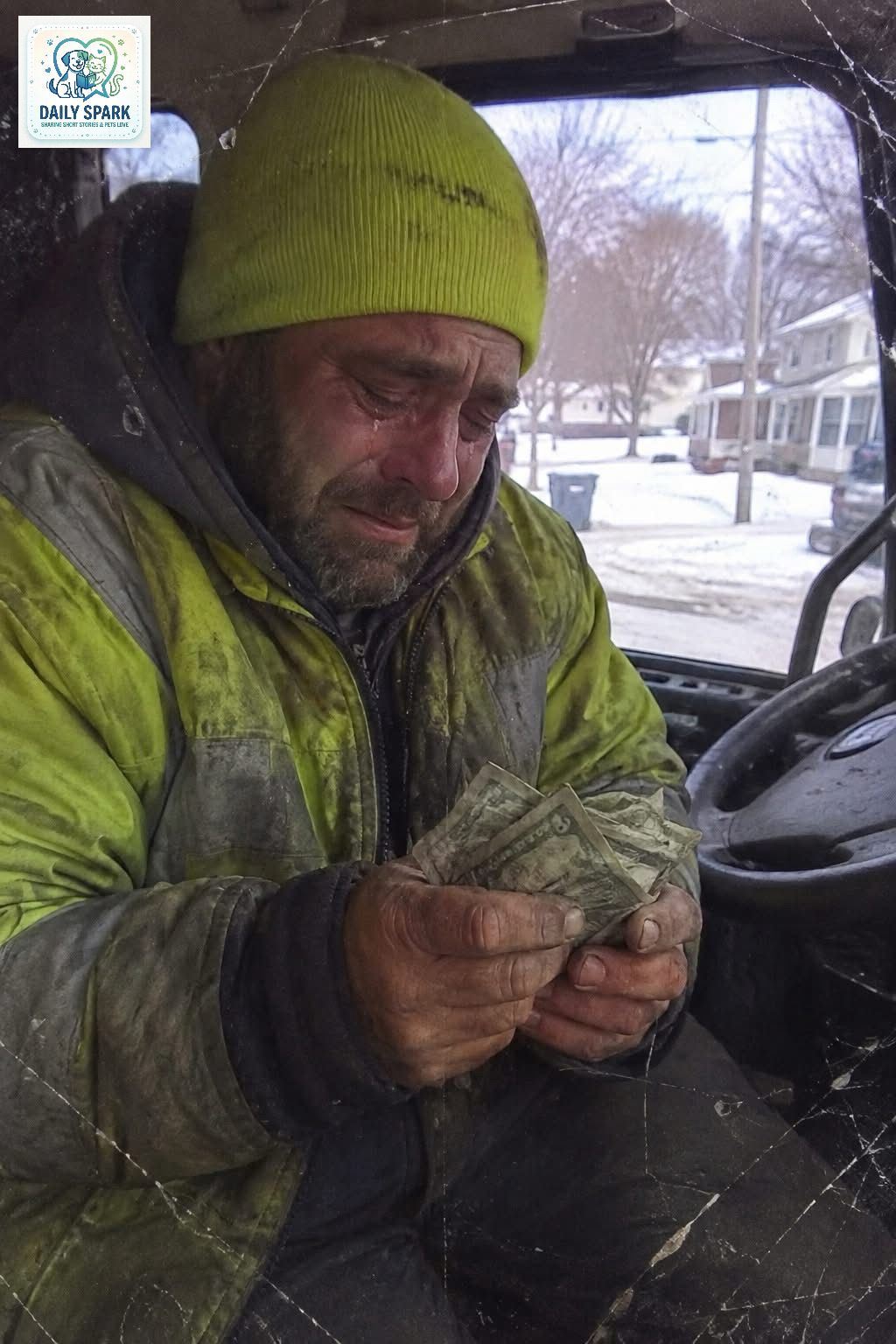
A freezing sanitation worker wept because he couldn’t afford a doll for his daughter’s birthday. Then, an 80-year-old widow’s trash bin left him totally speechless.
Bram sat in the idling cab of his garbage truck, staring at a crumpled wad of one-dollar bills, and let the tears fall.
It was exactly twenty-two dollars and fifty cents. That was all he had left after paying the rent and keeping the electricity on for another month.
Tomorrow was his daughter Junia’s sixth birthday. For months, she had been carrying around a crumpled, dog-eared page from a store catalog, pointing to a baby doll with blonde hair and a little pink dress.
It cost thirty-five dollars.
Bram was a sanitation worker in a city that was currently buried under a foot of snow. He spent his days clinging to the back of a freezing truck, hauling heavy bins in the bitter winter wind.
His knuckles were perpetually cracked, and his shoulders ached with a dull, heavy pain that never seemed to go away.
He worked double shifts whenever his boss allowed it. But as a single dad trying to survive on a single income, the math just never worked in his favor.
He wiped his eyes with the back of his worn-out leather glove, put the truck in gear, and drove to his next stop. He felt like a complete failure. A father who couldn’t even buy his little girl the one simple thing she asked for.
Ten minutes later, he turned down Oak Street.
It was a quiet neighborhood with older homes, including a small, faded blue house at the very end of a cul-de-sac. That house belonged to Mrs. Calloway.
Mrs. Calloway was an eighty-year-old widow who lived entirely alone. She used a metal walker with tennis balls on the feet, and she hadn’t driven a car in nearly a decade.
The city’s sanitation policy was strict: If a trash bin is not placed directly at the curb, the workers are instructed to skip the house. They have tight schedules to keep.
But Mrs. Calloway’s driveway was steep, long, and currently coated in a dangerous layer of black ice.
Bram knew there was no way a frail elderly woman could drag a heavy plastic bin down that hill.
So, for the past two years, every Tuesday morning, Bram broke the rules.
He would park the massive truck, walk carefully up the icy hill, wheel her bin down to the street, empty it, and then walk it all the way back up to her garage door.
He never asked for a tip. He never complained. He just did it because it was the right thing to do. Because he hoped that someday, if he lived to be eighty, someone would do the same for him.
Sometimes, Mrs. Calloway would be watching from her front window. She would wave a trembling hand, and he would tip his neon yellow beanie in return.
A few times over the summer, she had been sitting on her porch when he arrived. They had shared brief conversations.
She told him about her late husband. He told her about his sweet little girl, Junia, and how fast she was growing. He talked about his daughter constantly because she was the light of his difficult life.
On this freezing Tuesday, the morning before Junia’s birthday, Bram trudged up the icy driveway with a heavy heart. His mind was miles away, agonizing over what he would tell his daughter tomorrow when there was no wrapped present on the kitchen table.
As he reached the top of the driveway, he stopped dead in his tracks.
Sitting squarely on the lid of Mrs. Calloway’s empty trash bin was a box.
It was wrapped carefully in thick, old-fashioned floral wrapping paper, and then placed inside a clear plastic bag to protect it from the falling snow.
Bram frowned. He thought maybe she had accidentally left something out to be thrown away.
But as he brushed the snow off the plastic, he saw a thick white envelope securely taped to the top. Written in beautiful, shaky cursive were two words:
For Bram.
He froze. Whatever was inside that envelope had been left there for him—and he had no idea why.
Bram’s hands trembled beneath his thick gloves as he peeled the envelope off the plastic bag. The cold wind bit at his ears, but he barely felt it. Inside was a handwritten note on delicate stationery:
Dear Bram,
I hear you talking about your sweet Junia every week, and I know how hard you work to keep things going for the two of you. My late Arthur used to say that a good man’s heart shouldn’t have to carry every burden alone.
A couple of weeks ago, you mentioned how much she wanted that blonde doll from the catalog. Well, old women still know how to place an order by mail! Think of this not as charity, but as a small payment for two years of kindness on an icy driveway that a lonely old woman could never have navigated on her own.
Happy Birthday to little Junia.
Warmly,
Mrs. Calloway
Tears blurred Bram’s vision, but this time they were warm against the icy air. Pulling back the protective plastic, he looked down at the box. On the side was a photo of the very doll Junia had pinned to her bedroom mirror—Mrs. Calloway had used her postal catalog to order it weeks in advance.
He clutched the wrapped box tightly to his chest, looking up toward the small house. In the front window, behind the lace curtains, a faint shadow waved. Bram tipped his neon yellow beanie, a broad, watery smile breaking across his face.
The next morning, Junia woke up to the pink box wrapped in floral paper resting on the kitchen table. Her eyes lit up with pure joy as she hugged the blonde doll tight against her chest, declaring it the best birthday of her life.
That evening, Bram returned to Oak Street with a warm cherry pie and a handmade thank-you card drawn by Junia. As Mrs. Calloway opened the heavy oak door, the scent of vanilla and age spilled into the frosty night. She looked at the pie, then at the crayon-drawn card featuring a lopsided doll with an enormous smile, and for the first time since Bram had known her, the strict lines around her mouth softened into something resembling a quiet grace.
“She likes it, then?” Mrs. Calloway asked, her voice raspy, though the usual sharp edge was entirely gone.
“She hasn’t put it down all day,” Bram said, handing over the warm pie. “I don’t know how to thank you, Mrs. Calloway.”
The old woman took the pie, setting it gently on the small entry table alongside a stack of unopened mail. She smoothed the edges of Junia’s card with a thumb that trembled just slightly. “A child shouldn’t have to learn about an empty pocketbook on her birthday, Bram. There’s plenty of time for the world to be cold later.”
She looked up, meeting his eyes with a fierce, quiet warmth. “Besides, a house this quiet needs a little magic passing through it once in a while. Now get back inside before your toes freeze off.”
From that winter onward, Bram and Junia never let Mrs. Calloway spend another weekend alone. Every Sunday, Junia would sit on the rug in the old blue house, showing off her doll, while Mrs. Calloway laughed—a sound that slowly brought the quiet house back to life. Bram realized that small acts of quiet kindness never really end; they just find their way back home when you need them the most.

Leave a Reply