A Crossing Guard Saw a Little Girl Hide From an Ambulance—Then Two Paramedics Arrived at Her School With a Promise She Never Forgot
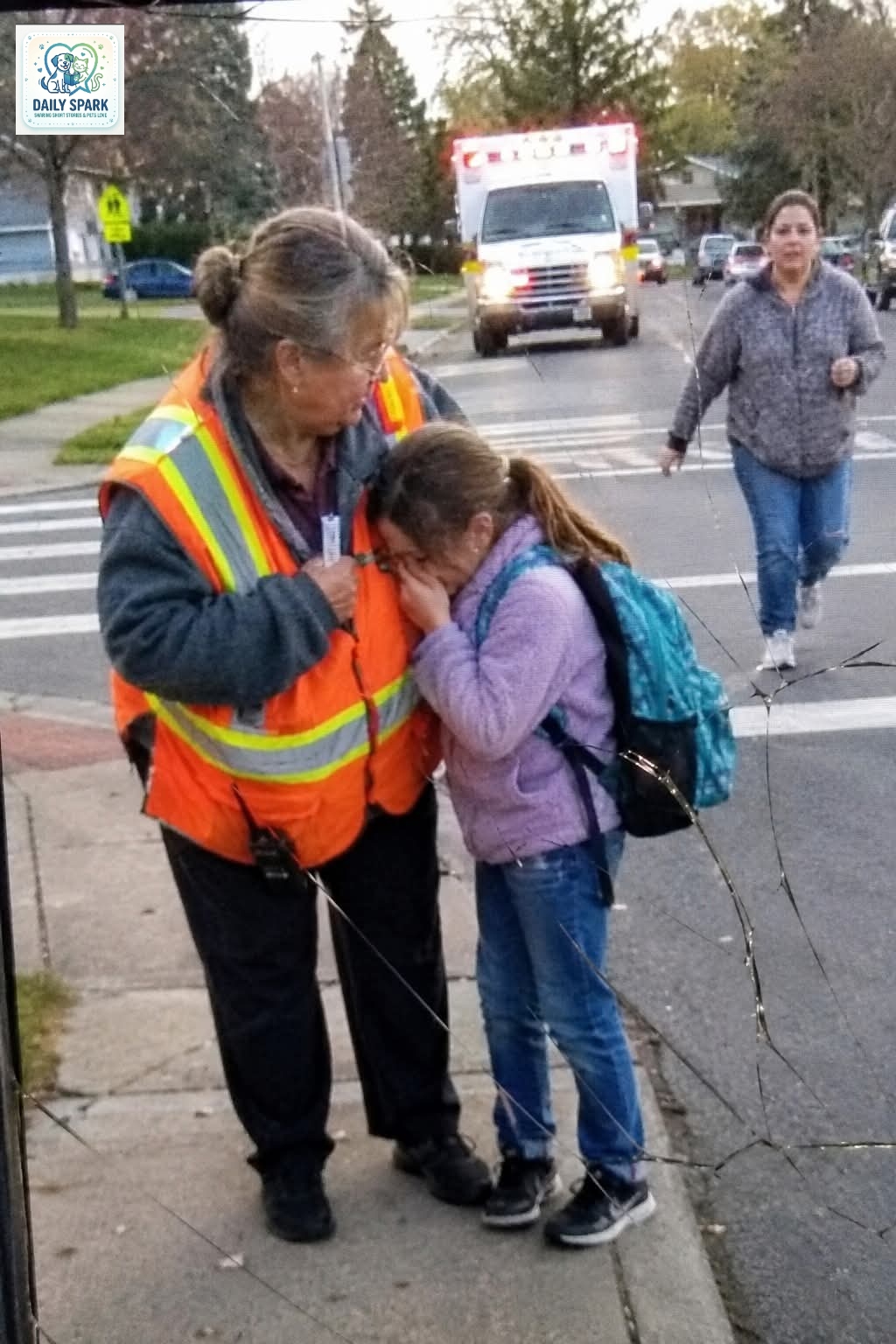
The ambulance was still three blocks away when seven-year-old Tessa dropped her backpack and ran behind me.
She wrapped both arms around my waist so tightly I could feel her shaking through my orange safety vest.
“Please don’t let them see me, Miss Maribel,” she whispered. “They’ll take me because I cried.”
For a moment, I thought I had misunderstood her.
I’m fifty-eight years old, and I’ve worked the morning crossing outside that elementary school in northern Ohio for nearly eleven years. I’ve seen children scared of thunder, barking dogs, substitute teachers, and the first day of school.
But I had never seen a child terrified of an ambulance.
The siren grew louder as it passed along the main road. Tessa buried her face against my coat and covered her ears.
I lowered my stop sign and knelt beside her.
“Honey, paramedics help people,” I said. “They don’t take children away for crying.”
Her eyes filled immediately.
“That’s not what Miss Kendra said.”
Tessa’s mother, Rochelle, was walking toward us from the parking lot. The moment she saw her daughter’s face, she hurried over.
It took several minutes before Tessa could explain.
The afternoon before, she had been at an after-school daycare program. A few older children had laughed when she struggled to pronounce a word during reading time.
Tessa had a slight speech delay. Most days she handled it with more courage than many adults would.
But that day, the teasing wore her down.
She began to cry.
Instead of comforting her, the aide supervising the room became frustrated.
According to Tessa, the woman pointed toward the road and said, “If you don’t stop crying, I’ll call the paramedics, and they’ll take you away.”
To an adult, it might have sounded like an empty threat spoken in irritation.
To a seven-year-old, it was a promise.
All evening, Tessa had watched the windows of her apartment, waiting for flashing lights.
She refused to put on her pajamas because she wanted to be ready if they came.
She asked her mother whether children were allowed to take stuffed animals in an ambulance.
Then she apologized again and again for crying.
Rochelle’s voice cracked as she told me.
“She kept saying she’d be good,” she whispered. “She thought being sad had made her bad.”
That sentence stayed with me all morning.
She thought being sad had made her bad.
I have raised three children and helped care for five grandchildren. I know adults get tired. I know patience sometimes runs thin.
But children remember the words we throw away.
A sentence that leaves an adult’s mouth in three seconds can live inside a child for years.
After the final bell that afternoon, I drove to the small fire and rescue station near the edge of town.
I didn’t know anyone there personally. I almost turned around twice because I felt foolish walking in with my crossing-guard vest still on.
A paramedic named Darnell met me near the front desk.
He was a broad-shouldered man in his early forties with tired eyes and a coffee mug that looked like it had been reheated several times.
I told him about Tessa.
He didn’t interrupt. He didn’t laugh or say children would forget.
When I finished, he set down his mug.
“What time does she cross tomorrow morning?” he asked.
“At seven forty-five.”
He nodded.
“We’ll be there.”
I thought he meant a quick wave from the ambulance. I was wrong about what they were planning.
The next morning, the autumn air was crisp, and the sky was a pale, clear blue. At exactly seven forty-two, long before Tessa usually arrived, a heavy red and white rescue vehicle turned the corner.
It wasn’t speeding. Its sirens were completely silent, but its amber warning lights flashed softly as it rolled to a stop right by the crosswalk.
I felt my heart skip a beat. Several parents waiting with their children turned, looking confused and slightly alarmed.
The passenger door swung open, and Darnell stepped out, followed by a younger paramedic with a gentle smile and a bright yellow badge pinned to his uniform. They weren’t wearing their emergency gear; instead, they wore clean navy shirts and carried a large, mysterious cardboard box.
Just then, Tessa and her mother appeared down the sidewalk.
As soon as Tessa saw the ambulance, she froze. Her small hand gripped her mother’s jacket so hard her knuckles turned white. She tried to step backward, her eyes wide with sudden panic.
“It’s okay, sweetheart,” I called out, stepping toward her with a reassuring wave. “Look who’s here.”
Darnell knelt down on one knee right on the pavement, putting himself at eye level with the terrified little girl. He held out his hands—completely empty, palms up.
“Good morning, Tessa,” Darnell said, his voice deep, warm, and entirely steady. “Miss Maribel told us that we missed meeting you yesterday. We heard you’re one of the bravest students at this school, and we wanted to officially introduce ourselves.”
Tessa hid halfway behind her mother’s legs, peering out with one cautious eye. “Are you… are you going to take me?” she whispered, her voice trembling.
Darnell shook his head slowly.
“Never,” he said firmly. “Paramedics don’t take people away for crying. Crying just means your heart is full and your body is letting some heavy feelings out. We only come to help when people are hurt, and we are never angry at anyone for being sad.”
He stood up and carefully opened the cardboard box. Inside sat a brand-new, miniature stuffed ambulance complete with soft felt wheels, and beside it, a small laminated card with an official gold star.
“This is your official Rescue Pass,” Darnell said, handing the soft toy down to her. “It means anytime you see us, you know we’re the good guys. And if you ever feel sad, you can remember that paramedics are here to protect you, not scare you.”
Tessa slowly let go of her mother’s coat. She looked down at the soft toy ambulance, then up at Darnell’s kind, tired eyes.
Slowly, hesitantly, she reached out and took the toy. A tiny, shy smile broke across her face—and right beside it, the same little dimple appeared.
Her mother wiped a sudden tear from her cheek, smiling through her own emotion, while the surrounding parents broke into a quiet, respectful applause.
That morning, Tessa didn’t hide behind my vest. She walked across the street holding her new toy in one hand and her mother’s hand in the other, standing a little taller than she had the day before.
And as the rescue vehicle pulled away—its lights flashing one final, friendly greeting—I knew that some mistakes made by careless adults can be completely healed when real heroes show up to remind a child how much they matter.

Leave a Reply