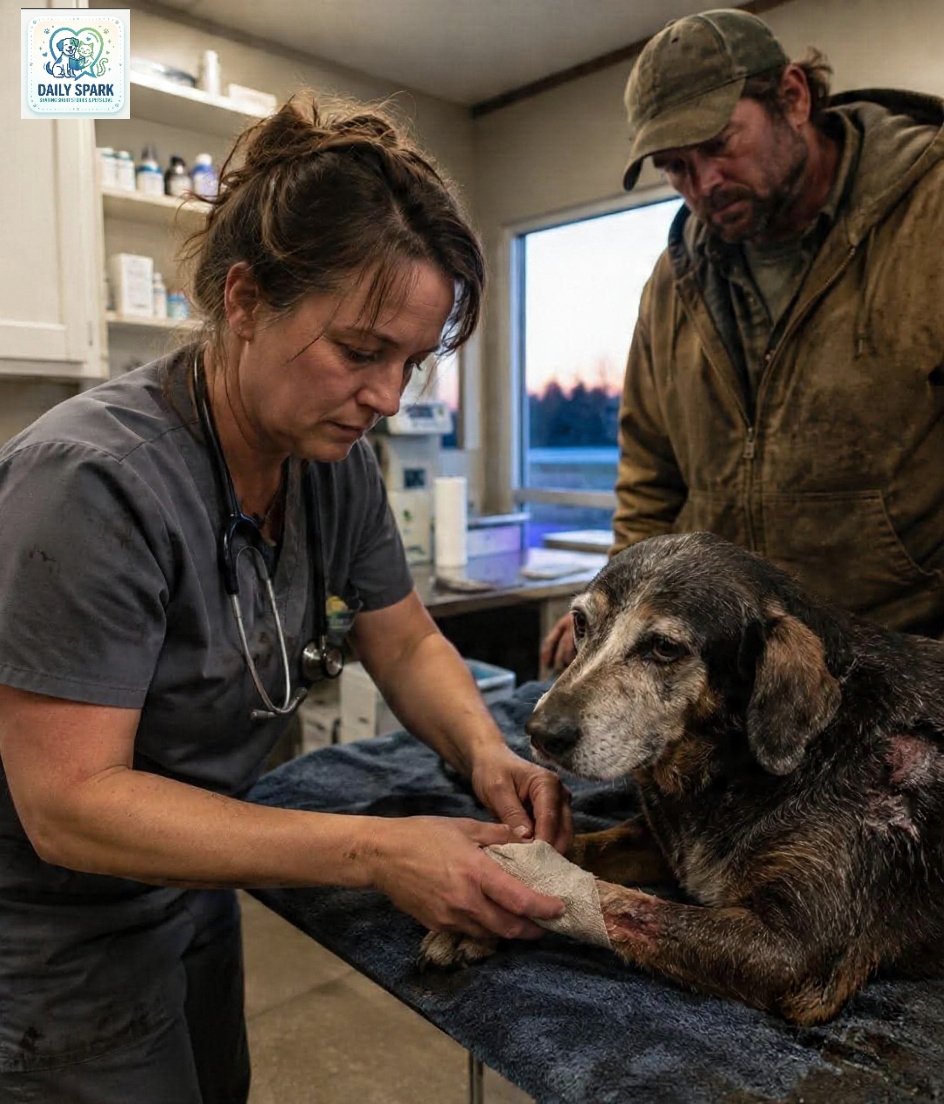
The veterinarian could barely hold her hands steady—but she stayed late to save an old dog no one seemed to want.
“Easy, old man. I’ve got you.”
I said it to the hound, but if I’m being truthful, I may have been saying it to myself too.
It was almost closing time at my little veterinary clinic in rural Oklahoma when a farmhand named Wade came through the front door carrying a mud-covered dog in both arms.
The hound was old.
Gray around the muzzle. Ribs showing beneath wet fur. One ear torn from some long-ago adventure.
And that afternoon, he had fresh cuts along his side and a badly injured front leg.
“Found him by the county road,” Wade said. “Storm must’ve scared him out of somewhere.”
I looked toward my receptionist.
No collar.
No tag.
No microchip.
No owner.
And from the condition he was in, no time to waste.
Normally, I would have moved quickly.
That day, my body had other plans.
I was 47 years old, and I had been living with multiple sclerosis long enough to recognize the days when it was going to win a few rounds.
My legs felt heavy.
My vision had been blurry since breakfast.
And the fatigue wasn’t normal tiredness.
It was the kind that made lifting a coffee mug feel strangely ambitious.
Worst of all, my hands had started trembling.
Not badly.
Just enough for me to notice.
Just enough to scare me.
My assistant, Rachel, saw it too.
“Mallory,” she said quietly, “I can call the emergency clinic in the city.”
The city was nearly an hour away.
I looked down at the dog.
He looked back at me.
His eyes were cloudy with age, but calm.
Trusting.
That was the part that got me.
Animals don’t know your diagnosis.
They don’t care whether you slept badly.
They don’t know your hands hurt or your legs feel like concrete.
They only know whether you stayed.
“I’m not sending him another hour down the road,” I said. “Let’s get him comfortable.”
We closed the front door.
Turned off the OPEN sign.
And stayed.
The exam room smelled like antiseptic, wet fur, and Oklahoma mud.
Rachel clipped hair away from his wounds while I worked slowly.
Very slowly.
There were moments when I had to stop and rest my hand against the table until the shaking settled.
The old hound never snapped.
Never growled.
Once, when I leaned close, he lifted his head and licked my wrist.
Rachel laughed softly.
“Well,” she said, “apparently he approves.”
By 8:30 that night, we had cleaned his wounds, wrapped his leg, given him fluids, and made him a bed from folded blankets in one of the recovery kennels.
I sat down beside him on the floor.
That was easier than standing by then.
“What are we going to call you?” I asked.
He stared at me.
I noticed the way he rested his chin on his paws, like a dog who had spent many years lying beside somebody’s rocking chair.
“Porch,” I said.
Rachel raised an eyebrow.
“Porch?”
“He looks like he belongs on one.”
So Porch it was.
The next morning, we started calling around.
Animal control.
Nearby clinics.
Feed stores.
The sheriff’s office.
We posted his description on community boards and asked people to spread the word.
“Old male hound found after storm. Gentle. Gray muzzle. Injured leg.”
Nothing.
Day one passed.
Then day two.
Porch started eating better.
He wagged his tail whenever I entered the room.
By the third morning, he had apparently decided my clinic belonged to him.
Rachel found him sitting behind the reception desk after he nudged open his kennel.
“He’s applying for a job,” she said.
“What position?”
“Management.”
For the first time in days, I laughed hard enough that I forgot how tired I was.
But underneath the laughter was a worry I wouldn’t say out loud.
What if nobody came?
I already knew what I would do.
I would take him home.
My house had a small fenced yard and a covered porch.
The name would finally make sense.
Around noon on the third day, the bell over our clinic door rang.
I was in the back when Rachel called my name.
Not loudly.
Just differently.
“Mallory?”
I came around the corner and saw an elderly man standing in the waiting room.
He looked to be in his late seventies.
Thin shoulders.
Faded work shirt.
Ball cap clutched in both hands.
His eyes were red.
He didn’t even introduce himself.
He simply held out a worn photograph.
“Have you seen this dog?”
The picture showed a woman sitting on a porch swing beside an old hound.
The woman had silver hair and a huge smile.
The dog had the same torn ear.
The same white patch on his chest.
The same cloudy eyes.
I felt something catch in my throat.
“Wait here.”
I opened the recovery-room door.
Porch was asleep.
Then he heard the old man’s voice from the hallway.
“Buddy?”
The dog’s head snapped up.
He struggled to his feet.
And suddenly this tired old hound who had moved carefully for three days was pulling toward the door with everything he had.
The man dropped to his knees.
“Buddy!”
Porch limped across the floor and pushed his whole head into the man’s chest.
The sound that came out of that man is something I still remember.
It wasn’t exactly crying.
It was relief.
Grief.
Love.
All tangled together.
He wrapped both arms around that dog and buried his face in his neck.
“I thought I lost you too,” he whispered.
Nobody in the room said a word.
After a while, the man told us his name was Earl.
Buddy had belonged mostly to his wife, June.
They had been married 51 years.
June had died eight months earlier.
Cancer.
Earl said Buddy had slept beside her chair every evening for nearly thirteen years.
After she died, the dog started sleeping on Earl’s side of the bed.
“He knows,” Earl said.
Then he looked down.
“He knows I’m lonely.”
The storm three nights earlier had knocked part of Earl’s back gate loose.
When he realized Buddy was missing, he drove every road he could think of.
He checked barns.
Ditches.
Neighbors’ properties.
He barely slept.
“I kept thinking about what June would say if I lost her dog.”
He tried to laugh.
He couldn’t.
Then came the part I’ll never forget.
Earl walked to the counter and pulled out an old leather wallet.
“How much do I owe you?”
I told him nothing.
He stared at me.
“No, ma’am. You treated him. You stayed with him. I can pay something.”
I shook my head.
“Take him home.”
He looked embarrassed.
“I don’t want charity.”
“It isn’t charity.”
I glanced down at Buddy.
“It’s just somebody getting home where they belong.”
Earl stood completely still.
Then he slowly put his wallet away.
His eyes filled again.
He stepped closer to me and lowered his voice.
“You gave me back the last piece of her I still had.”
That sentence hit a place in me I wasn’t expecting.
Because illness teaches you strange things.
It teaches you that loss doesn’t always happen all at once.
Sometimes it comes quietly.
A little strength.
A little independence.
A little confidence in your own hands.
A little piece of the person you thought you would always be.
There had been nights after my diagnosis when I sat alone in my kitchen wondering what MS would eventually take from me.
Would I still be able to practice?
Would I still trust my hands?
Would I become a burden?
Would the life I built slowly disappear one piece at a time?
I had never told Earl any of that.
He didn’t know why his words stopped me cold.
But standing there beside an old dog and a grieving husband, I realized something I badly needed to understand.
Maybe a life isn’t measured only by what we lose.
Maybe it is also measured by what we are still able to give.
That day, my hands shook.
I was exhausted.
I went home and slept nearly twelve hours.
But my hands had still done something good.
They had returned Buddy to Earl.
And sometimes that is enough.
A few weeks later, a truck pulled into the clinic parking lot.
Earl got out.
Buddy climbed down slowly beside him.
His leg was healing beautifully.
Earl carried a small wooden box under one arm.
Inside was a homemade peach pie.
“June’s recipe,” he said.
Then he pointed toward Buddy.
“He insisted.”
We sat outside during my lunch break.
Buddy stretched out beneath my chair.
Earl told me stories about June.
How she sang while washing dishes.
How she cheated at cards.
How she planted tomatoes every year and complained every year when they produced too many tomatoes.
Ordinary memories.
Which, I’ve learned, are usually the ones people miss most.
Before Earl left, he rested one hand on Buddy’s head.
“You know,” he said, “I spent three days asking why this happened to me.”
He looked at me.
“Maybe I should’ve been asking who helped me through it.”
I think about that often.
We live in a world that celebrates big gestures.
Big donations.
Big speeches.
Big rescues.
But most goodness I have witnessed in 47 years has been much smaller.
A farmhand who stops his truck for an injured dog.
A tired assistant who stays after closing.
An old widower who brings a peach pie because thank you doesn’t feel big enough.
And sometimes, a veterinarian having one of her worst days who decides she still has enough left in her to help.
Buddy wasn’t “nobody’s dog.”
He never had been.
He was somebody’s last connection to a lifetime of love.
We just didn’t know it yet.
And maybe that is why we should be careful about deciding what—or who—is worth our trouble.
We rarely know the whole story when kindness first asks something of us.
Sometimes the smallest kindness does not save a life. It gives someone back a piece of the life they thought they had lost forever, proving that even on the days our bodies or minds feel broken, our capacity to care for one another remains the most enduring magic we possess.

Leave a Reply