I went to the shelter with a clear plan. I wanted a young dog. Maybe a puppy. Someone easygoing. No hard history. No pain in the eyes. No past that would end up hurting me too.
I walked between the kennels where the young dogs barked and jumped and leapt at every visitor. I was almost to the puppy section when I stopped without meaning to.
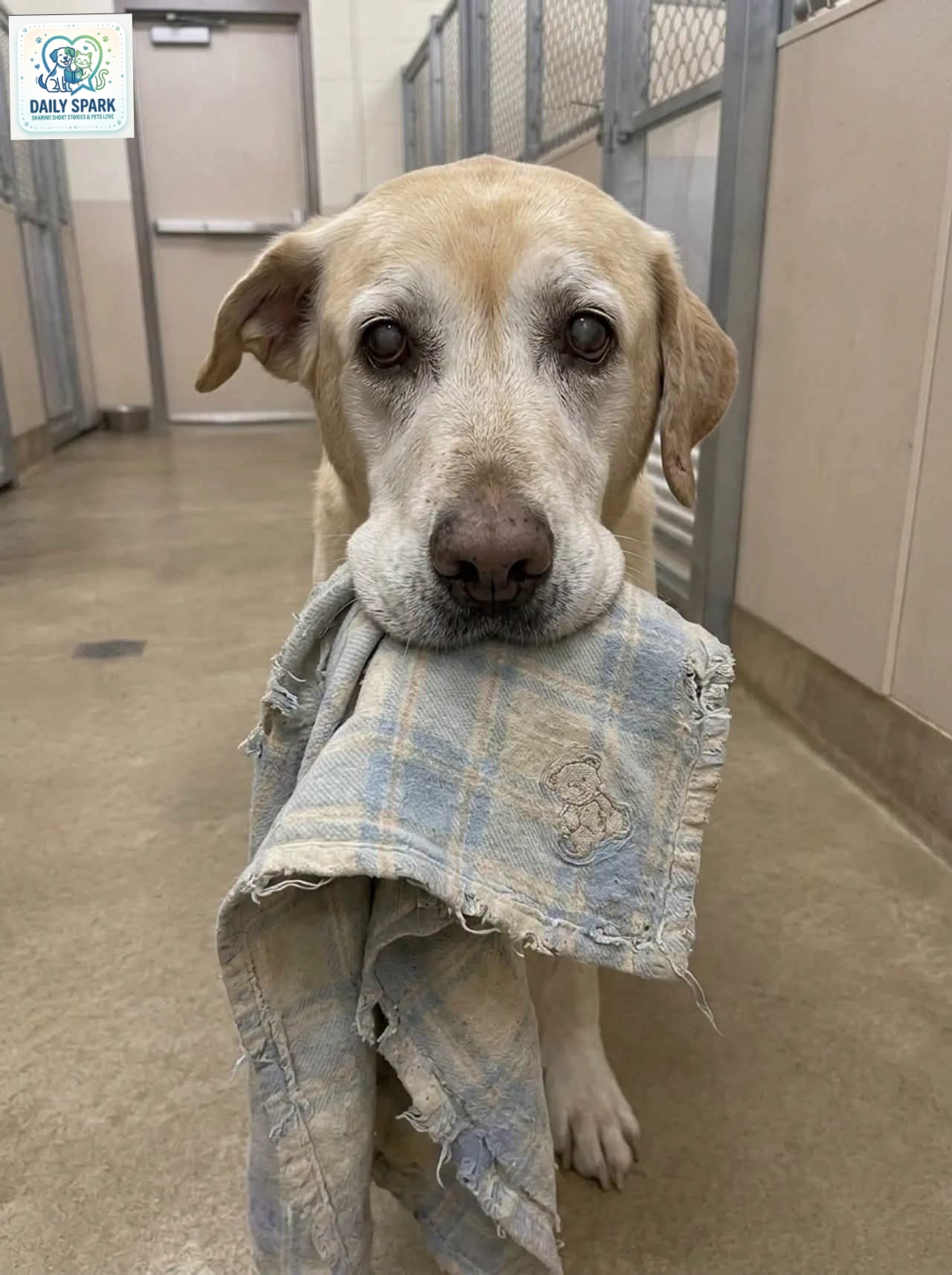
In the kennel behind me was Boone. A seven-year-old Golden Retriever mix with a scarred muzzle, a torn ear that never quite healed right, and a snout gone mostly white. He wasn’t barking. Wasn’t jumping. Wasn’t asking for anything at all. He just watched people walk past without stopping.
When he noticed I’d paused, he got up and walked to the back of his kennel. I thought he was retreating. Instead he came back carrying something in his mouth.
An old flannel baby blanket. Or what was left of one. Worn fabric, full of holes, edges frayed to almost nothing. He pressed it against the chain link and looked at me like he was handing over the most valuable thing he owned.
”Does he want to play?” I asked the volunteer nearby.
She shook her head.
”No. He does that with everyone. He never actually lets go of that blanket. He thinks it’s the only thing of value he has left. He believes if he offers it, someone will eventually take him home with it.”
Something in my chest went tight.
Boone had lived with a family for almost six years, she told me. They adopted him as a puppy. He grew up around their kids, slept in the nursery, went on every trip with them. Then the family moved overseas for work and decided a big older dog wasn’t practical anymore. They left him at the shelter with a bag of food, some paperwork, and that blanket.
It was the last piece of his old life.
For the first few weeks, Boone barely ate. He just carried the blanket from corner to corner, slept on top of it, buried his face in the fabric. Then he started bringing it to the kennel door every time someone walked by. Not to play. Not for attention. Like he was offering up everything he had, just hoping someone would finally take it.
While I was standing there, a family with two kids walked up to his kennel. Boone’s whole body lifted. He grabbed the blanket and ran to the gate, a flicker of something hopeful in his eyes.
The father glanced at the intake card, then at Boone, and said, “Let’s find something smaller.”
They walked away.
The blanket slipped out of Boone’s mouth. He didn’t bark. Didn’t whine. He just lay down on the concrete and rested his head on top of it.
That wasn’t anger.
That was a dog who had learned exactly what rejection felt like, over and over, and had stopped expecting anything different.
The volunteer told me he’d been there nine months.
Nine months of carrying that same blanket to the gate every single morning.
I knelt down at the fence and reached toward the fabric, not to take it, just to touch the edge of it the way he offered it.
That’s when I noticed something stitched into the corner, half-hidden in the frayed threads. A small embroidered patch, faded almost to nothing.
I leaned closer to read it.
The letters were small, stitched in faded blue thread that had begun to pull loose from the worn flannel: B + L — Always.
It was a monogram. Not a brand name, not a generic tag from a store. Initials.
”Do you know what the ‘L’ stands for?” I asked the volunteer, my fingers barely brushing the frayed edge of the fabric. Boone didn’t pull away; instead, he leaned his graying snout closer to the wire, his warm breath ghosting against my knuckles.
”Not really,” she sighed, checking her clipboard. “His paperwork just listed his original owner’s last name starting with a B, but nobody ever asked about the patch. He came in with it stuffed in his crate. We figured it was just an old baby blanket from when the kids were little.”
I looked down at Boone’s scarred muzzle and the deep, tired wisdom in his brown eyes. He wasn’t holding onto a baby blanket because it smelled like a nursery. He was holding onto it because it was the last tangible piece of the only person who had ever truly loved him—someone whose name started with an L, someone who had likely loved him just as fiercely before life, distance, or circumstance tore them apart.
When his family dumped him here a year ago, they hadn’t just abandoned a dog; they had abandoned the last living link to a chapter of his life that actually mattered. And every day for nine months, he had offered that fragment of his heart to strangers who only saw an old, broken-down animal.
My original plan vanished. I didn’t want a puppy anymore. I didn’t want an easygoing dog with no history.
I looked up at the volunteer. “Open the gate.”
She blinked, surprised. “Are you sure? He’s older, he has arthritis in his hips, and—”
”Open the gate,” I repeated, my voice steady.
She fumbled with the latch, swinging the chain-link door open. Boone didn’t rush out. He slowly rose to his feet, carefully picked up the tattered flannel by its corner, and stepped out of the kennel. He didn’t drop it. He carried it right up to my boots, his tail giving one tentative, hesitant sweep against the concrete.
I knelt down, ignoring the cold dampness of the shelter floor, and held out my hand. This time, I didn’t just touch the blanket—I took the edge of it, gently guiding it out of his mouth.
Boone flinched for a split second, the muscle in his shoulder tensing as if waiting for the inevitable yank or reprimand. But when I simply rolled it up and tucked it safely into the pocket of my coat, his whole body relaxed.
The heavy, defeated weight left his shoulders. He let out a long, shuddering sigh, stepped forward, and rested his heavy white chin squarely on my knee.
”Come on, boy,” I whispered, scratching behind his torn ear. “Let’s go home.”
The drive back was quiet. Boone curled up in the passenger seat of my car, his chin resting right on top of my coat pocket where his blanket lived. For the first time in nine months, his breathing was deep, slow, and completely at peace.
When we got to my house, I didn’t set up a dog bed in the hallway. Instead, I laid a soft, warm comforter right beside the fireplace in the living room, and placed his frayed flannel blanket safely in the center.
Boone walked over, sniffed the fabric, and lowered himself down onto it with a soft grunt. He looked up at me with those golden, expressive eyes—no longer empty, no longer desperate, but filled with a quiet, unwavering trust.
We had both walked into that shelter looking for an easy escape from the past. But sitting there on the rug, watching an old dog finally close his eyes without fear, I realized that true loyalty isn’t found in a blank slate. It’s forged in the pieces we refuse to give up on.

Leave a Reply