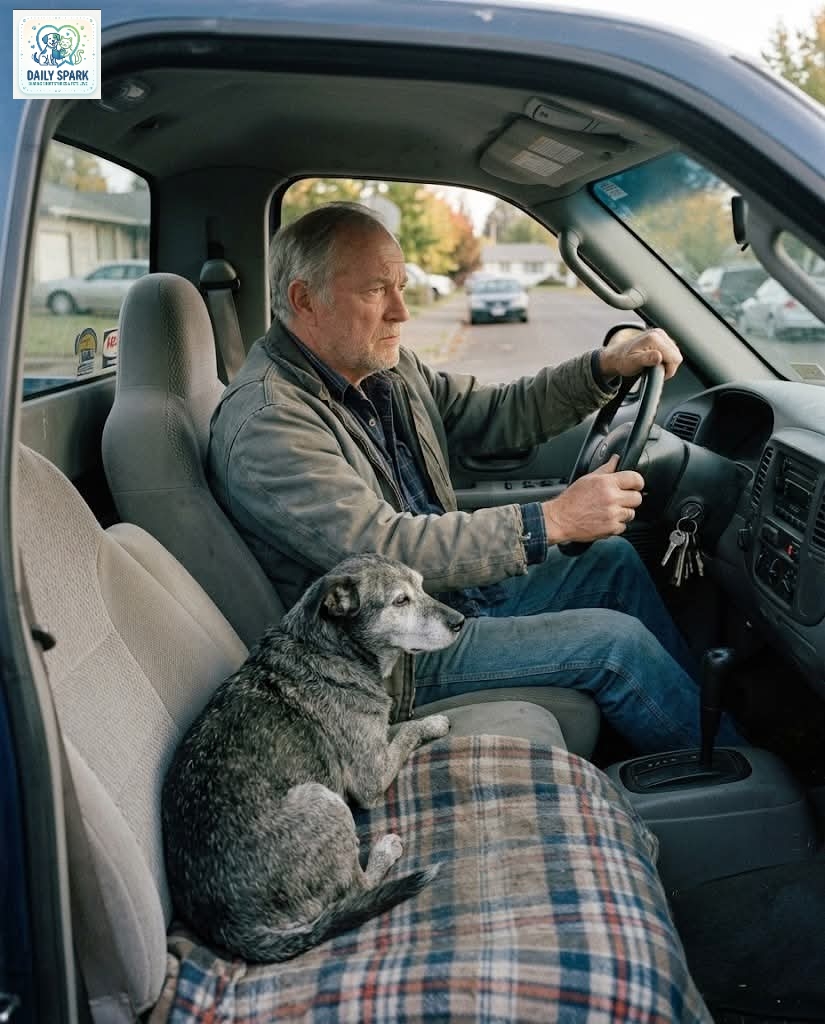
That morning, I put Otis’s old blanket on the passenger seat and started the truck knowing I was supposed to come home alone.
I was sixty-nine, and lately every decision seemed to come down to what I could afford to lose.
Two years earlier, my wife, Linda, died after forty-one years of marriage.
After that, my life came apart a little at a time.
I lost my maintenance job when the apartment complex changed hands.
Small repair jobs helped, but people weren’t exactly lining up to hire a man pushing seventy with a bad shoulder.
Then I lost the house.
It wasn’t much, but Linda and I had built our life there.
One kitchen cabinet still had a dent from the day she dropped a cast-iron skillet.
The back porch leaned slightly left.
Otis had worn a narrow path through the grass between that porch and the fence.
When I packed, I left almost everything behind.
But I took Otis.
He was thirteen, gray around the muzzle, stiff in his back legs, and stubborn enough to stand beside the refrigerator for twenty minutes if he thought cheese might appear.
He had been Linda’s dog as much as mine.
During her last months, he slept beside her bed every night.
After she died, he started sleeping on her side of mine.
For a while, that was how I knew I wasn’t completely alone.
Then I got accepted into a small senior apartment I could actually afford.
There was one problem: no dogs.
I called everyone I knew.
Nobody could take an old dog with arthritis who needed help getting into a car and sometimes had accidents indoors.
I contacted places that helped rehome animals, but older dogs were hard to place.
Every answer sounded the same.
Maybe.
Wait.
We’ll see.
I was running out of time, so I finally called a veterinary clinic and made an appointment.
Even saying the words made me sick because Otis wasn’t dying.
That was the worst part.
He still ate.
Still wagged his tail.
Still followed me from room to room.
But I had convinced myself there was nowhere left for him to go.
That morning, I made him scrambled eggs.
He ate them like it was Christmas, then climbed into the truck without hesitation.
Halfway there, he rested his head on my thigh.
I pulled into an empty parking lot and shut off the engine.
”I’m sorry, buddy,” I said.
Otis lifted his head and licked my hand.
I cried harder than I had at Linda’s funeral.
For five minutes, I almost turned around.
Then I pictured myself sleeping in my truck with an old dog beside me, both of us getting worse, and I started driving again.
About fifteen miles outside town, the truck began making a grinding sound.
The steering jerked hard.
Before I could recover, the truck left the road and dropped into a deep drainage ditch hidden behind tall weeds.
My shoulder slammed into the door.
My head hit something.
When I opened my eyes, everything tilted.
The driver’s door was jammed.
My phone had fallen somewhere beneath the seat.
The engine was off, but heat was building inside the cab fast.
Otis was whining.
The passenger door had popped partly open.
I reached across, shoved it wider, and pointed outside.
”Go.”
He stared at me.
”Go, Otis.”
Finally, he climbed down and disappeared through the weeds.
I remember thinking that at least I had done one decent thing that day.
At least he had a chance.
Then I heard scratching.
Otis came back.
He pushed into the truck and climbed across the passenger seat toward me, his paws shaking as he pressed his body against my side.
I tried to push him away.
”Don’t stay here.”
He wouldn’t move.
I pushed again, and he licked my face.
Something in me gave way.
That morning, I had been driving him somewhere because I had decided his life had become too difficult for mine.
Now I was trapped in a ditch, barely able to stay awake, and that old dog refused to leave me.
”I was going to give up on you,” I whispered.
Otis rested his head against my chest.
I don’t know how long we stayed like that.
The cab kept getting hotter, and I drifted in and out until Otis suddenly lifted his head.
Then he climbed out of the truck again and disappeared into the weeds.
I waited, listening to the dry rattle of the tall grass outside.
My head throbbed, and every breath felt like pulling glass through my chest.
The steering wheel pressed hard against my ribs, pinning me in place as the midday heat baked the cab like an oven.
Minutes ticked away, measured only by the heavy beating of my own heart.
I thought about Linda, wondering if this was how it ended—stuck in a weed-choked ditch, paying the price for a coward’s choice.
Then, a sharp, familiar bark cut through the silence.
It wasn’t the weak, stiff-legged sound of an old dog giving up.
It was sharp, urgent, and angry.
I forced my eyes open, staring through the cracked windshield.
A few yards up the embankment, near the edge of the country two-lane road, Otis stood awkwardly on three legs, barking toward the pavement.
Beside him stood a red pickup truck with its hazard lights flashing, stopped right on the shoulder.
A man in a high-visibility highway maintenance vest scrambled down the ditch, pushing through the brush.
“Hey! In the truck! You alive in there?”
I tried to shout, but it came out as a gravelly croak.
“Here… inside.”
The worker reached the jammed driver’s side door, threw his weight against it until rusted metal shrieked, and finally popped it free.
Cool air rushed into the burning cab like a miracle.
“Hang on, old-timer,” the worker said, bracing my back.
“Let’s get you out of this heat.”
It took both of us—with Otis nudging my boot encouragingly every step of the way—to climb out of the ditch and up onto the solid gravel shoulder.
Paramedics arrived ten minutes later, sirens wailing across the empty valley.
They checked my shoulder, wrapped my head, and put me on a stretcher.
As they loaded me into the back of the ambulance, a paramedic reached for Otis, who was trying to climb up the metal steps right behind me.
“Whoa, hold on, buddy. You can’t ride in here.”
I managed to sit up, ignoring the sharp pain in my shoulder, and grabbed the edge of the stretcher.
“He stays,” I said, looking right at the paramedic.
“He goes wherever I go.”
The paramedic looked at the gray-muzzled dog, then at me, and slowly lowered his hands.
“Alright. Hop in, boy.”
Three weeks later, things looked different.
My shoulder was healing, the old truck was totaled, but a local community aid group helped me secure a small ground-floor unit on the edge of town—one that welcomed pets, after all.
I never made it to that veterinary clinic.
Instead, every afternoon, Otis and I sit on the small front porch of our new place.
There’s a narrow path worn through the grass between the screen door and the sidewalk now.
Sometimes, when the afternoon sun catches his cloudy eyes, I remember the man I was in that truck—the man who thought he had nothing left to lose.
I look down at him sleeping beside my chair, breathing heavy and deep, and I know the truth.
I hadn’t lost everything.
I had just forgotten how to fight.

Leave a Reply