The Iowa Farmer Thought His Father Needed Help With One Last Harvest—Then He Saw Two Lawn Chairs Waiting Beside The Field
“Caleb, you need to come see the beans.”
My father had said it four times that week.
Each time, I gave him the same answer.
“I will, Dad. Soon.”
Soon.
That word can become a dangerous habit when you think the people you love will always be there waiting for you.
I was 58 years old, running the same Iowa farm my grandfather had started with two horses, a borrowed plow, and more stubbornness than money.
By that fall, I was close to losing it.
Three bad seasons had stacked themselves on top of each other.
Equipment repairs.
Rising costs.
A crop that looked better from the road than it did on paper.
There was a folder on my kitchen table I had stopped opening.
Inside were letters from the bank.
I knew what they said.
I didn’t need to read them again.
My wife, Ellen, would sometimes find me sitting there at two in the morning with cold coffee in my hand, staring through the window toward the machine shed.
“You can’t fix everything tonight,” she’d say.
Maybe not.
But when you’re the third generation to work a piece of ground, losing it doesn’t feel like losing property.
It feels like being the man who dropped something his grandfather carried through the Depression and his father carried through droughts, debt, and years when the crops barely paid for seed.
My father, Harold, was 86.
He lived ten miles away in the little white farmhouse he’d moved into after handing our home place over to me.
His knees were bad.
His hearing wasn’t much better.
But his mind still ran straight down the rows.
Every Sunday, he’d call.
“How’s the south field?”
“Too dry.”
“Did you check the bin fan?”
“Yes, Dad.”
“Beans turning yet?”
“A little.”
Then he’d say it.
“You ought to come see them.”
I thought he was worried about something.
A fence.
A drainage ditch.
Maybe deer getting into the field.
There was always something on a farm.
So I kept putting him off.
Monday became Thursday.
Thursday became Saturday.
That Saturday evening, he called again.
His voice sounded different.
Not weak.
Just quiet.
“Caleb,” he said, “come see the beans.”
I rubbed my eyes.
I’d been underneath a combine most of the afternoon trying to fix a problem I couldn’t afford to pay someone else to fix.
“Dad, if something’s broken, tell me what it is.”
There was a pause.
“Nothing’s broken.”
“Then what do you need?”
Another pause.
“You.”
I don’t know why that one word got through when everything else hadn’t.
Maybe because fathers like mine didn’t say things like that.
Harold Mercer had told me he was proud of me exactly twice in my life.
Once when I graduated high school.
Once when my son was born.
He believed love was mostly a verb.
It looked like getting up first.
Keeping the furnace going.
Fixing your kid’s truck without mentioning he’d backed it into a fence.
Leaving half a sandwich wrapped in wax paper on the tractor seat because you knew he’d forgotten lunch.
So when he said, “You,” I shut the toolbox.
Ellen looked surprised when I walked inside and grabbed my jacket.
“Where are you going?”
“To see the beans.”
She smiled.
“Good.”
I found Dad’s pickup parked beside the field he’d farmed most of his adult life.
It was an old gravel lane I hadn’t driven down in months.
The beans had turned gold-brown, their leaves thinning in the September light.
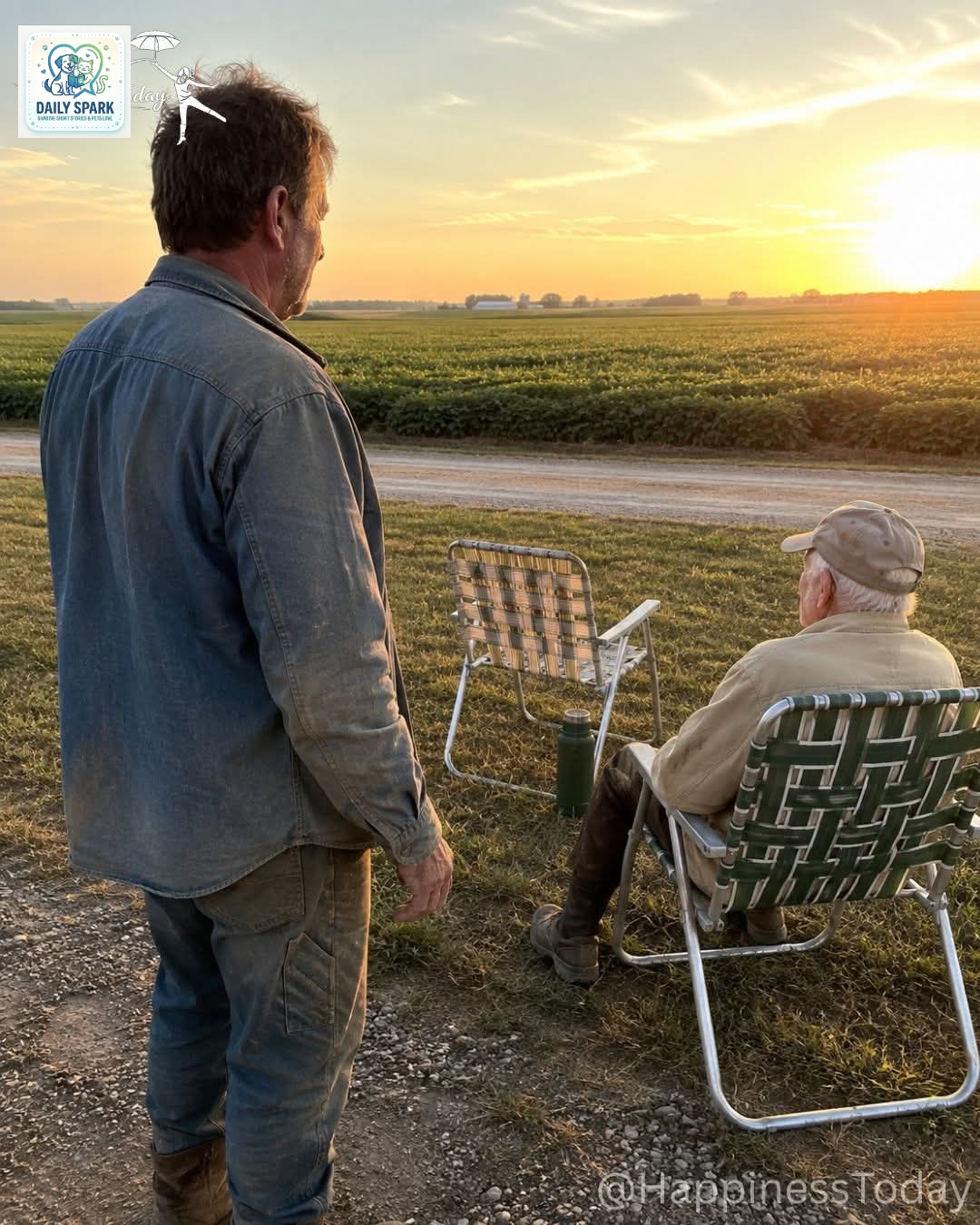
And there, at the edge of the field, sat my father.
Two folding lawn chairs were beside him.
Between them was an old green thermos.
That was it.
No broken fence.
No equipment.
No emergency.
Dad lifted one hand.
“You’re late.”
I checked my watch out of habit.
“For what?”
“The sunset.”
I nearly laughed.
“Dad, I’ve got a combine in pieces.”
“I know.”
“I’ve got corn that needs checking.”
“I know.”
“The bank—”
“I know about the bank too.”
That stopped me.
I stared at him.
He poured coffee into the thermos lid and handed it to me.
Then he pointed at the empty chair.
“Sit down.”
I sat.
Not because I wanted to.
Because he was 86 years old, and suddenly I realized I couldn’t remember the last time he’d asked me for anything.
For several minutes, neither of us spoke.
The field stretched out in front of us, glowing under a sky turning orange around the edges.
Crickets worked the ditch.
Somewhere down the road, a dog barked.
Dad took a slow drink from his coffee.
“You remember your first harvest out here?”
I did.
I was twelve.
Dad had let me steer the old tractor while he walked beside it for the first hundred yards.
I thought I was doing everything myself.
Years later, I understood his hand had been close enough to grab the wheel the whole time.
“You yelled at me because I ran over a row,” I said.
Dad grinned.
“You ran over six.”
We both laughed.
Then his face settled again.
“I’ve been thinking about this field.”
My stomach tightened.
I thought we were finally going to talk about money.
About whether we should sell eighty acres.
About whether I had failed.
Instead, he said, “Your mother used to bring supper right over there.”
He pointed toward a grassy patch near the ditch.
“Fried chicken in that red cooler. Remember?”
I nodded.
I hadn’t thought about that cooler in thirty years.
Suddenly I could almost smell it.
Chicken.
Sweet corn.
Coffee.
Diesel fuel.
Dust.
My mother calling us in from the field while the sun sank behind the barn.
Dad stared ahead.
“Funny thing about getting old,” he said. “You stop remembering yields.”
I looked at him.
He continued.
“I couldn’t tell you what we made per acre in 1978. Couldn’t tell you what fertilizer cost in 1985. I worried plenty about it back then.”
He tapped one finger against the thermos.
“But I remember you riding on the fender beside me.”
My throat tightened.
“I remember your mother’s sandwiches. I remember your little boots sitting by the back door. I remember you falling asleep in the truck before we got home.”
He turned toward me.
“Those are the things that stayed.”
I looked away toward the beans.
He knew me well enough to give me a second before continuing.
“I hear you’re working until midnight.”
“Sometimes.”
“Ellen says you hardly eat.”
“Ellen talks too much.”
Dad smiled.
“Your mother did too. Usually when she was right.”
Then he said something I’ll remember as long as I live.
“I don’t need you to save everything, Caleb.”
I stared at him.
His eyes were wet.
That scared me more than any letter from a bank.
He looked back at the field.
“I just miss my boy.”
I was 58 years old.
My hands were cracked from grease and harvest dust.
My hair had gone gray around the temples.
I had a grown son of my own.
But sitting beside my father that evening, I wasn’t a farmer with debt.
I wasn’t a husband worrying his wife.
I wasn’t the third-generation owner of anything.
I was somebody’s boy.
And my father missed me.
I put my coffee down.
“I thought you wanted me to check the crop.”
“I’ve seen crops.”
He shrugged.
“I wanted to see you.”
That was the first Sunday evening we sat beside the field.
It wasn’t the last.
No matter what was broken, overdue, unpaid, or waiting, I started driving those ten miles every Sunday.
Sometimes Dad brought coffee.
Sometimes Ellen packed sandwiches.
Once my son came too, and three generations sat there arguing over which tractor had been the worst piece of machinery our family ever owned.
Dad voted for the old red one.
I still say it was the green one.
Those Sundays didn’t solve my problems.
The bank didn’t erase the debt because I watched sunsets with my father.
The machinery didn’t repair itself.
The crops didn’t suddenly become better.
But something in me changed.
I stopped treating every hour that wasn’t spent working as an hour wasted.
I started eating supper at the table again.
I called my son without needing a reason.
When Ellen stood on the porch at night, I sometimes stood beside her instead of walking past toward another job.
We eventually sold one small parcel of ground.
I hated signing those papers.
Dad came with me.
When we walked outside afterward, I apologized.
“I couldn’t keep all of it.”
He looked almost irritated.
“Land’s land.”
Then he put his hand on my shoulder.
“Family is family.”
Dad died the following spring.
Quietly.
At home.
His old green thermos was still sitting on the kitchen counter.
A few days after the funeral, I drove to the bean field by myself.
There were no beans yet.
Just dark Iowa soil waiting for planting.
I carried out the two lawn chairs.
One for me.
One for him.
I poured coffee into the thermos lid and watched the sun go down over ground my family had loved for generations.
And for the first time, I understood something my father had probably known for years.
We spend so much of our lives trying to preserve the things our parents built that sometimes we forget the reason they built them in the first place.
It wasn’t so we’d become servants to the farm.
It wasn’t so we’d measure our worth in acres, bank balances, or how tired we were at the end of the day.
They worked that hard so their children could have a life.
A home.
A place to return to.
Someone beside them when the sun went down.
I nearly missed my father’s last harvest because I was trying so desperately to save the farm he had given me.
Turns out, the last thing he wanted me to save was a Sunday evening with him.
Sometimes the inheritance our parents care about most isn’t the land they leave us.
It’s the time we finally remembered to giving them.

Leave a Reply