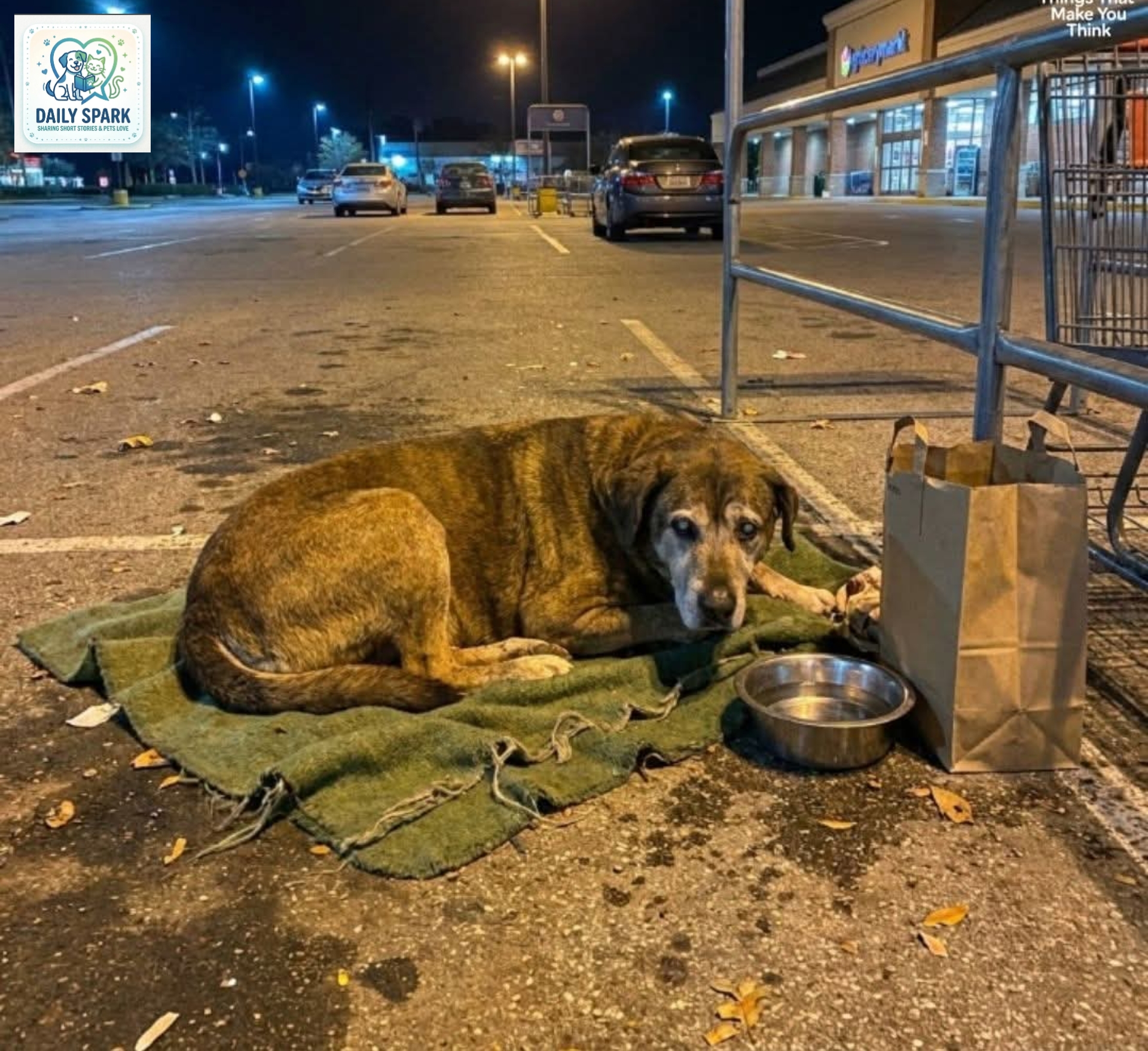
The old dog had been tied to a shopping cart for three nights, but every morning, his water bowl was clean and full.
I first saw him after my shift ended a little past midnight.
He was lying beside the cart return at the edge of the parking lot, curled up on an old green blanket. He was a big brown dog with a gray muzzle, cloudy eyes, and one back leg that didn’t move quite right.
A paper grocery bag sat beside him. Inside were two cans of dog food, a plastic bowl, and a folded note.
His name is Otis. He didn’t do anything wrong.
That was all it said.
I stood there for a minute, angry at a person I had never met.
I was fifty-two years old, tired from working nights, and already in a bad mood most days. My wife had been gone for two years. My son lived three states away and called less often than I thought he should.
Back then, I had strong opinions about people who left.
I figured whoever had abandoned Otis was just another selfish person who wanted an easy way out.
I gave him some water and told the morning manager about him. I assumed someone would take care of it.
The next night, Otis was still there.
The blanket had been pulled closer around him. The food bag was lighter. His water bowl looked freshly washed.
On the third night, I found the same thing.
Someone was feeding him.
Someone was giving him water.
But no one was taking him home.
When I reached for the rope tied around the cart, Otis lifted his head. He didn’t growl. He just stared past me toward the road.
Every time headlights came around the corner, his ears lifted.
I untied him and tried to lead him toward my truck.
He wouldn’t move.
I pulled gently. He planted his front paws and looked back at the empty space beside the cart.
“Come on, old man,” I said. “You can’t stay here.”
He lay down.
I don’t know why I said what I said next.
“I’ll bring you back tomorrow morning.”
Otis slowly stood up.
That should have told me everything.
At my house, I set up a blanket beside the couch and filled a bowl with food. Otis sniffed it but didn’t eat.
I made myself a sandwich and sat at the kitchen table.
Only then did he start eating.
He took a few bites, looked at me, then took a few more.
That night, he refused the dog bed I made for him. Instead, he slept against the front door.
At 3:17 in the morning, he woke me by scratching at the wood.
I let him outside, thinking he needed to use the yard.
Instead, he pulled toward my truck.
The same thing happened the next morning.
And the morning after that.
Each time, I drove him back to the store. He sat under the parking lot light and watched the road.
On the fourth morning, I decided to stay.
I parked across the lot, turned off the headlights, and waited with Otis beside me.
A little before four, an old silver sedan rolled in and stopped near the cart return.
A woman stepped out carrying a jug of water and a small food container.
She looked to be in her sixties. Her hair was pulled back in a loose knot. Her coat was too thin, and she moved like someone who had not slept well in a long time.
The second she saw the empty cart, she dropped the water.
Then she looked straight at Otis and whispered one word that changed everything.
“Otis?”
The silver sedan’s headlights flickered off, plunging the parking lot back into shadow, but the woman didn’t move. Her hands hovered over the open water jug as she stared at the empty space where the shopping cart usually stood.
Otis didn’t bark. He let out a low, raspy whimper—the sound of an old engine finally turning over after a long freeze—and began to drag his stiff back leg across the asphalt toward her.
I stepped out of my truck, closing the door softly so I wouldn’t break whatever fragile thread had just connected the two of them.
The woman spun around, her eyes wide with panic, clutching the plastic food container to her chest as if she were bracing to defend herself or run. But when Otis reached her, he didn’t care about the fear or the cold or the empty cart. He pressed his massive gray muzzle straight into her trembling hands, his tail giving a slow, rhythmic thud against the ground.
She dropped to her knees right there in the gritty dirt of the parking lot, burying her face in his thick fur, her shoulders shaking with quiet, exhausted sobs.
I walked over slowly and stood a few feet away.
“He waited for you,” I said, my voice rough in the predawn air. “Every single night. Right here.”
She looked up, wiping her face with the back of a thin sleeve. Her eyes were rimmed with red, shining with a mix of shame and deep relief.
“I didn’t want to leave him,” she whispered, her voice cracking. “I lost my apartment last month. The landlord wouldn’t allow pets in the temporary shelter downtown. I tried… I tried to find someone who could take him, someone with a warm floor and a yard, but every shelter was full. I thought—I thought if I left him near the store, where people are kind, someone might see how good he is and give him a home until I got back on my feet.”
She stroked Otis’s gray head, her fingers trembling against his fur. “I came back every morning to make sure he had water. I just… I couldn’t bear the thought of him being thirsty.”
I looked down at the old dog. He was looking back and forth between us, his cloudy eyes calm, as if he knew everything was finally going to be all right.
For two years, since my wife passed and my son moved away, my own house had felt like a parking lot—quiet, empty, and waiting for someone who wasn’t coming back. I had spent all my time judging people who walked away, forgetting that sometimes people don’t leave because they’re cruel; sometimes they leave because they’re drowning.
“The shelter downtown might be full,” I said quietly, stepping closer and offering her my hand to help her up. “And your temporary room might not allow dogs. But my place has a big yard, a soft couch, and an extra bedroom with plenty of space for a woman who loves her dog enough to walk two miles in the freezing dark just to make sure his water bowl is clean.”
She stared at me, stunned, the morning light beginning to break pale and golden over the horizon.
Otis gave one sharp, happy bark, turned around, and started waddling toward my truck like he owned the place.
We didn’t go back to the cart return. We all piled into the cab, the heater blowing warm air against our legs, and drove home together—proving that sometimes, the things we lose in the dark are simply waiting for the right morning to find their way back, and that opening your heart to someone else’s storm is the only way to finally clear the weather in your own life.

Leave a Reply