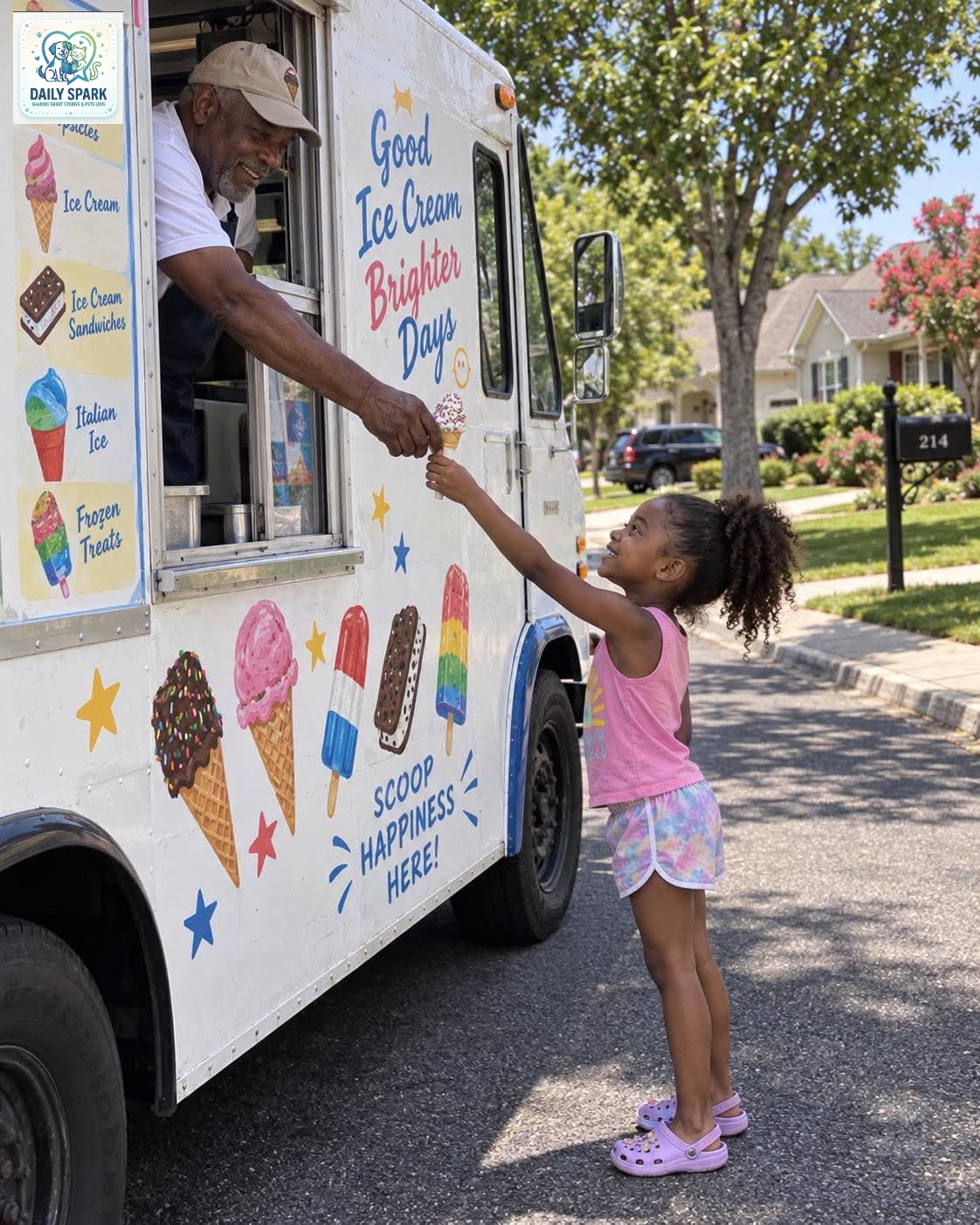
For two weeks my nine-year-old kept coming home with free ice cream from the same truck. Then the driver handed her a folded note and told her to make sure her mom read it — and when I finally walked out there myself, he looked at me and said my name.
It started in the second week of July.
We live on about as ordinary a street as exists in this country, and the truck comes through three or four evenings a week in the summer with the music on.
The second my daughter hears it she’s at the front door with her hand out for three dollars.
That afternoon she came back in holding a strawberry shortcake bar.
I thought you were out of allowance, I said.
I didn’t need any. The man gave it to me.
I assumed he was being kind. There are always eight or nine kids around that truck.
Then it happened again two nights later. And again on the Saturday.
By the fourth time I asked her properly why this guy kept handing her free ice cream.
She shrugged the way nine-year-olds shrug.
He says strawberry was your favorite too.
I put down what I was holding.
My favorite?
She nodded. He said you always got that one.
Strawberry shortcake bars were the only thing I ever bought off an ice cream truck between about six and eleven. My grandmother used to say I’d eat one in a snowstorm.
Did you tell him my name, I said.
No.
Did you tell him what I used to eat?
No. He told me.
I asked her four separate times over five days, in four different ways. Nine-year-olds contradict themselves constantly under repeated questioning.
She didn’t contradict herself once.
Two evenings later she came in with a folded piece of paper instead of a bar.
He said make sure your mom reads this.
I didn’t read it. I put it face down on the counter and I got my shoes.
The truck was still two houses up. I walked out with her hand in mine, which she found embarrassing, and stood behind her at the window.
He was late fifties, early sixties. Gray hair under the company cap, glasses, a plaid short-sleeve shirt. He looked like a man who’d recently retired from something else.
He saw her first and said hey, kiddo, in the automatic way you say it to a regular.
Then he saw me standing behind her.
And he stopped. Not dramatically. He looked at my face the way you look at a face you’re trying to place, and he kept looking about four seconds longer than a stranger does.
Then he said, you’re her mom?
Yes.
He nodded a couple of times, slowly, like a man agreeing with himself about something.
And then he said my first name.
I hadn’t told him. My daughter hadn’t told him — I asked her twice afterward and she’s never lied to me about anything that mattered.
Do I know you, I said.
He gave a small laugh with nothing funny in it at all.
Probably not anymore.
That’s not an answer, I said.
He opened his mouth — and I didn’t wait for it.
I picked my daughter up, nine years old and forty-eight pounds of complaint, carried her back down the sidewalk to my own house, and locked the door.
Then I called my husband. Then I called the company and gave them the number off the side of that truck.
And at ten past eight, with her upstairs and the doors locked, I sat down at my kitchen table and unfolded the paper.
Four sentences. And a name at the bottom I hadn’t heard spoken out loud in about twenty years.
The handwriting was cramped, slanting sharply to the left like it had been written in a hurry on a vibrating dashboard.
I watched you grow up on this exact street before the maple tree in your front yard was half this size. Your father used to lend me his socket wrench when my old Ford broke down in ’94. I’m sorry I wasn’t there when the bank took everything and your family had to scatter to the wind.
My breath hitched. The memory slammed into me with the force of a physical blow—the summer of my fourteenth year, the quiet, kind-eyed neighbor who lived two doors down, the man everyone called Uncle Ray before he mysteriously packed up his station wagon one rainy Tuesday and vanished without a single goodbye.
The note continued, trembling slightly near the bottom crease:
I didn’t mean to scare you. I just wanted to see if the little girl with the strawberry shortcake habit grew up to be okay. Tell your mother I still have the wrench.
At the very bottom, signed in block letters beneath a faded smudge of grease, was a name I thought had been erased from my history completely: Raymond Vance.
My phone buzzed on the laminate tabletop, startling me so badly I nearly knocked over my glass of water. It was my husband, frantic, asking if the police had arrived yet.
”Don’t call them,” I whispered, staring down at the paper as a single, heavy tear finally broke free and tracked down my cheek. “Don’t call anyone.”
I stood up from the kitchen table, walked over to the window, and looked out into the gathering dusk. The street was quiet now, the ice cream truck long gone, leaving only the sound of cicadas and the rustle of the maple tree leaves in the evening wind.
Ray hadn’t come back to haunt us or to cause harm. He had come back because some ghosts don’t haunt out of malice—they just want to know that the people they left behind in the wreckage of the past managed to build a safe harbor after all.




Leave a Reply