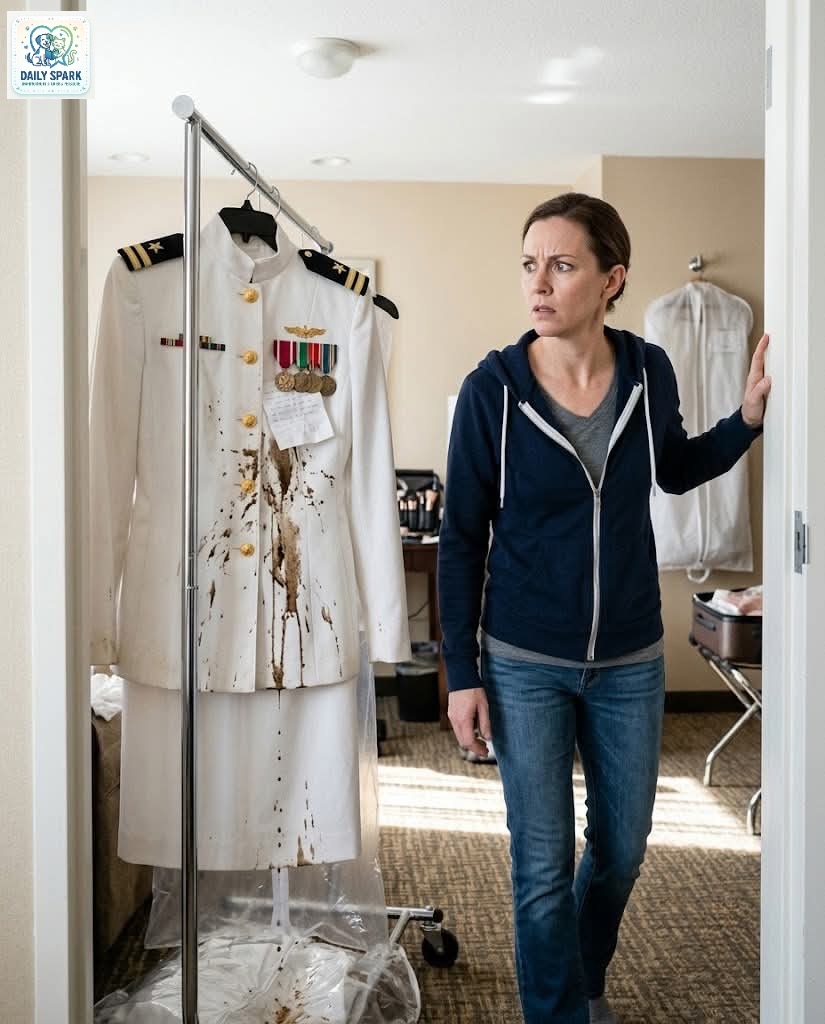
Three hours before my military wedding, I stepped into the bridal suite and found my ceremonial dress uniform hanging there like a crime scene. Someone had poured foul-smelling sludge over the white jacket, destroying the medals, ribbons, and gold trim I had spent nearly twenty years earning. Pinned to the front was a handwritten note: “Know your place.”
The smell hit first—sour, heavy, impossible to ignore. Then I saw the thick gray-brown mess worked into the seams and soaked through the ribbon rack. Gold braid that had been pressed perfectly that morning hung stiff and filthy. I stood there with one hand still on the door, staring at a uniform that had survived nearly two decades of my life only to be deliberately ruined hours before I was supposed to get married.
I wanted to rip the note down. I didn’t. Whoever had done this wanted a reaction, and somewhere along the way the military had taught me that anger was most useful after you understood what you were looking at.
I pulled out my phone, photographed the jacket exactly where it hung, then called the person I was supposed to marry.
“Come to the bridal suite,” I said. “Come alone.”
Their voice changed immediately. “What happened?”
“Just come.”
They were there minutes later, still half-dressed for the ceremony. They pushed through the door, saw the jacket, and stopped so abruptly that their hand stayed wrapped around the handle.
Then they saw the note.
“What?” I asked.
Instead of answering, my partner stepped closer and read it again. Their eyes moved from the words to me, then back to the paper.
“Where exactly was this?”
“Pinned to the jacket.”
They pulled out their phone.
That was when the story changed.
At 11:43 the night before, their mother had sent a message I had never seen: “Before you marry her, make sure she knows her place.”
Same phrase. Same contempt.
I looked at my partner. “Why didn’t you show me this?”
“Because I thought she was angry and venting.” Their thumb hovered over the screen. “She’s been pushing me for weeks to talk you out of wearing the uniform. She said it would make the wedding about your career instead of the family.”
I stared at the ruined jacket again. The medals were mine. The years were mine. But suddenly this wasn’t only about destroying something expensive or embarrassing me before a ceremony.
Someone had tried to decide which part of me was allowed to walk into my own marriage.
My partner started toward the door.
I caught their wrist. “A text isn’t proof she did this.”
“No,” they said. “But it’s enough for me to ask her.”
I told them I wasn’t turning the wedding into a screaming match based on suspicion. I wanted one answer first: had their mother been anywhere near this room?
My partner nodded, but the look on their face told me the conversation was already bigger than the uniform.
I carefully removed the note and held it by the edge. My partner looked at it once more, then at the message glowing on their phone.
“Give me that,” they said.
Before I could change my mind, my partner took the note from my hand and walked straight toward the room where their mother was waiting.
The Confrontation
The hallway leading to the family wing was suffocatingly quiet. My boots made no sound on the thick runner, but my partner’s quick, hard steps echoed against the mahogany walls.
When we reached Suite 402, the door was slightly ajar. Soft classical music drifted out, clashing violently with the sour, chemical stench that still clung to my fingers from the bridal suite.
My partner didn’t knock. They pushed the door open with enough force to make it bang against the wall.
Eleanor Vance sat at the vanity table, adjusting a pearl earring in the mirror. She looked immaculate in a silver silk gown, an expensive glass of champagne resting within arm’s reach. She turned slowly, a polished, practiced smile on her face, expecting the wedding coordinator or a nervous relative.
Instead, she saw her child standing in the doorway—and she saw me behind them.
”Darling, shouldn’t you be dressing?” Eleanor asked, her voice dripping with smooth, practiced affection. “The photographer will be here in less than two hours, and—”
My partner didn’t let her finish. They stepped into the room, holding the ruined, foul-smelling note out like a weapon, dropping it squarely onto the silver-tray vanity among her cosmetics.
Eleanor blinked, her gaze dropping to the scrap of paper, then flicking up to her child’s face. “What is this nonsense?”
”You tell me,” my partner said, their voice shaking with a cold, terrifying fury I had never heard from them before. “You sent a text last night saying she needed to ‘know her place.’ And then someone walked into her suite and destroyed twenty years of her life with chemical sludge.”
Eleanor stood up slowly, her chin lifting with defensive arrogance. “I have no idea what you are talking about. Chemical sludge? Really, the dramatics today are quite exhausting. I expressed an opinion about the optics of a military costume at a high-society wedding, and suddenly I’m a vandal?”
”You knew the room number,” I said, stepping past my partner.
My voice was quiet, stripped of all emotion, the exact tone I used when briefing a tactical unit before an objective. I didn’t raise my voice. I didn’t yell. I just locked my eyes onto hers.
”The front desk only gives room keys to immediate family and bridal party leads,” I continued, closing the distance between us until she was forced to look straight up into my eyes. “You asked for a duplicate key this morning under the guise of dropping off a welcome gift. The front desk log has your signature, Eleanor.”
The color drained from Eleanor’s face. The polished, untouchable matriarch of the Vance family flickered for a fraction of a second, replaced by a woman who realized she had underestimated her opponent.
”Even if I did visit the room,” Eleanor snapped, recovering her composure with a bitter sneer, “you think a court will care about a lost costume? Or a messy jacket? This family built half the county, and your little army games don’t mean a damn thing in the real world. You are an outsider. A temporary fixture. I did what was necessary to protect my child from marrying a soldier who loves an institution more than a family.”
My partner stared at her mother, horror dawning in their eyes. “You did it. You actually did it.”
”I saved you!” Eleanor hissed, finally dropping the mask. “Look at her! She brings mud and violence into our world. She doesn’t belong here!”
The Decision
For a long moment, the room was completely silent.
I looked down at the note on the vanity. Then I looked at my partner. The person I was supposed to pledge my life to stood frozen, caught between the toxic gravity of the family that raised them and the future we had planned together.
”You’re right, Eleanor,” I said softly, turning back to face her. “I am a soldier. And soldiers know how to triage a threat.”
I reached into my pocket, pulled out my phone, and tapped the screen twice.
Within thirty seconds, heavy, deliberate footsteps echoed in the hallway. Two local police officers, accompanied by the hotel’s head of security, stepped into the doorway. They weren’t there by accident; I had alerted the desk detail the moment I left the suite, instructing them to hold the security logs and dispatch officers if my suspicions were confirmed.
Eleanor’s eyes widened in sheer disbelief as the lead officer stepped forward, his badge gleaming under the vanity lights.
”Mrs. Eleanor Vance,” the officer said, pulling a notebook from his pocket. “You’re being detained for questioning regarding destruction of private property and unlawful entry.”
”You can’t do this!” Eleanor shrieked, her silk gown rustling wildly as she backed away from the desk. “Do you know who my husband is? Do you know who I am?!”
”That,” the officer replied, clicking his pen, “is going to make the paperwork much more interesting.”
As they escorted her out of the room, Eleanor glared at me over her shoulder, her face twisted in absolute hatred. “You’ll never be part of this family!” she screamed down the corridor. “She’ll leave you before the year is out!”
The heavy oak door clicked shut, sealing out her voice.
A New Uniform
The room felt suddenly vast, quiet, and heavy with the weight of what had just happened.
My partner sank into the edge of the velvet bed, burying their face in their hands. Their shoulders shook silently. I walked over, kneeling down before them, gently pulling their hands away from their face. Their eyes were red, filled with a mixture of grief, embarrassment, and profound relief.
”I am so sorry,” they whispered, their voice breaking. “I should have cut her off years ago. I should have seen what she was.”
”You see it now,” I said, my voice steady. “That’s all that matters.”
”The wedding…” They looked around the room, realization dawning. “Your dress uniform… we can’t do the ceremony the way we planned.”
I stood up, offering them my hand. A small, faint smile touched the corners of my lips.
”Who said we need that uniform?” I asked. “The medals are ruined, but the twenty years of service are in my head and my heart, not hanging in a closet. And more importantly… the person standing at the end of the aisle hasn’t changed.”
My partner looked up at me, tears spilling over their lashes, and finally smiled—a real, brilliant smile that cut through all the shadows of the morning.
Two hours later, the chapel doors swung open.
There were no military sabers forming an archway, and I wasn’t wearing my white ceremonial jacket. Instead, I stood at the altar in a sharp, elegant civilian suit, wearing a single miniature service ribbon pinned neatly to my lapel—a quiet, unyielding reminder of where I came from.
When my partner walked down the aisle toward me, stepping completely away from the toxic dynasty that tried to break us, I knew one thing with absolute certainty:
Some battles you fight with weapons. Others you win by simply refusing to let the enemy win. And as we spoke our vows beneath the warm afternoon light, I knew that whatever storms lay ahead, we had already weathered the worst of them together.

Leave a Reply