The Inheritance of Truth
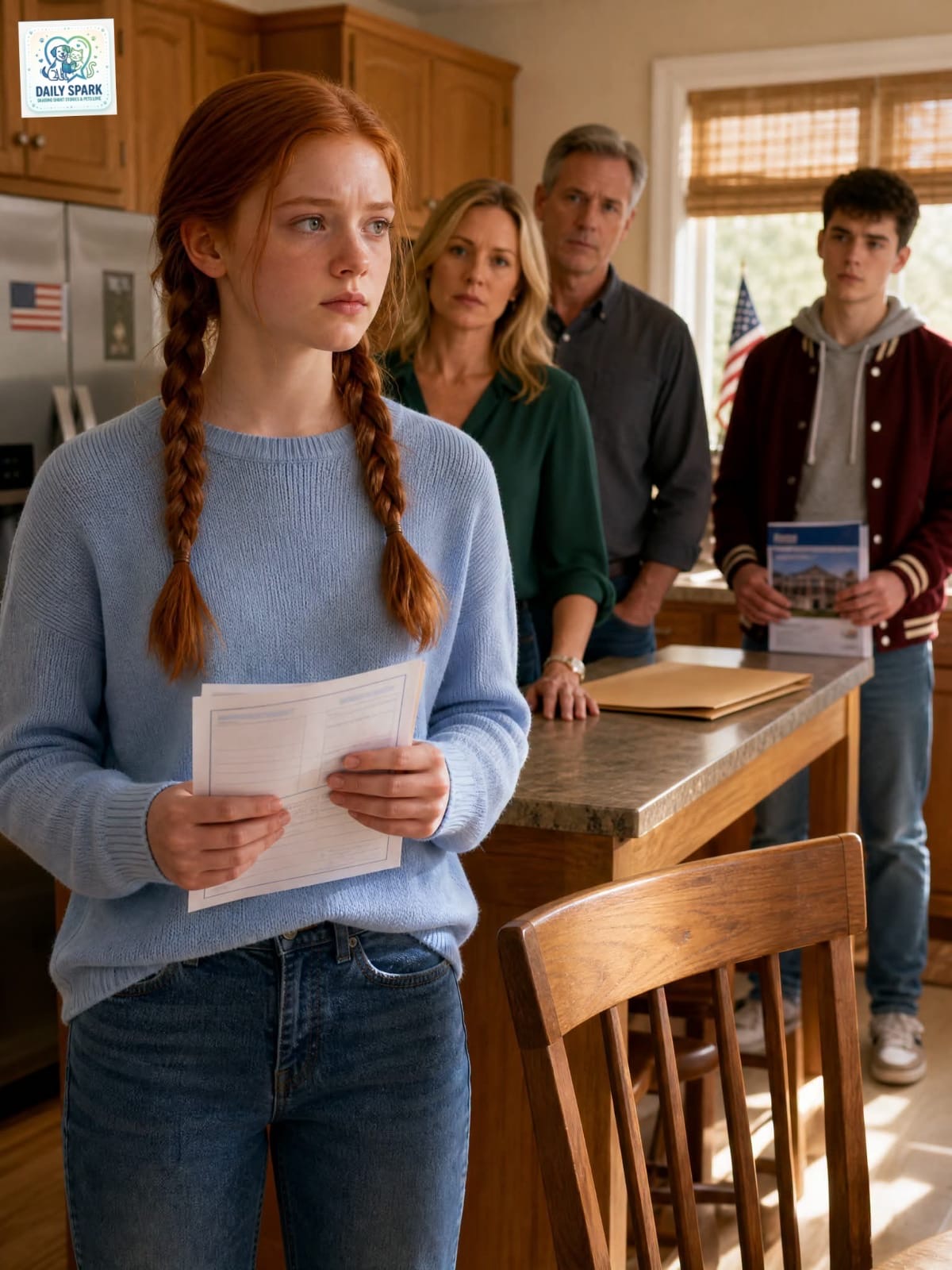
My parents sat me down at the kitchen table and said, “We’re not using your brother’s college fund for your treatment.” I was fifteen, dealing with a serious illness, and suddenly understood that I would have to find my own way. Before dawn, I left with seventy-three dollars, one backpack, and a quiet plan—one that would reshape our family for years to come. What my parents did not realize was that I had photographed every page on that table, saved every message, and remembered the name of the one person they had spent years making sure I never became too close to.
I still remember the sunlight coming through the white kitchen blinds that afternoon, striping the oak table where my mother had placed the insurance letter.
Mom sat across from her hands folded neatly beside it. Dad stood behind her chair, arms crossed. Upstairs, my brother Caleb had music playing.
Everything about the room looked ordinary.
That was what made it worse.
“What happens now?” I asked.
Mom glanced at the paperwork.
“We’re not moving forward with the treatment.”
I stared at her. “The specialist said I need it.”
Dad shifted his weight. “We can’t spend everything on this. Caleb starts college next year.”
For several seconds, the refrigerator humming behind me was the loudest sound in the room.
“You have savings.”
“That money already has a purpose,” Mom said.
Then Dad said the sentence I would remember years later with perfect clarity.
“We can’t throw away your brother’s future.”
I looked directly at him.
He seemed to realize how the words sounded, but he did not take them back.
“My treatment is throwing away his future?”
Mom’s expression tightened. “Don’t make this more dramatic than it is, Elena.”
I looked at the manila folder beneath her hand, then toward the ceiling where Caleb’s music continued as though nothing in our family had changed.
“You’re choosing his college over my medical care.”
“We’re making the responsible choice for the family,” she said.
The family.
Something about that word settled differently inside me.
I pushed my chair back and went upstairs without another argument.
No one followed.
An hour later, I could hear cabinet doors opening downstairs. Water running. The television turning on. Mom started making dinner.
I sat on the edge of my bed while roasted chicken filled the house with the smell of a normal evening.
That detail stayed with me.
They had just made the biggest decision of my life, and somehow their evening had continued.
So I opened my old laptop.
I searched for youth shelters, medical assistance, guardianship, legal aid, anything that might give a fifteen-year-old another path. Every answer led to more paperwork, more conditions, more adults who would need to believe me.
Then I opened the medical folder I had carried upstairs.
I photographed every page.
The specialist’s recommendation.
The insurance letter.
The treatment estimate.
I emailed copies to myself and saved them in a folder with a name so ordinary nobody would notice it.
For the first time that day, my hands stopped shaking.
Around midnight, the house went quiet.
I pulled an old backpack from the closet.
Two shirts.
Jeans.
Socks.
Toothbrush.
Phone charger.
School ID.
Medical papers.
A sweatshirt.
At the back of my closet was a glass jar containing birthday money and cash I had earned helping classmates with essays.
I emptied it onto the carpet.
Seventy-three dollars.
I counted it twice.
At the front door, I almost left a note.
I imagined writing, You chose him.
Instead, I remembered Dad’s calm voice at the kitchen table.
A note would only give them another opportunity to explain why I had misunderstood.
I turned the lock quietly and stepped outside.
Sprinklers clicked across a lawn down the street. Porch lights glowed behind curtains. Somewhere beyond the subdivision, tires hissed along the main road.
Nobody came after me.
Five blocks later, I sat beneath a streetlamp outside a twenty-four-hour grocery store with my backpack between my shoes.
Employees pushed shopping carts across the parking lot.
A delivery truck idled near the loading dock.
The sky slowly changed from black to gray.
I pulled out my phone and scrolled through my contacts until I reached one name.
Ruth.
My mother’s older sister.
My parents described her as irresponsible, difficult, and incapable of building a proper life. She lived alone in a small apartment and worked part-time tutoring students.
But years earlier, when I told her I wanted to write someday, she mailed me a used book of short stories.
Inside the cover she had written:
“Your voice belongs on the page.”
She was also the only adult who had ever looked at me during a family gathering and waited until I finished speaking.
I pressed call.
She answered after two rings.
“Hello?”
My throat closed.
“Ruth. It’s Elena.”
There was no irritation in her voice.
Only alertness.
“Where are you?”
I gave her the address.
“Are you alone?”
“Yes.”
I heard keys moving on the other end.
“Stay there. I’m coming.”
Less than an hour later, an old red sedan pulled crookedly into the parking lot.
Ruth climbed out wearing pajama pants beneath a gray cardigan.
She looked me over once, quickly, as though making sure every part of me was still there.
Then she opened her arms.
I stepped into them.
She did not ask for an explanation beside the grocery carts.
She simply said, “Let’s get you warm.”
Her apartment had one bedroom, a worn green couch, overflowing bookshelves, and a gray cat asleep on a chair.
“I can take the floor,” I told her.
“You’re taking the bed.”
“I don’t want to be a problem.”
She looked at me.
“You’re not.”
Those two words felt unfamiliar.
The next morning, Ruth waited until I had eaten half a plate of eggs before asking what happened.
I told her everything.
The diagnosis.
The insurance call.
The money.
Caleb’s college plan.
Dad’s sentence.
When I finished, she set down her coffee mug.
“You’re not going back there.”
I stared around her tiny kitchen.
“But the treatment costs too much.”
She raised one hand.
“Your job is getting better. I’ll deal with the rest.”
That afternoon, she began making calls.
The specialist.
A hospital financial counselor.
Legal aid.
A family attorney.
She filled a yellow legal pad with numbers while I sat across from her watching the total climb higher than anything I could imagine paying.
Then, without explaining herself, Ruth went into the bedroom and returned carrying a small metal file box.
She placed it on the kitchen table.
My parents had spent years telling me she barely had enough money to support herself.
Ruth opened the lid.
Inside were property records, savings statements, tax papers, and one document with an address I recognized.
I leaned closer.
“Ruth… what is that?”
She pulled the paper free, placed it between us, and reached for her calculator.
Then she said something that made me realize my parents had not only been wrong about her.
They had been counting on me believing them.
”That house,” Ruth said, tapping the oldest property deed on the table, “was never your father’s to mortgage. It was left to us jointly by our grandfather. When your parents wanted to buy their suburban home and fund Caleb’s elite private schooling years ago, they forged documents claiming I signed away my share. I stayed quiet back then to keep the peace. But they forgot one thing—fraud has no statute of limitations when the paperwork is filed with the state board.”
She slid a second document forward: a formal legal notice stamped by a county clerk just three months prior.
”They didn’t just withhold your treatment money, Elena. They were liquidating hidden assets behind my back to pay off debts they accumulated in secret. Your medical fund wasn’t sacrificed for Caleb’s college. It was sacrificed to cover their own financial collapse.”
The pieces clicked together in my mind with terrifying clarity. The quiet conversations behind closed doors, the sudden tension whenever money was mentioned, and the cold way my mother had dismissed my illness—it was all a mask for a house built on lies.
Within forty-eight hours, Ruth’s attorney had filed an emergency injunction. Armed with the medical photographs I took off the kitchen table and Ruth’s ironclad property claims, the legal wheels turned faster than my parents ever anticipated.
By the end of the month, the truth came crashing down. My parents received formal notice not just of a major lawsuit, but of an impending audit that exposed their deception to the entire extended family. Panic replaced their cold composure. My father tried calling Ruth’s phone dozens of times, but we left it ringing on the counter.
My treatment began the following week at a specialized clinic downtown. As the IV fluids and medication slowly worked through my veins, I sat in the recovery chair looking out the window at the city skyline.
Six months later, the legal battle concluded. The house was sold, the hidden assets were recovered, and my share of the inheritance was legally secured in a trust dedicated entirely to my health and future independence. My parents were forced to downsize drastically, their carefully curated illusion of perfection shattered beyond repair. Caleb, facing the reality of his parents’ actions, chose to move in with an uncle and distance himself from the wreckage.
I never returned to that suburban house with the white kitchen blinds.
Instead, I sat at Ruth’s wooden kitchen table—the real one, scarred and warm with life—typing on a new laptop. Next to me, the gray cat purred softly, and a framed copy of the book Ruth had mailed me years ago stood proudly on the shelf.
My parents had tried to write me out of their story. But sitting there, breathing deeply and feeling stronger with every passing day, I finally understood the truth of what Ruth had written inside that cover long ago:
My voice didn’t just belong on the page. It was writing the entire future.

Leave a Reply