The Snowplow Driver Broke One Small Rule for a Dying Man—Then an Entire Minnesota Town Followed His Example
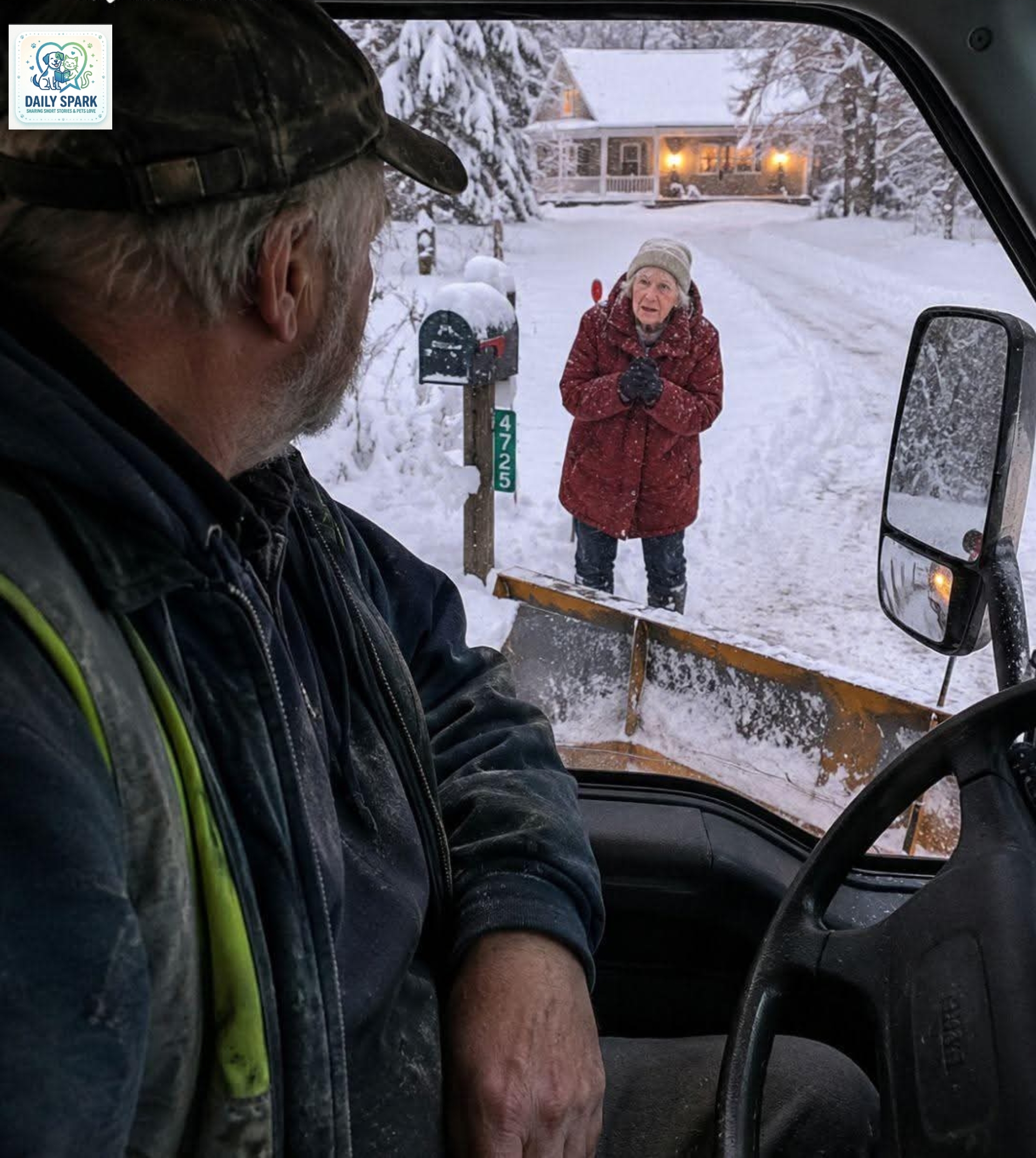
“Please,” the woman called through the blowing snow. “I just need enough room for the nurse to get in.”
Warren Beck looked at the driveway, then at the clock on the dashboard of his county snowplow.
He knew exactly what the rules said.
County equipment cleared county roads.
Not private driveways.
Not even one.
Warren was 62, three months removed from a heart attack, and still under strict orders from his wife to “stop acting like you’re thirty.”
He had returned to work because sitting at home made he restless. Besides, he had been driving a snowplow through northern Minnesota winters for nearly three decades.
He knew every curve, mailbox, drifting ditch, and stubborn stretch of road on his route.
And lately, he had started noticing the woman in the red coat.
Every time a heavy snow came through, she stood beside the same mailbox at the end of a narrow country driveway.
She was small, probably in her late seventies, with white hair peeking from beneath a knitted cap.
And every storm, her driveway disappeared beneath another wall of snow.
That morning, Warren stopped.
He lowered his window.
“You waiting on somebody?” he asked.
The woman looked embarrassed.
“A hospice nurse.”
Warren’s hands tightened around the steering wheel.
She nodded toward the small house at the end of the driveway.
“My husband’s inside. Cancer.”
Then she looked back at the snow.
“The nurse’s car got stuck last time.”
Warren stared toward the house.
A yellow porch light glowed through the storm.
He thought about his own heart attack.
He remembered lying in a hospital bed while his wife, Linda, sat beside him pretending not to be scared.
He remembered how helpless it felt to need other people.
And he remembered something his father used to tell him when Warren was a boy.
“If you have a machine big enough to help, son, you have a machine big enough to matter.”
Warren looked at the road behind him.
Then at the driveway.
“I’m not supposed to do this,” he said.
The woman nodded quickly.
“I understand.”
Warren put the truck in reverse.
“Good,” he said. “Then we agree I was never here.”
He lowered the blade.
One pass.
That was all.
Just enough to clear the entrance and push aside the hard ridge the county plow had created.
The woman covered her mouth with both mittened hands.
Warren pretended not to see.
He raised the blade and drove away.
Three days later, another storm came.
The red-coated woman was not standing by the mailbox.
But Warren made the pass anyway.
Then again the next week.
And again after that.
He learned her name was Eleanor.
Her husband was Frank.
They had lived in that house for forty-seven years.
Frank had built the back porch himself. Eleanor had planted the lilacs along the fence.
Their children lived several states away and came when they could, but most days it was just the two of them.
So before Warren finished his route after every major snowfall, he made one quiet extra pass.
He never went farther than necessary.
He never accepted money.
Once, Eleanor left a paper cup of coffee on the mailbox with a note taped around it.
For the man who makes hard days easier.
Warren kept that note in his glove compartment.
Winter rolled on.
Then, in February, his supervisor called him into the county garage.
There was a printed photo sitting on the desk.
Warren’s plow.
Eleanor’s driveway.
The supervisor sighed.
“You know the policy.”
“I do.”
“You know why it exists.”
“I do.”
“If we clear one private driveway, people can ask why we don’t clear every driveway.”
Warren nodded.
He wasn’t angry.
Rules existed for reasons.
“I’ll take whatever write-up you need to give me,” Warren said.
His supervisor rubbed his forehead.
“You could have asked.”
“And would you have approved it?”
A pause.
“No.”
“That’s why I didn’t ask.”
The reprimand was placed in his file.
Warren went home that night feeling strangely ashamed.
Not for helping Eleanor.
For causing trouble.
Linda read the paperwork at the kitchen table.
Then she looked at her husband.
“You regret it?”
Warren shook his head.
“No.”
“Then eat your soup.”
A week later, there was a county meeting.
Warren expected maybe a few uncomfortable questions.
Instead, he walked into the room and stopped.
Nearly forty people were standing along the walls.
Farmers.
Retired teachers.
A mechanic.
Two high school boys.
A woman from the diner.
A man who owned a landscaping business.
Several people Warren recognized from his plow route.
Eleanor stood near the front in her red coat.
Warren whispered, “Oh, Lord.”
But the neighbors had not come to demand the county ignore its rules.
They had come with another idea.
A farmer named Dale stood first.
“I’ve got a tractor with a front blade,” he said. “Give me three houses.”
A retired man raised his hand.
“I’ve got a snowblower and nowhere I need to be before noon.”
One of the high school boys said, “My brother and I can shovel.”
The diner owner offered free coffee to volunteers.
Someone else had made a list.
Elderly residents.
People with disabilities.
Families caring for someone seriously ill.
Widows living alone.
Anyone who might struggle to clear snow safely.
By the end of the meeting, every name on the list had been matched with a volunteer.
The county didn’t have to break a single rule.
The neighbors simply decided that caring for one another did not require a rule.
Warren sat quietly in the back row.
Eleanor came over and placed a hand on his shoulder.
“You started this.”
Warren shook his head.
“No, ma’am.”
“You did.”
“I cleared six feet of snow.”
Eleanor smiled.
“No. You reminded people to look down each other’s driveways.”
Frank died peacefully that spring.
Warren attended the funeral.
Eleanor hugged him afterward and slipped something into his hand.
It was the old coffee note he had kept in his glove compartment.
Or rather, another copy of it.
On the back, she had written:
Frank always knew when you had been there. He could hear the plow from his bedroom. He called it the sound of somebody remembering us.
Warren had to turn away for a moment.
The following winter, the first big storm arrived in December.
Snow fell all night, thick and steady.
Before sunrise, tractors started.
Snowblowers roared.
Teenagers pulled on gloves.
Neighbors carried shovels across roads and down driveways.
And all over town, small paths appeared through the white.
Warren drove his official route that morning and noticed something strange.
There was hardly anyone standing helplessly beside a buried driveway anymore.
Someone had already come.
At Eleanor’s house, two teenage boys were clearing the walk while a farmer pushed snow from the driveway.
Eleanor stood on the porch holding three steaming mugs.
When Warren passed, she waved.
He tapped the horn twice.
Then he looked down that snowy Minnesota road and realized something his father had understood long before he did.
Most people are willing to help.
Sometimes they just need to see somebody go first.
Warren retired two years later.
At his retirement dinner, nobody talked much about miles plowed or years of service.
They talked about one driveway.
One rule bent for the right reason.
One old woman in a red coat.
And a whole town that remembered what neighbors were supposed to be.
Because the best kind of kindness doesn’t stop with the person you help.
It travels.
Sometimes one cleared driveway is all it takes to open the road between strangers.
As the years passed and Warren watched the town thrive through every harsh winter from his front porch, he understood that the true legacy of that single morning wasn’t just the cleared roads, but the invisible bonds repaired beneath the snow. The town had learned that isolation is only ever a temporary geography, easily melted by the warmth of a neighbor willing to step out into the cold. Whenever the wind howled and the white drifts piled high against his windows, Warren would look out at the children playing safely in the cleared paths and smile, knowing that love, like a good plow, leaves tracks that never truly fade away.


Leave a Reply