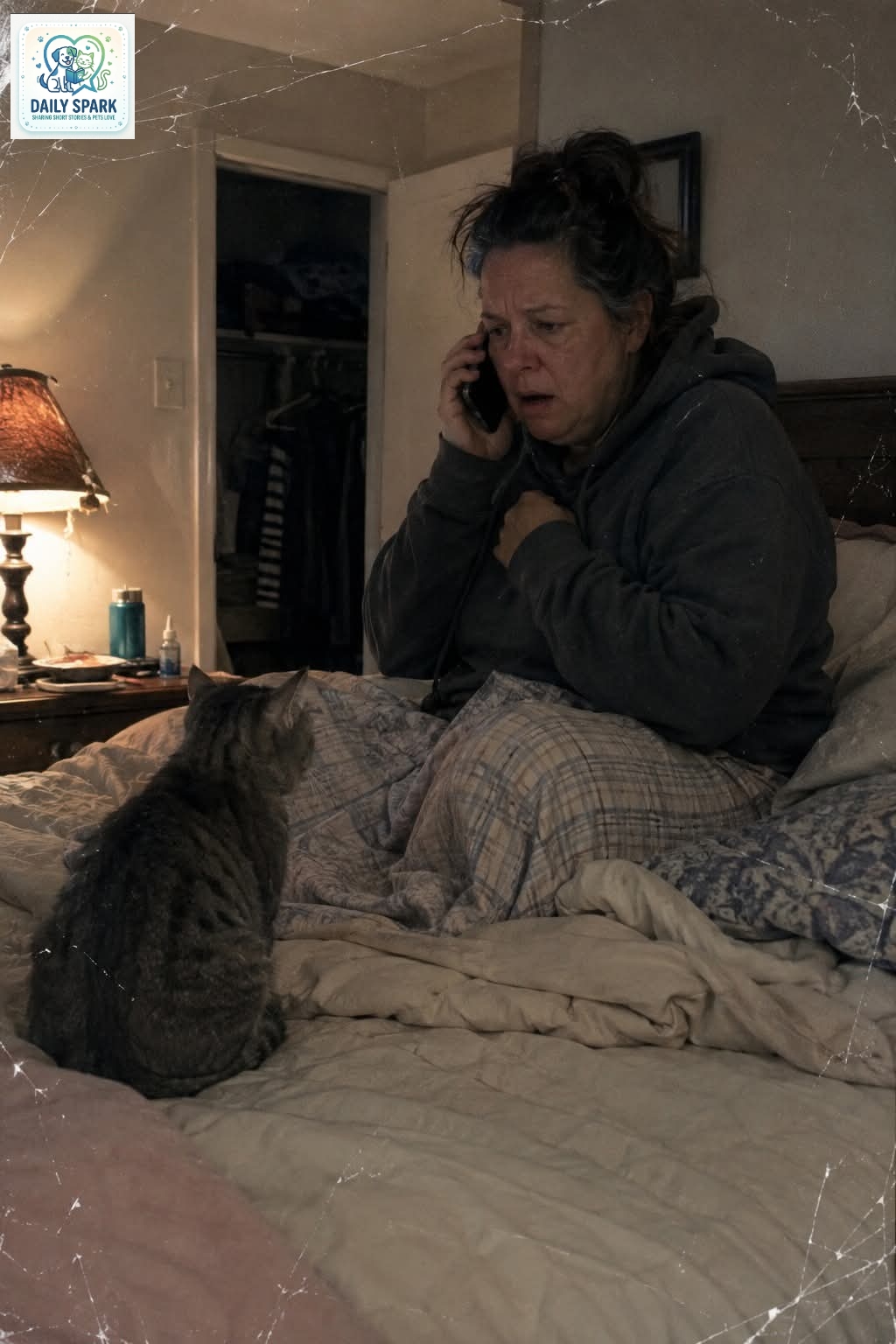
The shelter called me at 3:47 a.m. to say the cat I left behind was bleeding and would not stop screaming.
I was awake before the woman on the phone even finished my name.
A few hours earlier, I had brought home a little gray tabby named Junie.
She was supposed to be a short-term foster.
Just a few weeks, maybe less.
That was the promise I made to the shelter, and to myself.
I was forty-three, living alone in a one-bedroom apartment outside Columbus, working long hours answering customer calls for a medical billing contractor that kept cutting shifts and changing schedules. I was tired all the time. Tired in my bones. Tired in the way that makes even small kindness feel expensive.
One cat, I could do.
One litter box. One bag of food. One small life to help while I tried to keep mine from slipping any further.
But Junie had come in with her sister.
Her sister’s name was Marlow.
Same age. Same sharp little face. Same white patch on the chest. The only difference was the eyes. Junie looked at people like she was waiting to be disappointed. Marlow looked like she was ready to fight the world for one more day.
The shelter had warned me they were bonded.
I heard them.
I just didn’t listen hard enough.
On the phone, the night manager sounded close to tears.
“She tore up her bedding trying to get out,” she said. “She scraped both front paws on the crate door. She finally wore herself out, but every time she wakes up, she starts again.”
I turned on the lamp and looked down.
Junie was sitting at the foot of my bed.
She hadn’t slept either.
She was small enough to fit in the crook of one arm, but in that moment she looked heavy with something I understood too well.
Waiting.
I asked the question even though I already knew the answer.
“Do you need me to come get her?”
The woman let out a breath like she’d been holding it for an hour.
“If you can.”
At 4:00 a.m., I was in my car wearing flannel pajama pants, an old hoodie, and mismatched socks. The roads were empty. Every red light felt personal.
The whole drive, I kept telling myself this was temporary.
A couple days.
A week, maybe.
Just until they calmed down.
That was all.
When I got to the shelter, Marlow was curled in the back of the crate, shaking.
Her paws were raw.
Her voice was gone.
But the second I set Junie’s carrier near the crate, Marlow lifted her head.
Junie made one soft sound.
Not even a full meow.
More like a broken question.
Marlow stood up so fast she stumbled.
Then she pressed herself against the crate door—and what happened next made me realize I had badly misunderstood what separating these two cats would actually do to them.
She didn’t hiss or strike out. Instead, Marlow wedged her small, battered nose through the narrow wire gap of the cage, pressing her wet nostrils frantically against Junie’s side through the carrier mesh. A low, vibrating hum rattled out of Marlow’s throat—not a purr, but the sound of an animal vibrating apart at the seams, trying to call its other half back into existence.
Junie pushed her face as far as she could against the plastic door, her small body trembling so hard the crate rattled against the concrete floor.
The night manager stood nearby, wrapping a fresh roll of gauze around one of Marlow’s bleeding paws. Her hands were shaking.
“We tried to put her in a larger recovery pen an hour ago,” the woman whispered, not looking up. “She scaled the chain-link. Cut herself worse. She doesn’t care about the pain. She just wants through.”
I crouched down, the cold Ohio wind sweeping under the double doors of the shelter and biting through my thin hoodie. I thought about my one-bedroom apartment. I thought about my budget spreadsheet, neatly broken down to the penny, and the single bag of food I had bought earlier that day, calculating that a single cat’s provisions would barely squeeze into my monthly grocery allotment.
I was barely keeping my own head above water. How was I supposed to afford two? How was I supposed to manage two vet bills, two sets of vaccinations, twice the midnight worries?
Yet as I looked at Marlow’s raw, crimson paws and Junie’s desolate, unblinking stare, a deeper, uglier truth settled into my chest.
Some creatures are not designed to be divided.
I reached out and unlatched Marlow’s cage door.
The little tabby didn’t wait. She scrambled out, ignoring the sting of her injured paws, and slammed straight into Junie’s side. They tumbled together onto the linoleum floor, rolling into a frantic, tangled knot of gray fur and white chests, licking each other’s faces with desperate, frantic strokes until their breathing finally synchronized.
The heavy, suffocating silence in the room broke.
I stood up slowly and looked at the night manager.
“Bring me the paperwork,” I said.
The woman blinked, surprised. “For both?”
“Yeah,” I sighed, rubbing the bridge of my nose as a strange, unexpected warmth began to thaw the exhaustion in my bones. “Both.”
By 5:30 a.m., we were back in my apartment. The sun was just beginning to stain the eastern sky a bruised shade of purple over the gray Columbus rooftops.
I didn’t put them in separate rooms. I set their food bowls side by side in the kitchen, placed a single large litter box in the bathroom, and watched as they immediately curled up together on the corner of my mattress, exhausted, safe, and completely inseparable.
I sat down on the edge of the bed, pulled off my mismatched socks, and looked at the empty space beside me where two small lives had suddenly taken root.
I was still tired. The bills were still coming. My schedule was still an unpredictable mess.
But as I pulled the blanket up and felt two soft, rhythmic purrs vibrating against my shins, I realized something important. Sometimes, the things that threaten to break us open are the very things that save us from being completely alone.

Leave a Reply