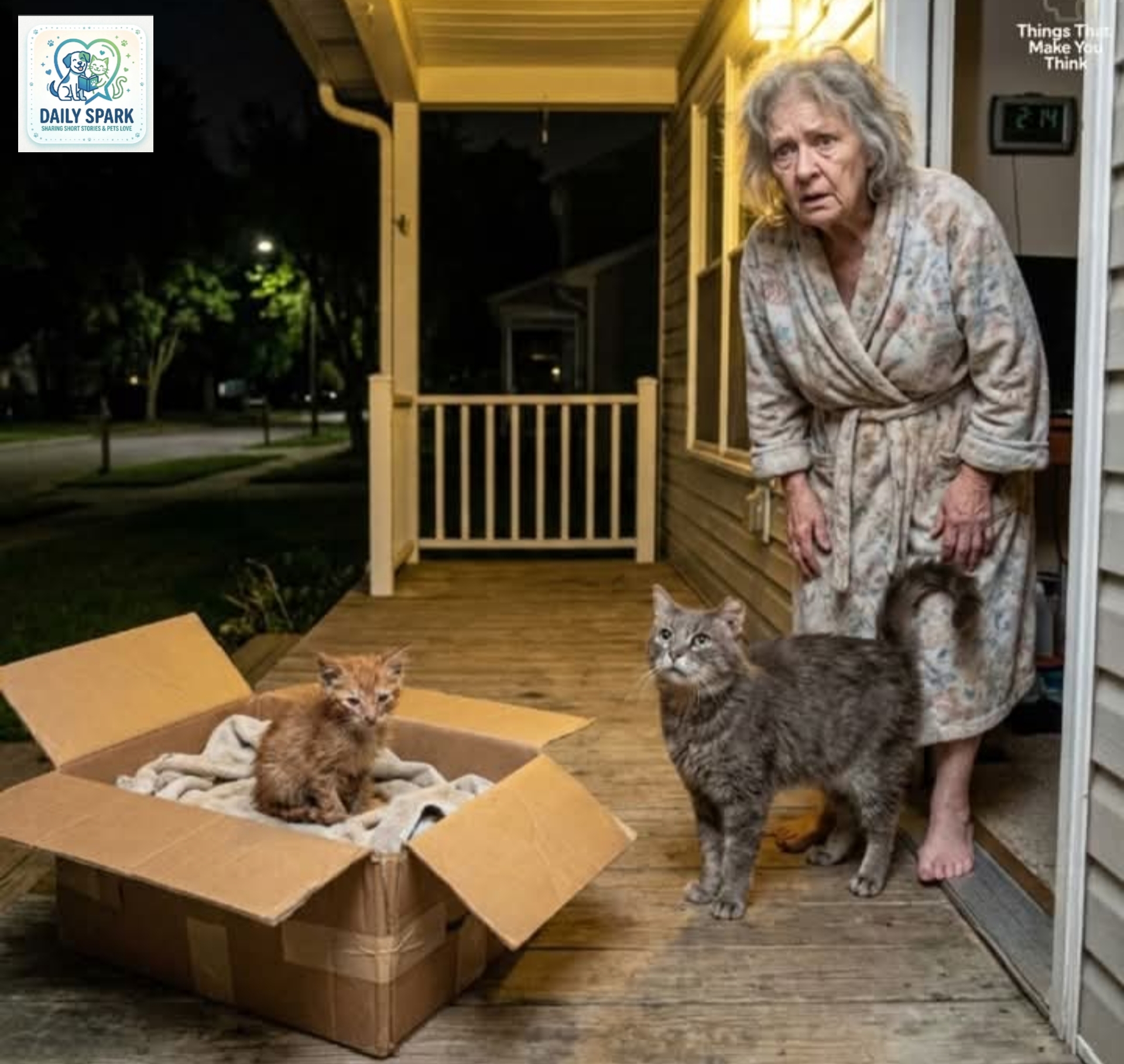
My cat had never been able to have babies, so I was not ready for the sound she made at 2:14 a.m.
It was not a normal meow.
It was low. Broken. Almost human.
I sat up in bed, my heart pounding, and saw Willow standing in the hallway, staring at the front door like something on the other side had called her name.
I lived alone in a small house at the end of a quiet street. At my age, you get used to little noises at night. The fridge humming. A branch tapping the window. Your own knees cracking when you get out of bed.
But this was different.
Willow looked back at me and cried again.
I put on my robe and followed her to the door. There, on the porch, under the yellow porch light, was a cardboard box.
At first, I thought someone had dropped off old towels.
Then the towel moved.
Inside was a kitten so tiny it looked more like a dirty sock than a living thing. Her eyes were crusty. Her fur was matted. She was shaking so hard the whole box trembled.
Willow pushed her nose against the screen door.
“No,” I whispered. “Stay back.”
I did not say it because Willow was mean. She was the gentlest soul I had ever known.
I said it because I was scared.
I had adopted Willow three years earlier, after my husband died and my house became too quiet to stand. She was already an adult cat then. Soft gray fur. Crooked tail. One torn ear. Big green eyes that looked like they had seen too much.
The shelter told me she could never have kittens.
They did not say it in a dramatic way. Just a fact.
But I noticed things after I brought her home.
She would carry my rolled-up socks into the laundry basket and sleep beside them.
She would drag a small dish towel into the corner and curl around it.
Once, I found her grooming a stuffed bear my granddaughter had left behind.
I used to laugh a little and say, “You are a strange girl, Willow.”
That night on the porch, I stopped laughing.
I brought the kitten inside and put her in a clean towel in the bathroom. I warmed her the best I could. I gave her a little food, drop by drop. I named her Penny because she was small, copper-colored, and looked like something the world had dropped without thinking.
Willow sat outside the bathroom door all night.
She did not scratch.
She did not howl.
She just lay there with one paw pushed under the crack.
Every time Penny made a tiny squeak, Willow answered.
By morning, I was exhausted. Penny was still alive, but barely. She would take a little food, then turn away. Her body felt too light, like there was not enough of her to hold onto life.
I sat on the bathroom floor and cried in a way I had not cried in years.
Not just for Penny.
For Willow.
For myself.
For every living thing that had ever been told, quietly or loudly, that it was too old, too damaged, too inconvenient, too much trouble, or not useful anymore.
That is a hard thing about this country right now. We are surrounded by people and animals who have been set aside. Older folks in little houses. Pets no one wants because they are not perfect. People smiling in grocery stores while carrying grief nobody sees.
Willow cried again from the other side of the door—but this time, there was something in her voice I couldn’t ignore.
I opened it, and what she did to that dying kitten left me completely speechless.
Without a single hesitation, Willow brushed past me and stepped into the bathroom, her gaze fixed entirely on the shivering bundle in the box. I held my breath, terrified that her maternal instincts might clash with her confusion, but what followed dissolved every fear I carried. She stepped directly into the towel, lowered her head, and began to groom the tiny, matted creature with a tenderness so fierce it made my chest ache. She licked away the crust from Penny’s eyes and smoothed her copper fur, treating her as if she were the most precious treasure on earth.
Penny let out a weak, searching squeak and wriggled forward, burrowing straight into the thick fur of Willow’s belly. In that exact moment, the impossible happened. Willow wrapped her crooked tail around the kitten like a protective embrace, settled deeply into the towel, and began to purr. It wasn’t just a normal purr; it was a deep, resonating vibration that filled the small room with warmth, healing energy, and life.
That miraculous morning marked the beginning of our healing. Over the next few weeks, Willow refused to leave Penny’s side, mothering her with a dedication that defied every rule of biology, while I fed the little fighter with warm formula around the clock. By the time Penny opened her eyes to reveal bright, luminous green irises just like Willow’s, she was strong, playful, and full of life. Our quiet little house at the end of the street transformed completely. The empty silence was replaced by the pitter-patter of tiny paws, soft rustling blankets, and the steady, comforting symphony of two contented cats sleeping side by side. We had both been told we were broken, cast aside, or incapable of giving life, but together, Willow and Penny taught me that love doesn’t care about the past—it only asks for a heart willing to open its doors.

Leave a Reply