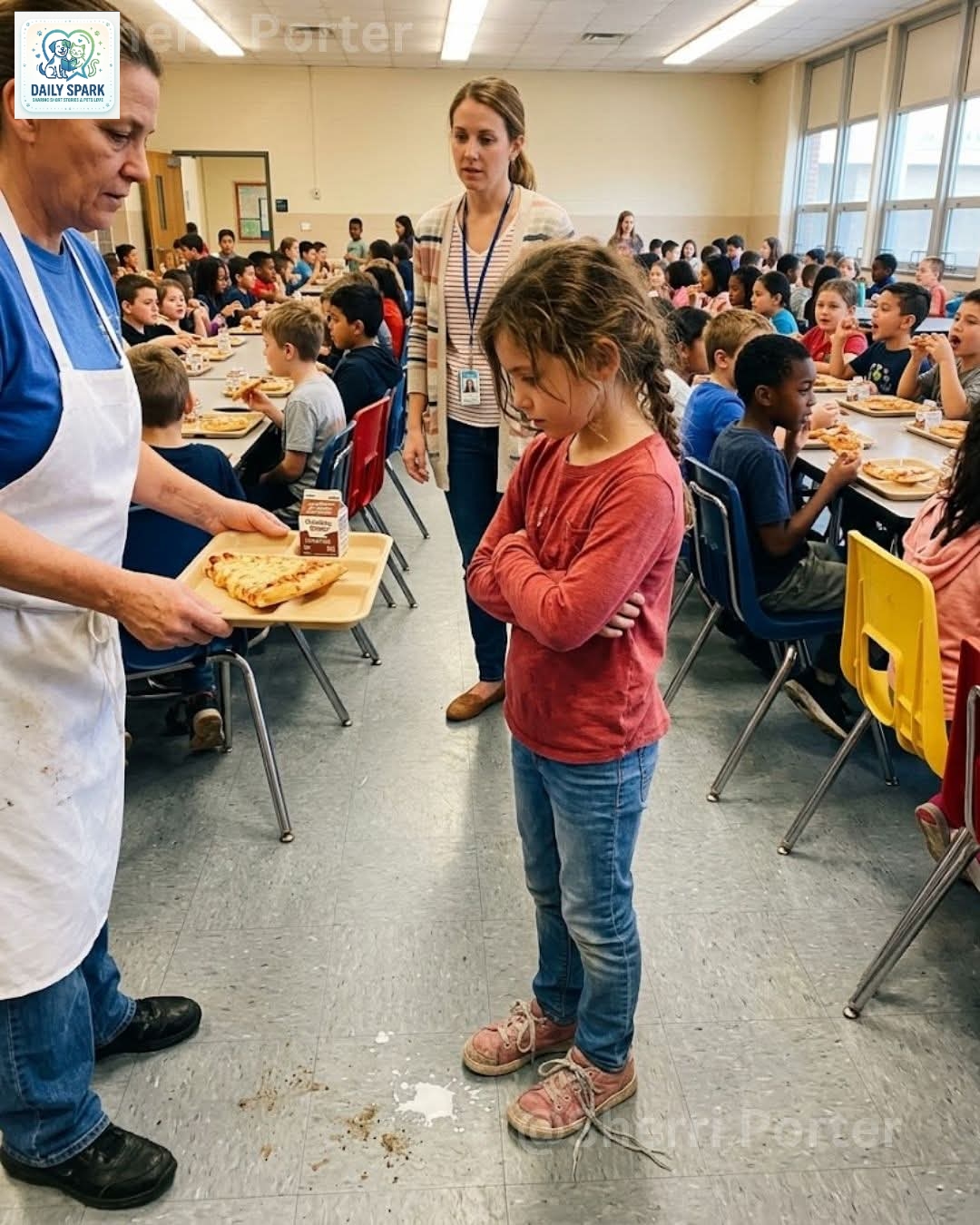
The first time I knew something was wrong, it was pizza day.
Every child in Room 14 smelled it before the lunch cart even turned the corner.
Twenty-two third graders lifted their heads at once, like little animals catching rain in the air.
“Pizza!” Marcus shouted, even though we all knew he was not supposed to shout.
Ava clapped both hands over her mouth and bounced in her chair.
Even quiet little Ben, who usually ate his sandwich crust first and saved the soft middle like treasure, smiled down at his math worksheet.
But in the back row, by the window, Lily Mercer closed her notebook and whispered, “I’m not hungry.”
That was the third time that week.
At first, I thought she was being picky.
Teachers are not supposed to say that out loud, but we think it sometimes. We see children refuse apples because they have spots. We see them cry over green beans. We see perfectly good trays dumped into trash cans because the macaroni touched the carrots.
So when Lily pushed her lunch card back toward me on Monday, I said what I always said.
“You need something in your stomach, sweetheart.”
She smiled politely.
Not warmly.
Politely.
Like a tiny receptionist.
“I ate breakfast,” she said.
On Tuesday, she said her stomach hurt.
On Wednesday, she said she was saving room for dinner.
On Thursday, she said she had a big snack before school.
And on Friday, pizza day, she said she was not hungry.
That was when I stopped believing her.
Lily was eight years old, with brown hair she wore in the same loose braid every day. The braid always started neatly near her ear and fell apart by recess. She had a purple backpack with a broken zipper, patched with a safety pin and a piece of blue ribbon.
She was not a loud child.
She was not a child people noticed first.
She turned in her homework. She said please. She sharpened her pencil over the trash can instead of at her desk. She helped push in chairs without being asked.
The kind of child adults praise because she makes their day easier.
The kind of child who can disappear right in front of everyone.
By October, I had learned to watch for the quiet ones.
I had been teaching third grade for nineteen years.
Long enough to know that children rarely say, “I am scared.”
They say, “My stomach hurts.”
They say, “I forgot.”
They say, “I don’t care.”
They say, “Can I go to the nurse?”
They say, “I’m not hungry.”
That Friday, I stood by the cafeteria line with my class behind me, the air heavy with warm cheese and floor cleaner. Lunch trays clattered. A milk carton rolled under the serving counter. Somewhere, a kindergartner sobbed because his pudding was chocolate instead of vanilla.
Lily stayed at the end of her line with her arms folded across her chest.
When Mrs. Donnelly, the cafeteria worker, smiled at her and said, “Cheese or pepperoni, honey?” Lily looked at the tray like it had asked her a question she could not afford to answer.
“No, thank you,” she said.
Mrs. Donnelly glanced at me.
I glanced at Lily.
Lily stared at her shoes.
They were pink sneakers, but one lace was white and the other was gray. The gray one was not a shoelace. It was a piece of string.
“Just milk then?” I asked gently.
She shook her head.
“I’m not hungry.”
I wanted to press her.
I wanted to kneel down right there on the scuffed cafeteria floor and say, “Lily, who told you not to eat?”
But children do not give you the truth just because you ask with a soft voice.
Sometimes they hand it to you in pieces.
Sometimes they hide it in a desk.
Sometimes they carry it home in their backpack.
So I let her sit with the class.
She chose the end of the table, near the wall.
All around her, children folded pizza slices in half and talked with red sauce on their cheeks. Someone spilled milk. Someone traded carrots for cookies. Someone dropped a crust on the floor and tried to pick it up before I saw.
Lily folded her hands in her lap and watched the clock.
Not the children.
Not the food.
The clock.
Like she was waiting for lunch to be over.
After recess, while the class was at music, I stood alone in Room 14 with the soft hum of the heater and the smell of dry erase markers.
I opened my bottom drawer.
Inside were the things teachers keep because schools run on emergencies.
Band-Aids.
Extra pencils.
A hair tie.
A stack of nurse passes.
Granola bars.
Crackers.
A pair of socks.
A toothbrush still in its wrapper.
Things bought one at a time at the grocery store and never submitted for reimbursement because there was no line on the budget form for “children whose lives are quietly falling apart.”
I took out a small pack of peanut butter crackers.
Then I hesitated.
We were trained not to make children feel singled out. Not to shame them. Not to assume.
So I walked to Lily’s desk and slipped the crackers into the little metal basket underneath, beside her reading folder and a crumpled spelling list.
When the class returned, Lily sat down and froze.
Her hand went under her desk.
She felt the package.
Her eyes lifted to mine.
I was writing the date on the board.
October 13.
I did not turn around.
I simply said, “Class, take out your science notebooks.”
For three minutes, Lily did not move.
Then I heard the soft crackle of plastic.
She ate one cracker.
Only one.
Then she wrapped the rest carefully, so carefully, and slid the package into the front pocket of her backpack.
That was the beginning.
Every morning after that, I put something small in Lily’s desk.
Crackers.
An applesauce pouch.
A cereal bar.
A little box of raisins.
Nothing big.
Nothing obvious.
And every day, she found it.
Every day, she looked at me.
Every day, I pretended not to see.
But the strange thing was this.
She almost never ate it.
Sometimes she took one bite.
Sometimes she held the package in her lap during silent reading, running her thumb over the wrapper like she was counting something.
But most days, she tucked it away unopened.
At first, I thought she was embarrassed.
Then I wondered if someone at home had told her not to accept food.
Then I wondered if she was hoarding.
Teachers learn terrible words without wanting to.
Food insecurity.
Neglect.
Chronic stress.
Mandatory reporting.
We learn to hear the difference between a child who forgot lunch and a child who has learned not to expect one.
But Lily did not look neglected.
That was part of what made me doubt myself.
Her hair was brushed. Her clothes were clean, though often too thin for the weather. Her homework was signed in careful block letters: Daniel Mercer.
Her emergency contact form had only one name.
Father.
No mother listed.
No grandmother.
No aunt.
Just one name, written twice, once in blue ink and once crossed out and corrected with a new phone number.
I asked the office if anyone knew the family.
Mrs. Alvarez, our secretary, lowered her voice.
“Dad picks her up every day. Very polite. Always on time.”
“That’s it?”
“That’s it.”
At pickup, I started watching.
Daniel Mercer drove an old silver sedan with a dented passenger door and a back window patched with clear tape. He always parked two blocks away instead of joining the long pickup line. He wore a navy work jacket, even when the afternoons were warm.
Lily always ran to him.
Not walked.
Ran.
He always crouched down like he had been waiting all day to be small enough for her. She threw her arms around his neck. He closed his eyes when he hugged her.
That did not look like neglect.
That looked like love.
Still, something was wrong.
One afternoon, I found Lily in the classroom after dismissal. The buses had left. The hallway had gone quiet except for the squeak of our custodian’s cart.
She was on her knees beside her desk, frantically emptying her backpack.
Folders spilled out.
A library book.
A mitten.
A wrinkled permission slip.
Three unopened packs of crackers.
Two cereal bars.
An applesauce pouch.
A small carton of shelf-stable milk from breakfast.
She looked up and saw me.
Her face changed instantly.
Not guilty.
Terrified.
“Lily,” I said softly.
She scrambled to shove everything back.
“I was just cleaning,” she said.
But her hands were shaking so hard she could not zip the broken backpack.
I knelt beside her.
“I’m not upset.”
She shook her head fast.
“I didn’t steal them.”
“I know.”
Her eyes filled.
“I didn’t.”
“I know, sweetheart.”
She clutched the backpack to her chest.
For a second, she looked younger than eight.
Much younger.
Like the whole world had handed her something too heavy and told her to keep quiet about it.
I reached slowly toward the front pocket, where the crackers had spilled halfway out.
Lily grabbed my wrist.
Not hard.
Just desperate.
“Please don’t take them,” she whispered.
The classroom seemed to go silent around us.
Outside, a basketball bounced once in the empty gym.
I looked at the food.
Then at her.
And for the first time, I understood I had been asking the wrong question.
It was not why Lily was not eating.
It was who she was saving the food for.
Before I could say anything, the classroom door opened.
Daniel Mercer stood there in his navy work jacket, breathing hard like he had run from the parking lot.
His eyes went to Lily.
Then to the backpack.
Then to the food scattered across the floor.
And his face broke in a way I have never forgotten.
He whispered, “Lily… what did you do?”
Daniel dropped to his knees on the linoleum and pulled his daughter tightly into his arms, tears streaming down his face. He choked out, “Sweetheart, I am fine. Why did you feel the need to save all of this?”
But as he pulled her close, I noticed something else—there was an old, bleeding scrape across the back of Daniel’s palm, and his navy work jacket was worn thin and torn at the cuffs. A sudden, heavy truth settled over the room.
Lily buried her face in his shoulder and whispered, “Daddy, I know you hide your own lunch in my backpack every single morning so I can eat at school, while you work out in the freezing cold all day with nothing. You haven’t eaten a proper meal in three days…”
Daniel stared at his daughter in stunned silence, then looked up at me. A deeper, shattering revelation came to light: Daniel hadn’t lost his job, but was quietly funneling every single penny of his meager wages to a struggling local foster shelter that had raised him and his two younger siblings when they were children. He was starving himself day after day just to ensure his daughter—and the children he considered family—survived.
I stepped forward slowly, kneeling beside them on the floor, and placed a gentle hand on Daniel’s shoulder. “Mr. Mercer, you don’t have to carry the whole world alone. Starting today, my classroom drawer and my own lunchbox belong to all of us.”
The room grew quiet and warm as the afternoon shadows lengthened, anchored by the profound, quiet sacrifice of a father and a daughter who taught a teacher that love is often measured by what we are willing to give away.




Leave a Reply