I was in the hospital for weeks and nearly lost my life. Not one person in my family came to visit me, not even once. A month later, my dad suddenly texted: “We need $12,000 for your mother’s surgery.” I sent him $1 and replied: “Good luck.” A few hours later, the police were knocking at my door because of my father’s accusation…
The first thing I heard when I woke up was a machine counting the seconds I had almost run out of.
Beep. Pause. Beep.
The sound came from somewhere to my left, steady and cold, while fluorescent light burned through a plastic ceiling panel above me. The room smelled of disinfectant, metal rails, and the lemon lotion nurses rubbed into their hands after washing them raw. When I tried to swallow, my throat felt rough and sore, like I had been breathing through dry air for days.
“Easy,” a man whispered.
I turned my head and saw Ethan, my husband, folded into a blue hospital chair that looked too small for his grief. His shirt was wrinkled. His beard had grown in uneven patches. Purple shadows sat under his eyes, and one hand covered mine like he had been afraid I would disappear if he let go.
When I realized I was looking at him, his face broke.
“Oh, thank God.”
My name is Mallory Hayes. I was thirty-three years old, a senior payroll manager in downtown Omaha, and for most of my adult life I had mistaken being useful for being loved.
The last thing I remembered was standing near the copier at work with a stack of reports pressed to my chest. Jenna had called my name from the hallway. The carpet tilted. The ceiling rushed down at me.
“How long?” I managed.
Ethan squeezed my hand hard enough that his knuckles went pale. “Nine days since you collapsed. You were unconscious for most of it.”
Nine days.
A nurse named Carla came in after Ethan hit the call button. She checked the monitor, shined a light into my eyes, and adjusted the blanket over my legs with hands so gentle they made me want to cry. She had silver braids pinned into a knot and the careful voice of someone trying not to frighten a patient who had already been frightened enough.
“You gave everybody quite a scare,” she said.
Everybody.
I looked past her toward the two empty visitor chairs near the window. No flowers from my mother. No balloon from my father. No frantic note on the whiteboard from my younger sister. The only things that proved I belonged to anyone were Ethan’s jacket, Jenna’s paperback novel, and a grocery-store bouquet drooping in a plastic pitcher.
“Where are they?” I asked.
Ethan glanced at Carla.
That glance told me everything.
“My parents,” I said. “Did anyone call them?”
Carla lowered her clipboard. “We used every emergency contact listed in your file. Your mother answered twice. Your father returned one call. They said they had several things happening and would come when their schedule allowed.”
“When their schedule allowed?”
She looked like she hated the words as much as I did. “We made it clear your condition was critical.”
My parents lived forty minutes away. My sister lived twenty-five minutes away.
For years, I had paid their phone bills, covered property taxes, rescued overdrafts, and driven across town at midnight whenever one of them used the word emergency. My mother had my spare key. My father had my bank’s old routing information from the year I helped him refinance. My sister knew exactly which guilt sentence would make me open my wallet.
Trust is not always a beautiful thing. Sometimes it is just the door you leave unlocked for people who already know where you keep the money.
By day eight, Ethan had asked the nurse to print the call log from my hospital chart. It showed two answered calls to my mother, one returned call from my father, and a note stamped under Nebraska Medical Center intake: FAMILY NOTIFIED — CONDITION CRITICAL. Jenna had sent screenshots of the work incident report from 3:17 PM, the ambulance dispatch line, and the email she wrote to my emergency contacts before she ever left the copier room.
Proof has a texture when love fails. Paper edges. Time stamps. Names in black ink.
I stayed in that hospital for weeks. Ethan slept in that brutal chair. Jenna brought clean socks and dry shampoo. Carla learned how I liked my water with extra ice.
My family never came.
Not once.
A month after I came home, my phone buzzed while I was sitting at our kitchen table, still weak enough that walking to the sink made my knees shake.
Dad: We need $12,000 for your mother’s surgery.
No hello. No how are you. No apology for letting a hospital room swallow me alone.
Just a bill.
I stared at the message until Ethan reached across the table and covered my wrist. I did not cry. I did not scream. I did not type the paragraph they deserved. My jaw locked so tight my molars ached.
Then I opened my banking app, sent my father $1, and replied: Good luck.
Three dots appeared. Then disappeared. Then appeared again.
Dad: You selfish little witch.
Mom is sick.
You owe this family.
That was the sentence that finally made something inside me go still.
I owed them? I owed the people who had left two visitor chairs empty while I fought my way back into my own body?
I took screenshots. I saved the transfer receipt. I forwarded everything to Ethan and Jenna, not because I expected drama, but because payroll managers learn early that anything not documented becomes a story someone else can rewrite.
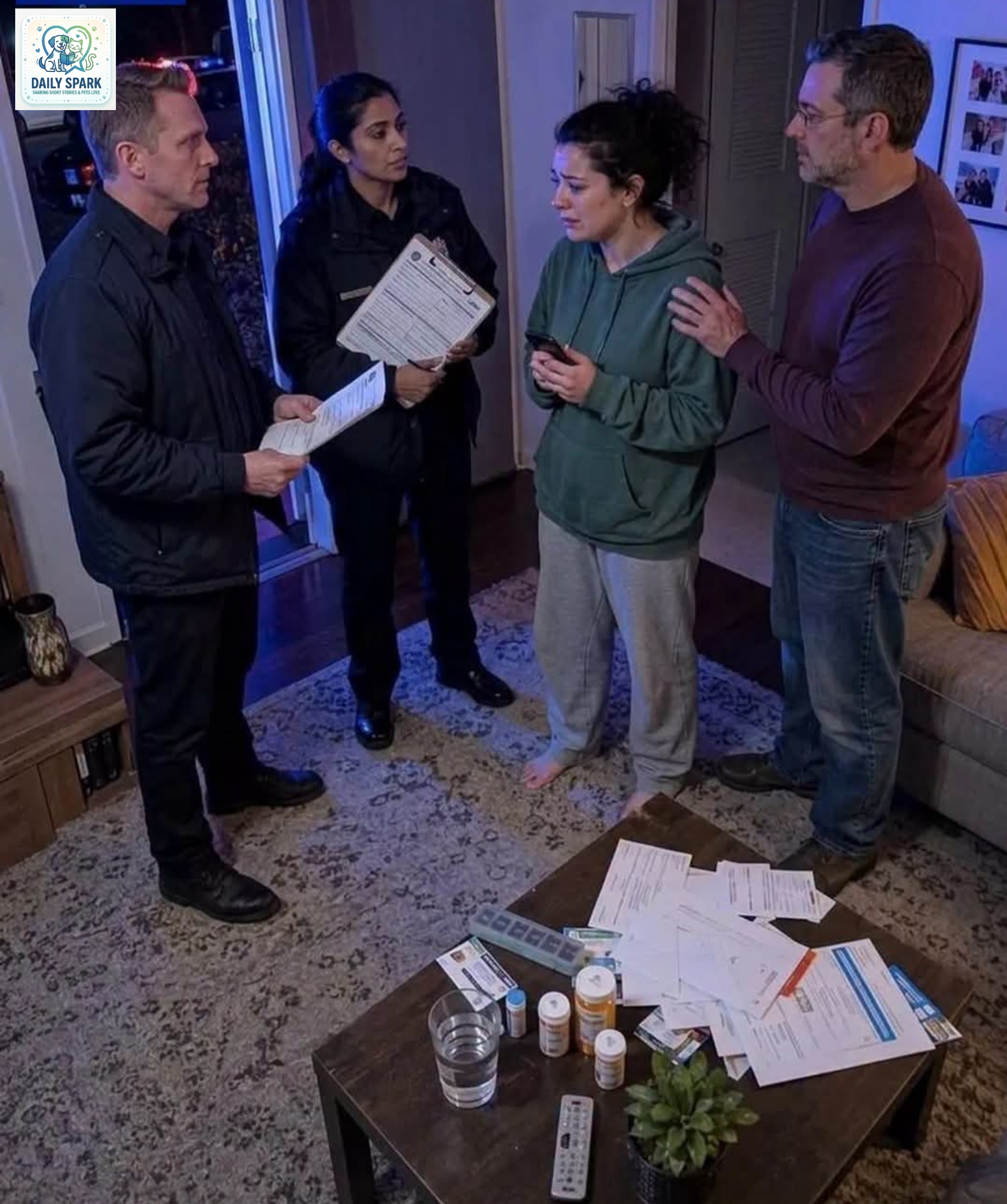
A few hours later, the knock came.
Three hard strikes against our front door.
Ethan looked through the peephole and turned back to me, his face changing before he said a word. Behind him, red and blue lights pulsed across our living room wall, washing over the hospital discharge folder still sitting on the side table.
“Mallory,” he said quietly. “It’s the police.”
I stood slowly, one hand on the chair, my legs trembling from weakness and rage.
When Ethan opened the door, two officers stood on our porch.
The older one held a printed complaint.
And the first line said my father had accused me of stealing the $12,000 meant to save my mother’s life.
The older officer’s name tag read Det. Vance. He looked at me, then at the hospital discharge papers resting on the coffee table, and back to his clipboard.
”Mrs. Hayes,” Vance said, his voice measured. “Your father, Richard Vance, filed a sworn report claiming you fraudulently transferred funds out of an account co-signed for medical emergency provisions and refused to relinquish those funds for critical surgery.”
I didn’t panic. For ten years in payroll, I lived in spreadsheets, paper trails, and undeniable facts.
”My father is lying,” I said calmly. “And I have the proof.”
Ethan invited them inside. I walked—slowly, but with a steady stride—to my laptop. I pulled up my bank statements spanning the last five years, the emergency contact call logs provided by Nebraska Medical Center, and every text message thread from the past six months.
”Officer, I have never held a joint account with my father,” I said, turning the screen toward Det. Vance. “What I have done is send him personal gifts for years. But a month ago, I was in an ICU fighting for my life. Here is the hospital record showing my family was notified of my critical status.”
I pointed to the timestamp on the screen.
”Here are the call logs showing my mother answered twice, my father once, and neither stepped foot in my room. And here,” I clicked on the text thread from that morning, “is the text my father sent today demanding $12,000, followed by his message calling me a ‘selfish little witch’ when I refused.”
Det. Vance leaned in, reviewing the screenshots, the $1 bank transfer receipt with the reply ‘Good luck,’ and the clear breakdown of my individual bank account holding no trace of any transferred money from my parents.
The younger officer looked at Vance. “Sir, there’s no paper trail supporting a theft. This looks like a false police report.”
Vance closed his notepad. “Mrs. Hayes, your father told us you stole the funds directly from a family trust. It’s clear now he used law enforcement to intimidate you into giving him money.”
Two hours later, the officers left our home and went straight to my father’s house.
Because my father had signed a sworn affidavit lying about a stolen $12,000 trust, he was cited for filing a false police report. The real truth came out shortly after: my mother didn’t need emergency surgery at all. They needed $12,000 to settle my sister’s defaulted credit accounts before a collection agency took her car.
The next afternoon, my mother tried to call. Then my sister. Then my father.
I didn’t answer. I sat at my kitchen table, took a deep breath of fresh air, and blocked every single one of their numbers.
I had spent thirty-three years believing my worth was tied to how much I could give to people who loved what I provided, not who I was. Standing in the quiet warmth of my home alongside Ethan, I finally closed the ledger on my past—realizing that the greatest gift of surviving a near-death experience wasn’t just getting my life back, but finally having the strength to walk away from people who only loved me when I was bleeding for them.


Leave a Reply