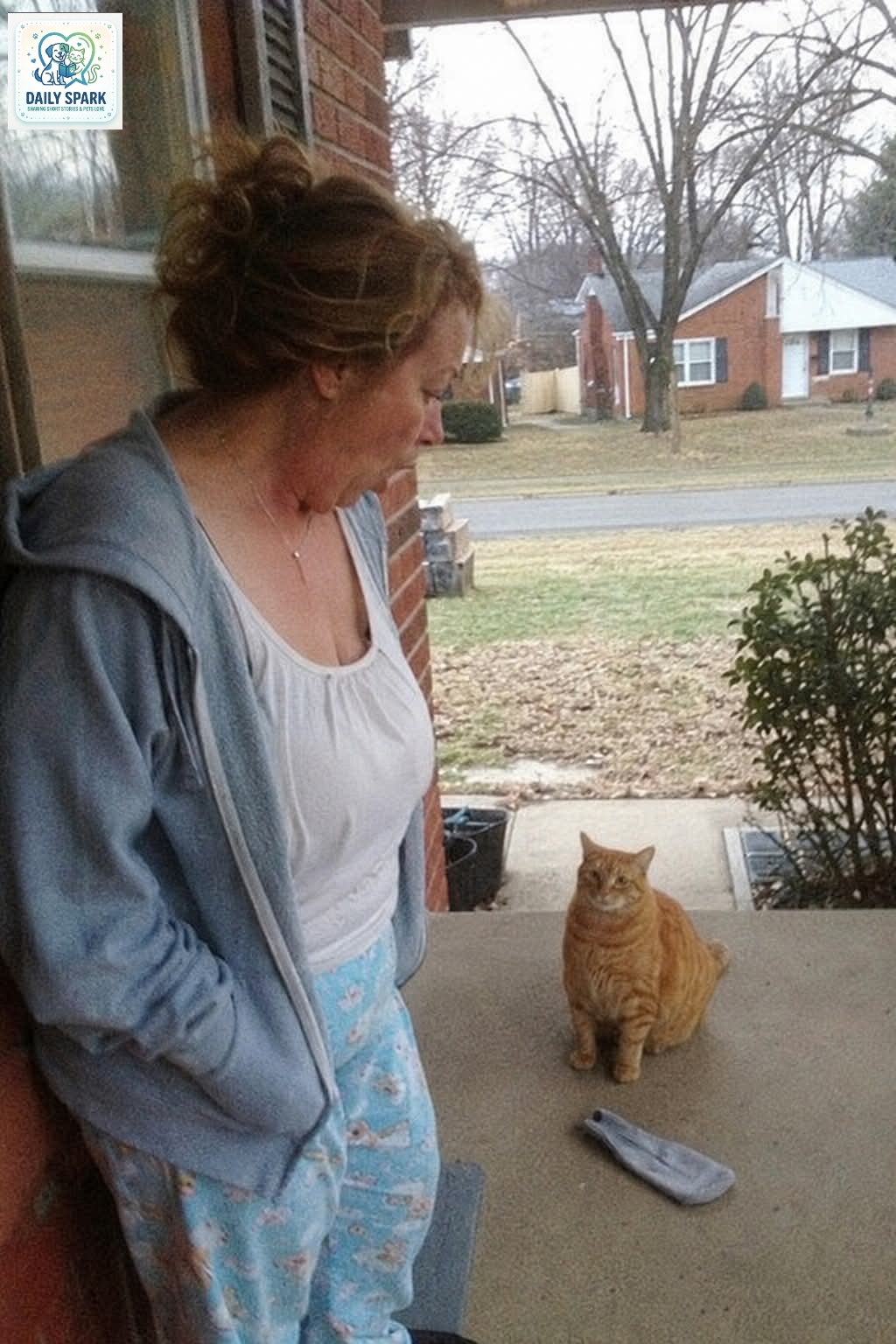
My cat dragged a gray men’s sock onto my porch like he had just solved a murder.
He dropped it at my feet, sat down, and stared at me.
I stared back.
“Absolutely not,” I told him.
Nacho blinked once, slow and rude, the way only an overweight orange cat can blink when he knows he pays no rent and still owns the house.
I was fifty-six, divorced, and living alone in a quiet little neighborhood outside St. Louis. My son had moved to Colorado the year before. He called every Sunday, which was sweet, but Sunday calls do not make a house feel full on a Tuesday night.
So I had Nacho.
Nacho was twelve pounds of fur, attitude, and mysterious decisions. He hated expensive cat food, loved cardboard boxes, and judged me every time I sang in the kitchen.
The sock was new behavior.
I picked it up with two fingers.
It was clean. Folded, almost. Gray, with a hole near the heel.
“Where did you get this?”
Nacho turned around and waddled away like a tiny landlord.
The next morning, there was another sock.
The day after that, a brown glove.
Then a handkerchief.
Then one very ugly winter hat with ear flaps.
By Friday, my porch looked like a lost-and-found table at a retirement center.
I was mortified.
I imagined every neighbor whispering, “There goes Marla, the woman with the laundry-snatching cat.”
So I made a basket, put everything inside, and walked door to door.
Nobody claimed a thing.
Finally, Mrs. Patterson from across the street pointed toward the pale blue house at the corner.
“Looks like Gus’s stuff,” she said. “He hangs laundry out back sometimes. Doesn’t talk much anymore.”
Gus.
I knew him, sort of.
Everyone knew Gus, sort of.
He was in his seventies, tall, thin, always wearing the same brown jacket. He waved if you waved first. His wife had passed a couple years back. After that, his house seemed to shrink around him.
I carried the basket to his porch and knocked.
It took a while.
When Gus opened the door, he looked at the basket, then at me.
“My cat brought these home,” I said quickly. “I am so sorry. He’s not normally involved in… textiles.”
Gus looked into the basket.
Then he picked up the ugly hat.
“Well,” he said, “at least the cat has terrible taste.”
I laughed because I didn’t know what else to do.
His mouth twitch like he had not meant to be funny.
“I’ll try to keep him away,” I said.
Gus nodded. “No harm done.”
That should have been the end of it.
It was not.
Two mornings later, Nacho brought home a small towel with a blue E stitched in the corner.
He placed it on the porch and meowed like he had delivered important mail.
I knew right away it belonged to Gus.
When I took it back, his face changed.
Not a big change. Just enough to make me realize that towel meant far more to Gus than I could have imagined.
Gus took the small towel from my hands, his fingers trembling slightly as they brushed the blue embroidered initial. He didn’t say anything for a long moment, staring down at the faded fabric as if he were trying to pull a memory back from a very long distance.
“My wife, Eleanor, embroidered those,” he finally whispered, his voice cracking around the edges. “Fifty years ago. I thought I lost the last set when we moved into this house.”
My chest tightened. I stood there on his porch, suddenly acutely aware of how quiet his house was, how the pale blue paint was chipping by the front steps, and how lonely two people could be in a neighborhood full of closed doors.
“Nacho has quite an eye for vintage items, it seems,” I said gently, trying to lighten the heavy air between us.
Gus looked up, a faint, fragile smile touching his lips. It was the first real smile I had ever seen from him. “Tell that rascal of yours that my missing wool scarf is still hanging on the clothesline out back. See if he’s ambitious enough to scale the fence.”
I laughed, feeling the tension evaporate. “Oh, don’t tempt him. He thinks he’s a mountain lion.”
That afternoon, I didn’t just walk back to my house. I lingered on my own porch, watching the shadows stretch across the grass. Ten minutes later, I grabbed a thermos of fresh coffee and two paper cups, walked back down the sidewalk, and knocked on Gus’s door again.
When he opened it, looking surprised, I held up the thermos.
“Nacho doesn’t drink coffee,” I said, “so I figured I’d better help you finish it before he drags my entire kitchen over here.”
Gus stepped aside and held the door open wide. “Come on in, Marla. Let’s see what else your cat has been plotting.”
We sat at his small wooden kitchen table, drinking coffee and talking about nothing and everything—about lost spouses, empty houses, and the strange, stubborn ways life finds to stitch us back together. By the time I walked home, the sun was setting, casting a warm, golden glow across the street.
When I reached my porch, Nacho was sitting right by the welcome mat, tail curled neatly around his paws, looking terribly pleased with himself.
I nudged him gently with my shoe.
“All right, you little thief,” I murmured, smiling down at him. “You win. Good cat.”



Leave a Reply