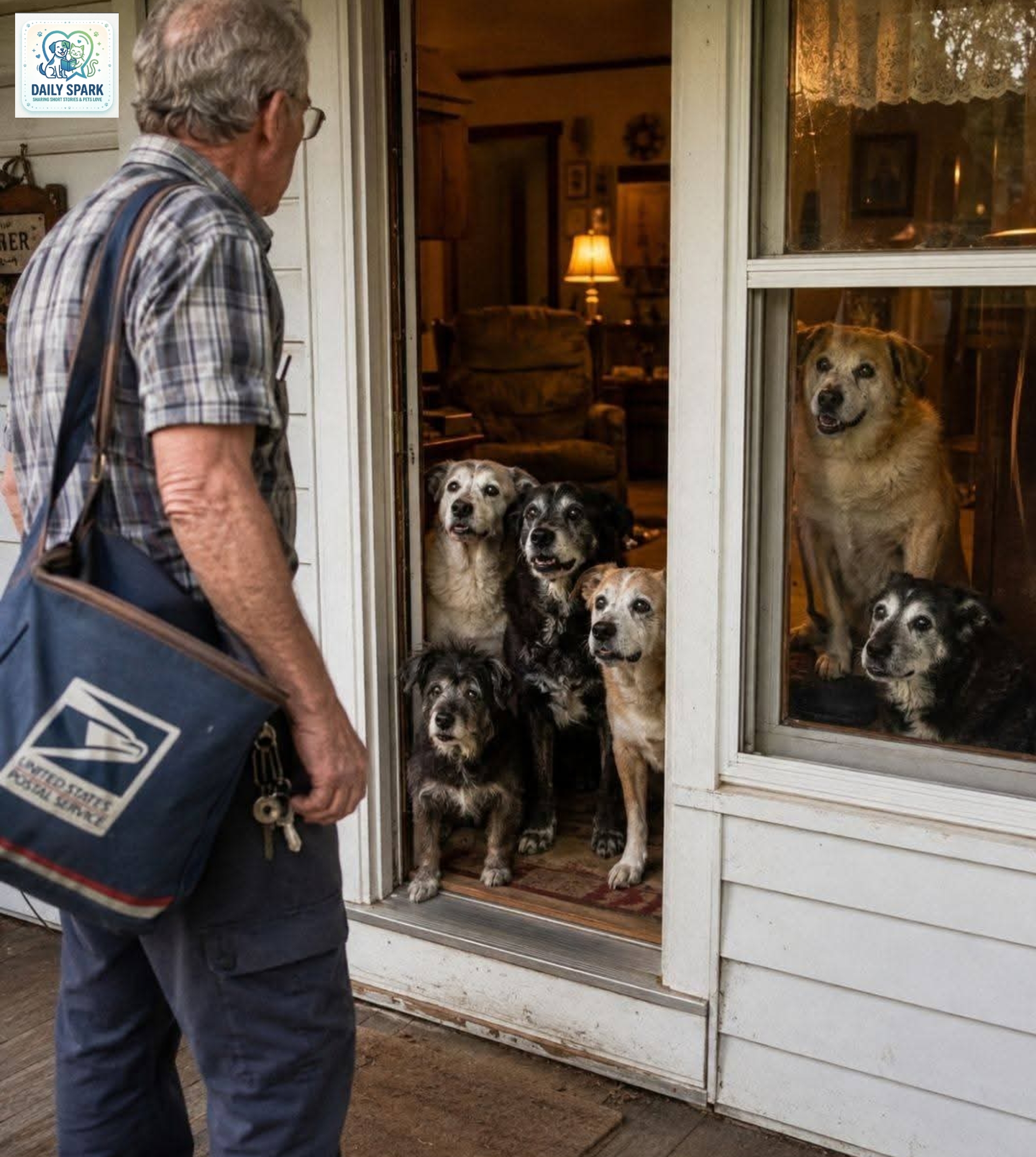
The old mailman took in six dogs nobody came back for — then one afternoon he finally understood what they were waiting for.
At 4:27 every afternoon, all six dogs walked to Walter’s front window.
Not some days.
Every day.
Old dogs. Slow dogs. One with cloudy eyes. One with a stiff back leg. One little brown mutt who had to climb onto the arm of Walter’s faded recliner just to see over the windowsill.
They would stand there and stare down the same quiet road.
And for three years, Walter thought he knew why.
“They’re waiting for the people who left them,” he told me.
Walter was sixty-eight and had spent nearly forty years delivering mail through a small town where everybody knew his truck, his winter hat, and the way he always carried dog biscuits in his shirt pocket.
He knew which porches had loose boards.
He knew which widows liked their mail handed directly to them.
He knew which kids were waiting for birthday cards.
And he knew almost every dog on his route by name.
That was how the six ended up in his house.
The first was Buddy.
Buddy belonged to an older man named Frank who lived alone in a white house with a porch swing that squeaked whenever the wind picked up.
Walter had delivered Frank’s mail for seventeen years.
Every afternoon, Buddy would be waiting at the fence.
Walter would give him half a biscuit.
Buddy would wag his entire body like Walter had just returned from war.
Then Frank got sick.
One week, the porch swing stopped moving.
A few weeks later, Frank’s niece came to clean out the house.
She told Walter she was taking Buddy “for now.”
Three days later, Walter saw Buddy behind the gate again.
Alone.
There was a bowl of water on the porch and a note taped to the door saying somebody would come back Saturday.
Saturday came.
Nobody did.
Sunday came.
Nobody did.
By Monday morning, Buddy was sitting beside Walter’s mail truck when Walter turned onto the street.
“He looked at me like I was late,” Walter said.
Walter brought him home.
“Just for the night,” he told himself.
Buddy slept beside the front door.
The second dog came a year later.
Her name was Rosie.
Her owner had been an eighty-one-year-old woman Walter had known for decades. When she moved into assisted living, her family said one of the grandchildren would take Rosie.
Walter heard that sentence three times.
Someone will take her.
Somebody is coming.
We’re figuring it out.
Two weeks later, Rosie was still sleeping on the woman’s back porch.
Walter brought her home too.
Then came Scout, whose family moved out of state.
Then Molly, after her owner died.
Then Duke, whose elderly owner could no longer care for him.
And finally little Peanut, who spent almost a month being passed between relatives who all said the same thing.
“I wish I could keep him.”
Walter never planned on becoming the old man with six dogs.
He lived alone in a modest ranch house with chipped green shutters and a garage full of fishing rods he rarely used anymore.
His wife, Ellen, had died eight years earlier.
They never had children.
After she was gone, Walter retired from the postal service and discovered something nobody had warned him about.
Silence.
For almost forty years, Walter had spent his days knocking on doors, waving to neighbors, talking to people across fences, hearing dogs bark before he even reached the porch.
Then retirement came.
No truck.
No mailbag.
No dogs waiting at gates.
No Ellen asking how his route went.
Just a clock ticking in the kitchen.
“I thought I wanted quiet,” he told me.
He looked down at Buddy, now nearly fourteen, sleeping across his shoes.
“Turns out I just wanted peace. Those are different things.”
The dogs gave the house noise again.
Toenails clicking across the floor.
Water bowls being pushed around the kitchen.
Snoring from six different directions.
Walter complained about the fur constantly.
Then he bought a bigger vacuum cleaner.
Every dog had a bed.
None of them slept in it consistently.
Instead, around 4:30 every afternoon, they gathered at the front window.
Walter noticed it almost immediately.
That was around the time he used to finish his mail route.
But he didn’t connect the two things.
He assumed they were waiting for their old people.
After all, every one of those dogs had once watched someone leave.
Some had waited hours.
Some had waited days.
A few had waited long enough that eventually Walter had been the person who came instead.
So every afternoon, when six gray muzzles pointed toward the road, Walter felt a little ache.
“I used to apologize to them,” he admitted.
I thought I had misheard him.
“You apologized?”
He nodded.
“I’d say, ‘They’re not coming, guys.’”
Sometimes Walter sat beside them.
He would look down the road too.
A pickup might pass.
A school bus.
A neighbor walking.
The dogs would watch, then settle back down.
Walter believed they were carrying old hope that didn’t know when to die.
Until a Tuesday in October.
That morning, Walter drove to a town about forty miles away to help his brother move some furniture.
He planned to be home by three.
Then the truck battery died.
By the time he got a jump and started home, the sun was already dropping.
Walter didn’t own a cell phone at the time.
Nobody at home knew why he was late.
At 5:12, he turned onto his street.
And what he saw through the windshield made him slow down.
All six dogs were at the window.
Buddy was standing even though Walter knew it hurt his hips.
Rosie had both front paws against the sill.
Peanut was balanced on the recliner arm.
They were staring straight at Walter’s truck.
Walter pulled into the driveway.
Before he even opened the door, the house erupted.
He could hear them barking from inside the cab.
He walked toward the porch.
Six dogs disappeared from the window.
A second later, they were crowded behind the front door.
Walter stepped inside.
“I swear you’d have thought I’d been gone six months,” he said.
Buddy pressed his head against Walter’s knee.
Rosie whined.
Peanut ran circles around the coffee table.
Walter stood there laughing, trying to calm them down.
Then something clicked.
He looked at the clock.
5:16.
He looked at the window.
And suddenly three years of afternoons rearranged themselves in his mind.
The dogs weren’t waiting for Frank.
They weren’t waiting for Rosie’s old family.
They weren’t waiting for the people who moved away.
They weren’t staring down the street hoping the past would come back.
They were waiting for Walter.
“I felt about two inches tall,” he told me.
His voice got quieter.
“All that time, I thought they were wishing for somebody else.”
Walter sat down in his recliner.
Buddy immediately placed his chin on Walter’s boot.
“I kept thinking I was the substitute,” he said. “The backup plan. The guy who took them because nobody else did.”
He rubbed Buddy behind the ears.
“But dogs don’t understand backup plans.”
Walter swallowed hard before continuing.
“They just know who comes home.”
After that day, Walter started paying attention.
Every time he left for groceries, they watched the window.
Every time he went to the hardware store, they waited.
And every time he came home, six old dogs celebrated like the most reliable miracle in the world had happened again.
A person left.
And came back.
Over and over.
Until leaving stopped meaning abandonment.
Walter still keeps a jar of dog biscuits by the front door.
Old habit.
He still knows half the dogs in the neighborhood by name.
Kids walking home from school wave when they see him sitting on the porch with his pack scattered around his feet.
Some people joke that Walter runs a retirement home for dogs.
He laughs.
“That’s about right.”
Buddy died last winter.
Walter buried him beside a maple tree in the backyard.
For several afternoons afterward, Walter noticed the other five still gathering at the window at 4:30.
There was one empty space.
Walter expected that to break him.
Instead, he sat beside them.
And when the dogs eventually wandered away from the window and settled around his chair, Walter understood something else.
Maybe he had rescued them.
Maybe they had rescued him.
Maybe it didn’t matter.
A widower with too much quiet had found six animals who knew what it felt like when a house suddenly became empty.
They had all lost somebody.
They had all learned to listen for footsteps that never came.
And somehow, in Walter’s little house with chipped shutters and dog hair on everything, they taught each other a new expectation.
Someone can leave.
And still come back.
Walter told me the lesson as I was walking toward my car.
He stood on the porch with five old dogs behind him.
“You can’t erase the people who left,” he said. “You can only become the person who comes back.”
And maybe that is one of the simplest definitions of love I have ever heard.
Sometimes healing begins when somebody finally proves that goodbye does not always mean gone. As the quiet evening shadows lengthened across the wooden floorboards, Walter reached out to stroke the soft gray fur of the dog resting nearest to his boots. In that gentle touch, all the loneliness of the past melted away, leaving behind only the profound peace of knowing that love is measured not by who left, but by who always returns to share the warmth of home.


Leave a Reply