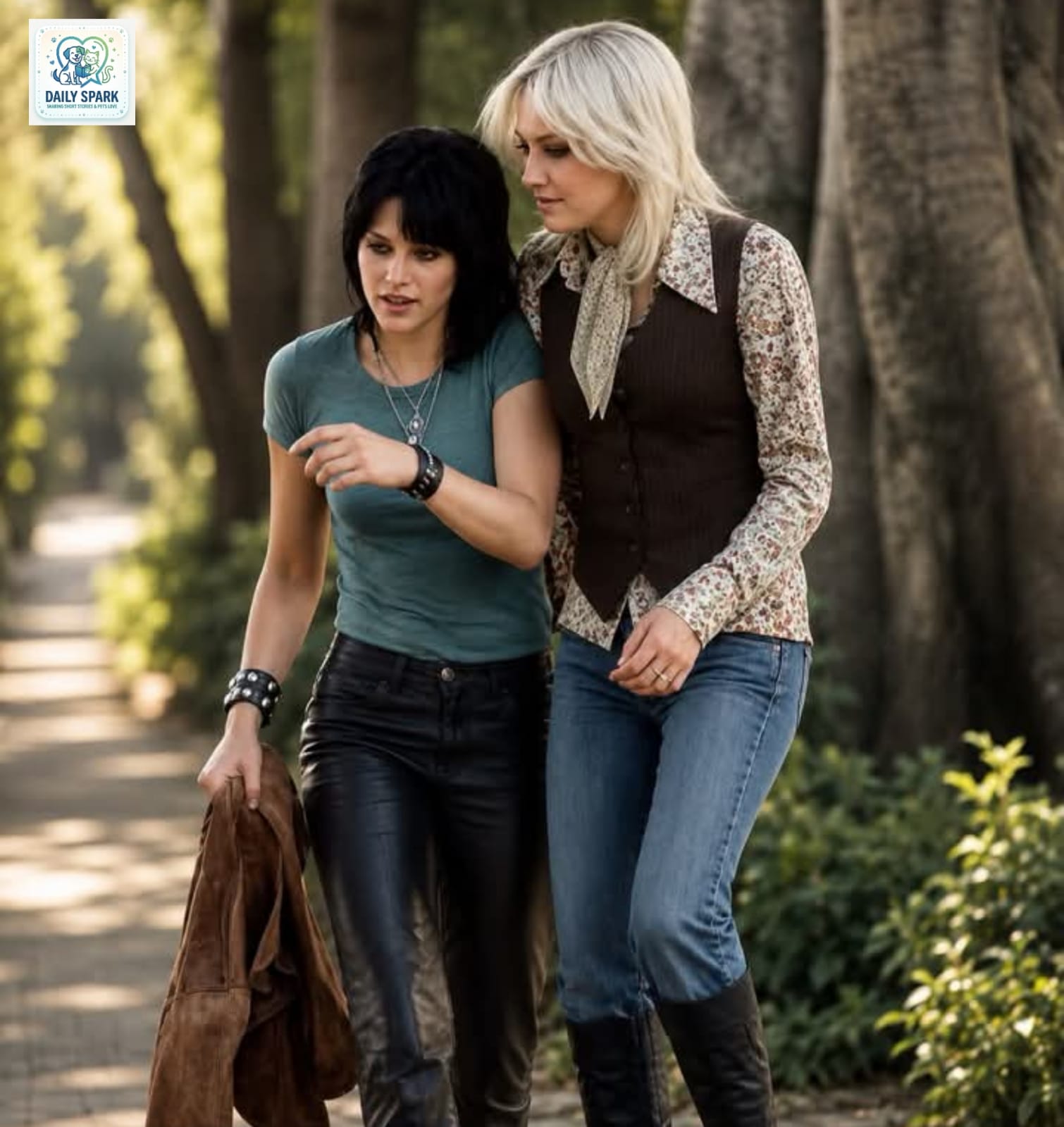
She was thirteen years old, standing in a music store in suburban Pennsylvania, having just talked her parents into buying her a guitar.
Her name was Joan Marie Larkin, born September 22, 1958, the daughter of an insurance salesman and a secretary. A self-described tomboy who loved baseball and Black Sabbath, she took exactly one guitar lesson before quitting her instructor told her girls couldn’t play rock and roll, so she decided he was wrong and taught herself instead.
When her family moved to Southern California, she was fifteen and started showing up at a Los Angeles youth club where glam rock kids and music industry misfits gathered. There, she met producer Kim Fowley, who had an idea: an all-girl teenage rock band, unlike anything the industry had seen before.
She said yes immediately.
In August 1975, the Runaways came together. Joan Larkin was now Joan Jett, a name she adopted after her parents’ divorce. The founding lineup started with just three girls Jett on rhythm guitar, Sandy West on drums, and Micki Steele on bass and they played their earliest shows at house parties and clubs around Los Angeles before the group expanded.
They still needed a lead singer.
Fowley and Jett found her at a teen nightclub called the Sugar Shack. She was fifteen, the daughter of an actress, and raised in Encino. Her name was Cherie Currie, and she had never sung with a rock band before. She showed up planning to audition with Peggy Lee’s “Fever,” but nobody in the room could play it the way it needed to be played.
Instead of sending her home, Jett and Fowley wrote a new song on the spot to fit Currie’s voice. It took mere minutes, and they called it “Cherry Bomb.”
Currie was fifteen. Jett was sixteen. Alongside Lita Ford on lead guitar and Jackie Fox on bass, the five of them became the classic lineup of the Runaways.
In 1976, Mercury Records signed them and released their self-titled debut. Critics were dismissive, and American audiences didn’t quite know what to make of five teenage girls playing loud, unapologetic rock. Jett described being hit by thrown bottles and a battery during shows, while Currie recalled European crowds being outright hostile.
They kept playing anyway.
In the summer of 1977, a tour of Japan changed everything, at least temporarily. They arrived to crowds Jett later compared to Beatlemania, sold out arenas, and had their live album go gold, treated as genuine rock stars in a way American audiences had not offered them.
But the group was already fracturing. Currie left the band in 1977, later documenting her struggles with addiction and the heavy toll of fame in her memoir, Neon Angel. She eventually rebuilt her life as a drug counselor and chainsaw sculptor.
Jett took over as lead vocalist and kept the band going through two more albums before it finally broke up in April 1979.
What followed was a wall of rejection. Twenty-three record labels passed on Jett’s demo, calling it too hard, too female, and not commercial enough.
She didn’t quit. In 1980, Jett and producer Kenny Laguna founded Blackheart Records, one of the first female-owned independent labels in rock, pressing and selling albums largely out of the trunk of a car.
In early 1982, “I Love Rock ‘n’ Roll” hit number one on the Billboard Hot 100 and stayed there for seven consecutive weeks, becoming one of the decade’s defining rock anthems.
In 2015, Joan Jett & the Blackhearts were inducted into the Rock and Roll Hall of Fame. She has since been named to Rolling Stone’s list of the 100 Greatest Guitarists the girl once told she couldn’t play rock and roll, now recognized as one of the best to ever do it.




Leave a Reply