The Weight of Silence
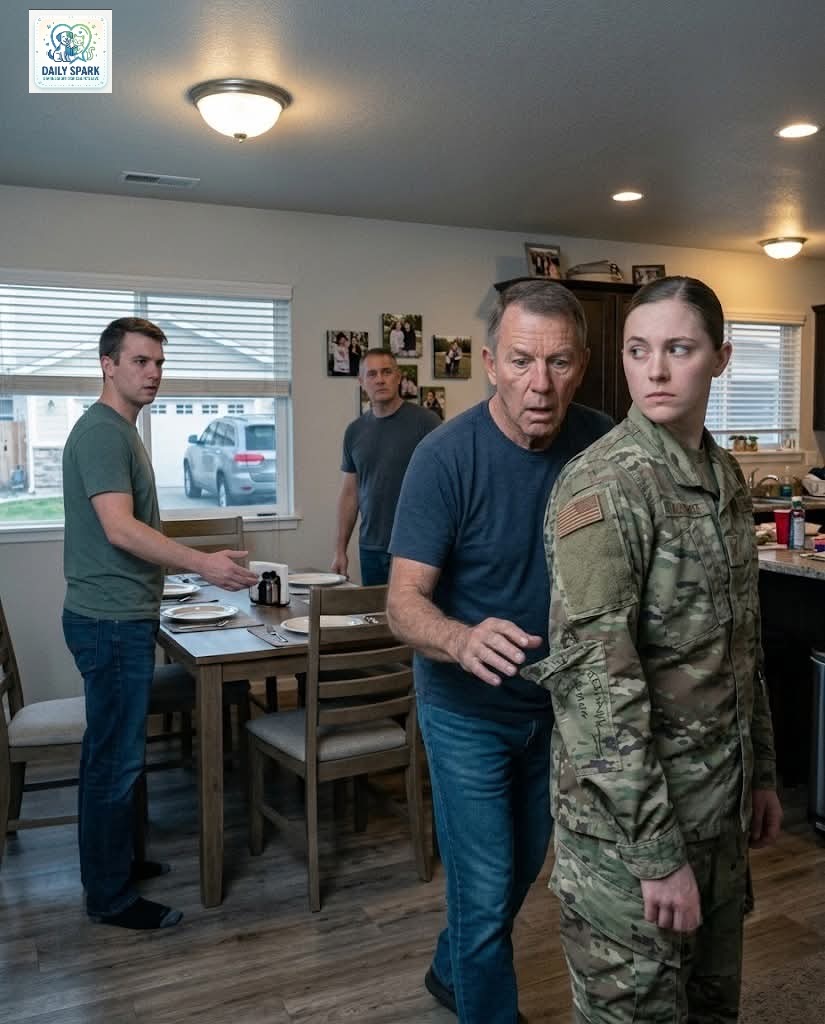
My older brother told me to change out of my Air Force uniform before dinner because I was “pretending to be some kind of hero.” My father agreed in front of the entire family. Then my retired Air Force Special Operations uncle walked behind me, saw something stitched beneath my sleeve, and suddenly stopped breathing. He leaned close and whispered a classified unit name that made everyone wonder who I really was.
I lowered my arm until the sleeve covered the stitching again. A fork scraped against a plate somewhere down the table, and the food in front of me suddenly smelled heavier than it had a minute earlier.
My uncle stayed beside my chair.
“Where did you get that?” he asked.
My brother laughed. “Seriously? Now we’re doing secret patches?”
Uncle didn’t even look at him. His eyes stayed on my sleeve.
“It came with the assignment,” I said.
His jaw tightened. “You were read in?”
“I can’t discuss that here.”
My brother leaned back like I had just proved his point. “Convenient.”
“No,” Uncle said. “Disciplined.”
That landed harder than shouting would have.
Dad put down his fork. “What exactly are you two talking about?”
I had spent years answering that question with the same boring phrases. Training. Support work. Long hours. Nothing interesting. I never lied about being in the Air Force. I just let my family believe the most ordinary version of it because the alternative required answers I wasn’t free to give.
My brother had always taken that silence as proof that I wasn’t doing much.
Dad had let him.
Whenever I came home, conversations eventually turned into comparisons. Who was doing better. Who had the more impressive life. Who had something worth talking about at the table. My work never produced a story I could tell them, so eventually I stopped trying.
Now Uncle pulled out the chair beside me but didn’t sit.
“I know that stitching,” he said. “Because a long time ago, I wore it under my own sleeve.”
My brother’s chair shifted sharply against the floor.
Dad stared at him. “You did?”
Uncle nodded once. “Different time. Same lineage.”
My brother pointed at me. “So what, he copied yours? He knew you’d recognize it.”
“I never showed him mine.”
That was the first thing that changed Dad’s face.
My brother tried again. “You could’ve told him about it.”
Uncle finally turned toward him. “I didn’t even know he was anywhere near that world until thirty seconds ago.”
Dad looked at me. “Is he telling the truth?”
“Yes.”
One word.
It was the most I had ever confirmed at that table.
Dad rubbed a hand over his mouth. “So all these years, when we asked what you were doing—”
“I told you everything I was allowed to tell you.”
“You could’ve said it was important.”
I looked at him. “I did.”
He stopped.
That memory belonged to both of us. The calls where I tried to explain that the work mattered without explaining why. The holidays when I arrived tired and left early. The times he treated my short answers like evasions instead of boundaries.
My brother wasn’t finished.
“This is insane. He walks in wearing a uniform, refuses to explain anything, and suddenly everybody’s supposed to treat him like some action-movie hero?”
“I never asked for that,” I said.
“You wore the uniform to dinner.”
“I came straight here.”
He reached across the table toward my sleeve.
I stepped back before his fingers touched it.
“Don’t.”
Uncle moved between us without raising his voice.
My brother’s hand dropped, but his expression didn’t.
Dad looked from him to me. “Then tell me one thing. Are you actually part of what your uncle thinks you’re part of?”
I could have enjoyed that moment. After all those years, I could have made him sit in the uncertainty he had handed me so easily.
Instead I gave him the only answer that felt clean.
“Your brother recognized something he had earned the right to recognize. That’s all you need to know.”
Uncle looked at me for a long second.
Then he reached into his pocket and pulled out an old, worn challenge coin. The edges had gone smooth from years of being carried. He turned it once between his fingers, looked at the stitching beneath my sleeve again, and seemed to make a decision.
“I’ve kept this since my last assignment with that community,” he said.
My brother started to speak.
Uncle ignored him.
He opened my hand, placed the coin in my palm, closed my fingers around it, and moved my hand away from the table.
…and closed my fingers over the heavy, scarred metal.
The weight of the coin settled into my palm like a quiet recognition, bridging decades of silent service that my family had dismissed as ordinary. Dad stared at it, the red crest of the unit embossed across the brass catching the amber light of the dining room chandelier. He looked up, his voice losing its defensive edge.
“You… you never said,” he murmured, the realization finally breaking through years of casual condescension.
My brother pushed his plate away, his face tightening with a mixture of disbelief and embarrassment as he realized the sheer scale of his misjudgment. But the table was no longer a place of comparison or dismissal.
Uncle gave my shoulder a firm, grounding squeeze, then turned his gaze back toward the rest of the room. “Some stories don’t belong at a dinner table,” he said quietly. “Some are just carried.”
I slipped the coin into my pocket alongside my hand, letting the sleeve drop back down to conceal the classified stitching. The food on the table still grew cold, but the air felt entirely different. For the first time, I didn’t need to prove anything to anyone. The silence between us was no longer a wall—it was a shield we both finally understood, and as I looked around the table, I knew my service would forever speak for itself.




Leave a Reply