He Hid His Shaking Hands From Everyone—Then 27 Neighbors Came Down The Road To Save The Harvest He Thought He’d Lost
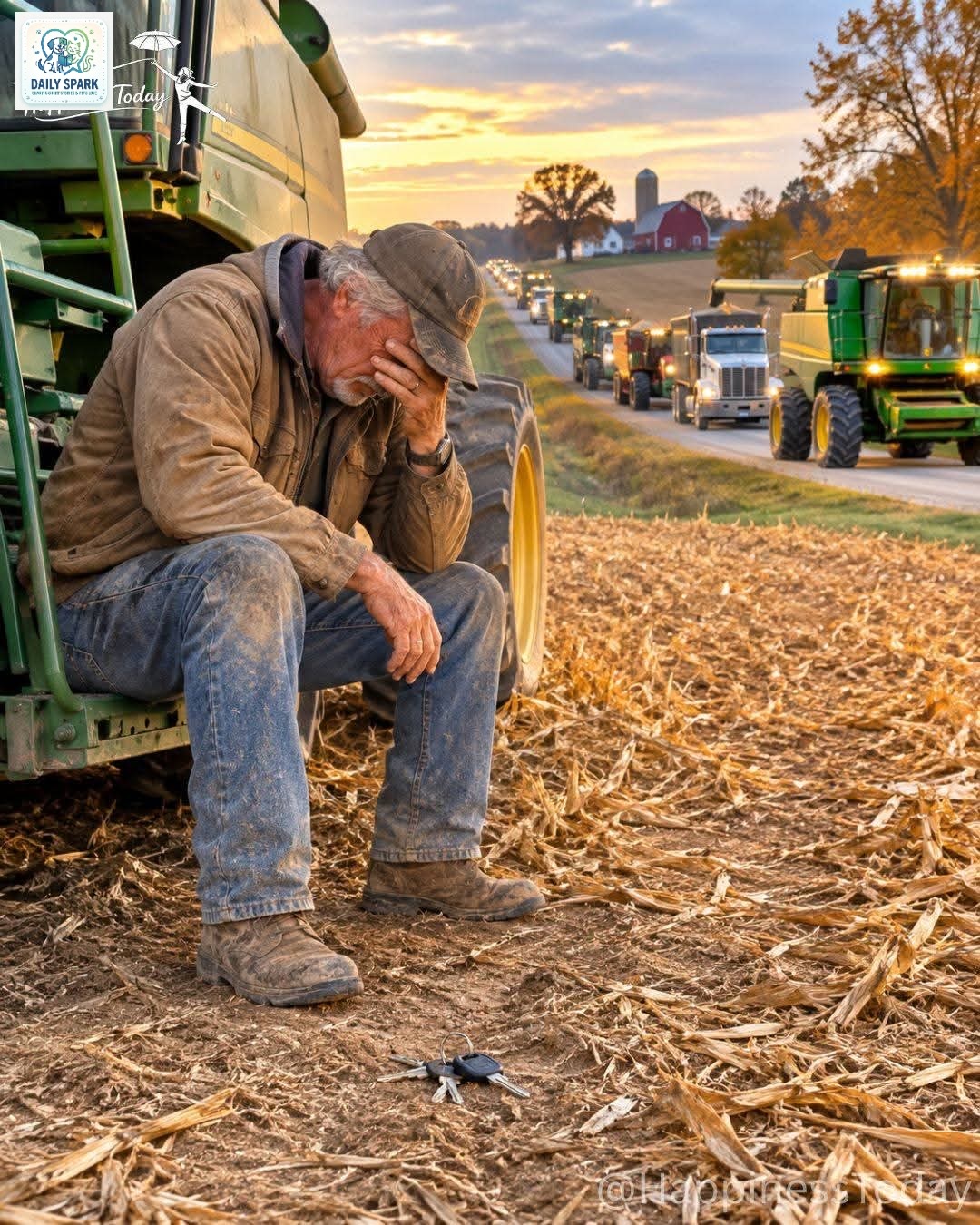
The combine keys slipped from Earl Dawson’s hand and disappeared into the dry Indiana dirt.
He stared at them.
They were only six inches from his boot.
For most of his life, Earl could have bent down, scooped them up, climbed into the cab, and had the first rows of corn coming down before the morning dew burned away.
But that October morning, his right hand was shaking so badly he couldn’t make his fingers obey him.
“Come on,” he whispered.
He bent at the waist.
His knees stiffened.
His hand reached toward the keys, trembling harder the closer it got.
Once.
Twice.
Three times.
Each time, his fingers missed.
Finally Earl lowered himself onto the step of the combine and looked across the field his family had worked for generations.
Sixty-seven years old.
Fifty-one harvests behind him.
And for the first time in his life, Earl Dawson was afraid he might not be able to bring one in.
Three months earlier, a doctor had given his shaking a name.
Parkinson’s.
Earl had listened quietly while the doctor explained that symptoms could progress differently for different people and that they would talk about treatment and what came next.
Earl remembered very little after hearing the word.
On the drive home, he pulled his pickup onto a gravel road and sat there with the engine running.
He thought about his father.
His grandfather.
The farmhouse with the porch his mother used to sweep every Saturday morning.
The barn where his son, Caleb, had learned to drive a tractor before he was tall enough to comfortably reach the pedals.
Then Earl thought about Caleb losing his factory job that spring.
Caleb had a wife, two kids, a mortgage, and enough worry already.
So when Caleb asked how the doctor appointment went, Earl smiled.
“Getting old,” he said. “That’s all.”
It became his standard answer.
When his coffee cup rattled against the saucer, he blamed too much caffeine.
When he struggled with a wrench, he blamed arthritis.
When he took longer climbing down from the tractor, he joked that sixty-seven wasn’t sixteen.
He became an expert at hiding his right hand in his jacket pocket.
At church suppers, he carried his plate with both hands.
At the diner, he ordered sandwiches instead of soup so nobody would notice the spoon.
And every morning, before daylight, he walked into the barn and told himself the same thing.
One more season.
Just get through one more season.
Earl wasn’t ashamed of being sick.
He was terrified of becoming someone his family had to worry about.
His father had raised him with a sentence Earl had carried all his life:
“A man takes care of his own.”
Earl had always believed that meant working harder when things got difficult.
He had not yet learned that sometimes it meant allowing your own to take care of you.
By September, hiding the shaking was getting harder.
His neighbor, Roy Mercer, noticed Earl fumbling with a fuel cap one afternoon.
“You all right?”
Earl shoved his hand into his pocket.
“Fine.”
Roy watched him for a moment.
“You sure?”
“I said I’m fine.”
The words came sharper than Earl intended.
Roy nodded and walked away.
That evening Earl sat alone at his kitchen table feeling ashamed.
His wife, June, had been gone six years.
There were still moments when Earl caught himself wanting to tell her things.
He looked at her picture beside the salt shaker.
“You’d be mad at me, wouldn’t you?” he murmured.
June seemed to smile back.
Harvest morning arrived cold and clear.
Earl was awake at 4:37.
He made coffee.
He ate half a piece of toast.
Then he stood at the kitchen window and watched the sky turn from black to gray over the corn.
He had prayed for this harvest all summer.
Now it was ready.
All he had to do was bring it home.
But there he sat beside the combine, unable to pick up his own keys.
Earl covered his face with both hands.
For the first time since June’s funeral, he cried.
Not loudly.
Just an old farmer sitting in the dirt beside a machine he had operated for decades, trying to understand how life could change while the fields stayed exactly the same.
Then he heard something.
An engine.
Then another.
Then several more.
Earl wiped his eyes and looked toward the county road.
A combine turned onto his lane.
Behind it came another.
Then a grain truck.
Then another combine.
Tractors.
Grain carts.
Pickup trucks.
More machinery kept appearing until Earl stood up, completely confused.
He counted until he lost track.
Roy Mercer climbed down from the first combine.
“What in God’s name is this?” Earl asked.
Roy walked over and picked up the keys from the dirt.
He placed them gently in Earl’s palm.
“Harvest.”
Earl looked toward the road again.
Neighbors were climbing from trucks.
Men he had helped fix fences for.
A widow whose soybeans Earl had harvested after her husband died.
A young farmer Earl had loaned money to without ever charging interest.
Two brothers he had coached in Little League thirty years earlier.
A retired teacher.
A mechanic from town.
Caleb.
Earl’s eyes stopped on his son.
“You knew?”
Caleb nodded.
“Roy called me after he saw your hands shaking.”
Earl looked down.
“I didn’t want you worrying about me.”
Caleb stepped closer.
“Dad, I’ve been worried about disappointing you since I lost my job.”
Earl looked up quickly.
Caleb’s eyes were wet.
“You never disappointed me.”
“Then why did you think getting sick would disappoint me?”
Earl had no answer.
Caleb put a hand on his father’s shoulder.
“You spent your whole life teaching me family takes care of family.”
Earl swallowed hard.
“I thought that meant I was supposed to take care of you.”
“It does,” Caleb said. “You just forgot it works both ways.”
Behind them, engines started roaring to life.
Twenty-seven combines, trucks, tractors, and grain carts spread across Earl Dawson’s fields.
By midmorning, golden rows were disappearing beneath machine headers.
Grain poured into carts.
Trucks rolled toward the bins.
Neighbors brought casseroles, sandwiches, coffee, and apple pie.
Someone set folding tables beside the barn.
Children chased each other through the yard while their grandparents told stories about harvests from forty years earlier.
It looked less like a rescue and more like the kind of community Earl remembered from childhood.
Back when people didn’t need invitations to show up.
Back when somebody’s trouble became everybody’s business, not because they were nosy, but because nobody was supposed to carry hardship alone.
Earl spent most of the day riding with Caleb.
At first, he hated sitting in the passenger seat.
Then Caleb asked him how fast to run the header.
Where the low spots were.
Which rows usually stayed damp.
And Earl realized something.
His hands might be changing.
But fifty-one harvests had left him with something no disease could shake out of him.
Knowledge.
Experience.
A lifetime stored in memory.
Just before sunset, the final rows came down.
The last grain cart rolled toward the bins.
Someone honked.
Then another horn answered.
Soon the entire field was filled with the sound of men and women cheering, laughing, and leaning on dusty machinery.
Earl stood beside Caleb and watched the last truck pull away.
“This should have taken me two weeks,” he said.
Roy grinned.
“Good thing you had twenty-seven people who didn’t ask permission.”
Earl laughed.
Then he cried again.
This time he didn’t hide it.
A few weeks later, Earl finally told people about his diagnosis.
Not everyone.
Just the people who mattered.
He started accepting rides when he needed them.
He let Caleb handle more of the machinery.
He stopped pretending every difficult day was an easy one.
And when spring came, Earl planted again.
Not alone.
He never was again.
Years earlier, Earl’s father had told him a man takes care of his own.
Earl still believed it.
He just understood the sentence differently now.
Sometimes strength is working from sunrise until dark.
Sometimes it is fixing the neighbor’s tractor without sending a bill.
Sometimes it is raising children who know how to show up.
And sometimes strength is sitting beside a field you cannot harvest alone and having enough courage to let people love you.
Because the strongest communities are not built by people who never need help.
They are built by people who never let a neighbor face the harvest alone.
As the sun finally dipped below the horizon, painting the Indiana sky in shades of bruised orange and deep purple, Earl walked back toward the old farmhouse with a lighter step than he had known in months. He paused on the porch, his fingers resting gently on the wooden railing that his father had built decades ago. The shaking in his hand was still there, a quiet reminder of the challenges ahead, but for the first time, it didn’t feel like a secret he had to carry in the dark. It felt like part of a story written not just by one man, but by an entire community holding each other up when the ground beneath them shifted.
#HeartwarmingStories #SmallTownCommunity #FamilyFirst #InspirationalStories #RuralLife #HarvestTime #OvercomingHardship #NeighborlyLove #HumanKindness #StrengthInCommunity #LifeLessons



Leave a Reply